
💡 Top tip: a will doesn’t control every payout after death. For many homeowners, a trust linked to a life insurance policy can help ensure the money goes to the right people more smoothly and with greater control. I’ll come back to that in practical terms later.
A lot of people think estate planning starts and ends with writing a will. In practice, that’s where confusion begins. Your home, your mortgage, your life cover, and the way assets are legally owned can all affect what happens to your family.
For homeowners in Chelmsford, Braintree, Colchester and across Essex, this matters because property is often the biggest part of the estate. If the paperwork doesn’t align, your wishes and the legal outcome may not align.
If you want a useful legal primer alongside this guide, the BDJ Express Law estate planning insights provide a good overview of the different structures people encounter. For a more mortgage- and family-focused explanation, EHF also covers wills, power of attorney, and probate in plain English.
An Introduction to Wills and Trusts
For many UK homeowners, the biggest estate planning mistake is assuming a will covers the whole job. It does not. Your property ownership, mortgage, life insurance, and beneficiary nominations can all fall outside that simple assumption, which is why wills and trusts need to be considered together, not as separate legal topics.
At a practical level, a will sets out what should happen to your assets after death. A trust is a legal arrangement used to hold assets for designated beneficiaries under specific terms, either during your lifetime, after your death, or both. The difference matters most where families want control, speed, or protection around high-value assets such as the home or a life policy payout.
That is the point many homeowners miss. The legal document may be in place, but the outcome for the family can still be wrong.
In Chelmsford and across Essex, property is often the largest asset by a distance. If the house is owned in a way that does not match the will, or the life cover is not written into trust, the estate can become slower to deal with and less predictable for the people left behind. BDJ Express Law estate planning insights provide a useful legal overview of the structures people commonly encounter.
Why this matters more for homeowners than it first appears
A homeowner’s estate plan often has several moving parts:
A property held jointly or in one sole name
A mortgage that still needs to be cleared
Life insurance is intended to protect the family home
Pensions and death benefits with separate nominations
Savings or investments held in different names
Each of those can follow different rules on death. That is where families get caught out.
A will may deal with part of the estate, but it does not automatically control every asset or payout. Trusts can be useful when the aim is to direct funds outside the estate, protect money for children, or ensure a life insurance payment reaches the right people without unnecessary delay. From an advice point of view, that is often the practical reason trusts come up in mortgage and protection conversations.
The practical test is simple. Do your will, property ownership, insurance arrangements and nominations all support the same result for your family?
If the answer is unclear, the plan needs to be reviewed. EHF explains the wider picture in this guide to wills, power of attorney and probate, which helps frame the legal side in plain English.
What Is a Will and Why Every Homeowner Needs One
For many UK homeowners, the will is the document that decides whether the family home passes smoothly or becomes part of an avoidable legal mess. If you own property, carry a mortgage, or expect life insurance to protect your family, a current will belongs alongside the rest of your financial planning.

A will sets out who should inherit from your estate, who should administer it, and who should look after any children under 18. For homeowners, the point is practical. It can deal with your share of a property, set out who steps into responsibility after death, and reduce confusion at a time when your family is already under pressure.
I see the same problem regularly. People assume the house will just pass to the right person, the mortgage will somehow sort itself out, and the insurance payout will follow their wishes. Those are three separate issues, and they do not always follow the same rules.
What a will actually covers
A properly drafted will can help you:
Name the people who should inherit from your estate
Appoint executors to deal with probate and administration
Update the plan after marriage, divorce, children or a house move
Pass on your share of a property, where that share forms part of your estate
Record clear instructions instead of leaving relatives to work it out under pressure
A will also has limits. It does not automatically control every asset you own. Some life insurance policies, pensions, jointly owned assets and trust-held arrangements can pass outside the will. That is why homeowners need the will to match their property ownership, beneficiary nominations and any protection policies written in trust. EHF covers that wider point in its guide to how trusts can work alongside protection planning.
Why dying without a will creates problems
If there is no valid will, intestacy rules decide who inherits. That can produce outcomes very different from what the family expected, especially in blended families, second relationships, or cases where one partner assumes they are protected, even when the legal position is less straightforward.
For a homeowner, the risk is not abstract. It can affect who inherits your share of the property, who has authority to deal with the estate, and how quickly decisions can be made about the home. If your family needs to keep paying the mortgage while the estate is being sorted, delay has a real cost.
A will gives your family instructions, not guesses.
Why does this carry more weight for homeowners?
Property is often the largest asset in the estate. In areas such as Chelmsford and across Essex, that usually means a large part of the family wealth is tied to one house, often with borrowing still attached. A will helps clarify what should happen to your share, but it only works properly if it fits how the property is owned.
Review the will urgently if any of these apply:
You own a home jointly and are not sure how the ownership is set up
You bought your property after writing the will
You now have children or dependents
You are in a second marriage or long-term relationship
You have life cover intended to repay the mortgage or support the family
You assume your will controls every payout on death
That last point catches people out. A will is a key part of the plan, but it is only one part. For homeowners, the right question is simple. Does your will align with your homeownership, your mortgage, and any life insurance intended to protect the people living in that home?
Understanding Trusts: A Tool for Control and Protection
A trust is a legal arrangement that lets you control who benefits from an asset, who manages it, and when money or property is passed on. For homeowners, that matters most where the family home is only part of the picture. Life insurance, death-in-service benefits, and other lump sums can be just as important if the aim is to keep the mortgage paid and the household financially stable after a death.
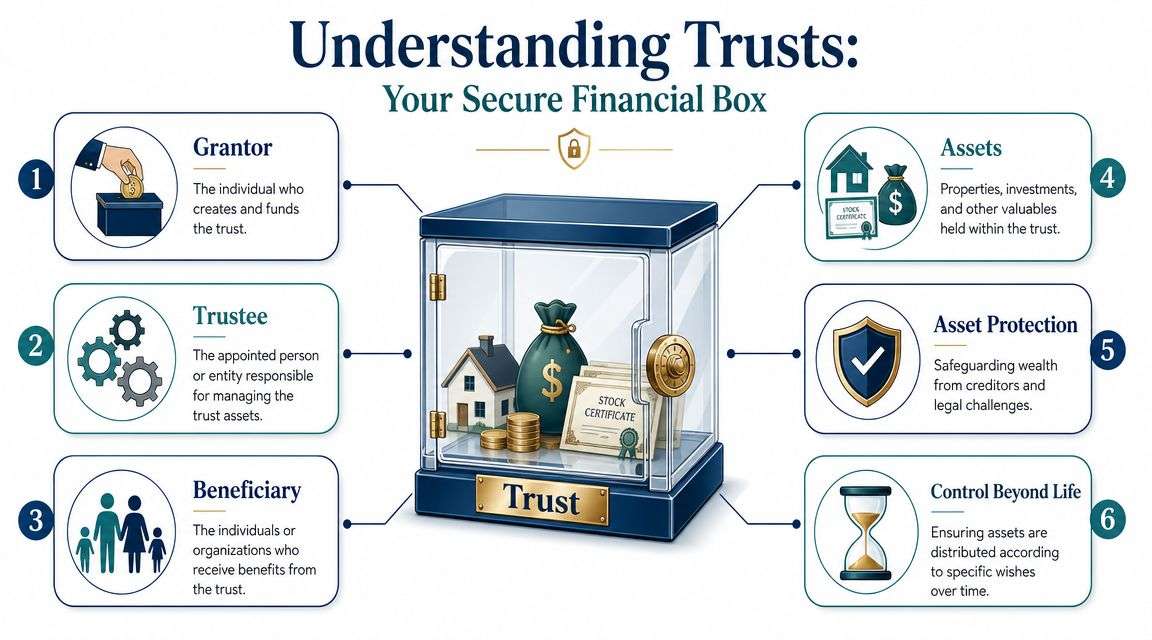
A will says who should inherit from your estate. A trust does a different job. It sets rules around a specific asset or pool of assets, often with more control over timing and decision-making. That extra control can make a real difference where children are young, beneficiaries are vulnerable, or family circumstances are more complicated than a straightforward first marriage with adult children.
The key people in a trust
Three roles sit at the centre of any trust:
The person creating it places the asset, policy, or funds into a trust
The trustee looks after the asset and follows the trust terms
The beneficiary is the person or group the trust is meant to help
On paper, that is simple. In practice, the choice of trustee matters a great deal. Trustees may need to deal with insurers, keep records, make decisions fairly, and act in line with the wording of the trust. Picking someone reliable is often more important than clients first expect.
Where trusts are useful for mortgage clients
The most common trust discussion I have with homeowners is about protection policies rather than the property title itself.
If a life insurance policy is written in trust, the insurer can usually pay the proceeds to the trustees under the terms of the trust instead of paying them into the deceased’s estate. That can help the money reach the right people faster and reduce the risk of it being tied up during estate administration. For a family trying to cover monthly mortgage payments, that timing matters.
Trusts often deserve closer attention where there are:
Children who are too young to manage a large payout
Blended families or children from a previous relationship
A beneficiary who needs support but should not receive money outright
A wish to release funds in stages rather than in one lump sum
Life cover is intended to clear the mortgage or give the surviving family breathing space
This is also where legal wording and financial planning need to line up. A policy may have been taken out to protect the home, but if it is not set up properly, the payout structure may not align with that intention. Homeowners reviewing this area can get a clearer picture from EHF’s guide to how trusts work with protection policies and estate planning.
What a trust can and cannot do
A trust can add control, but it also adds responsibility. The documents need to be completed correctly. Trustees need to understand their role. The arrangement needs to be reviewed after major events such as marriage, divorce, a house move, a new child, or replacing an existing policy.
It is also easy to overestimate what a trust fixes. A trust does not remove the need for a will. It does not automatically solve every tax issue. It does not correct poor beneficiary choices later if no one reviews the paperwork.
For a useful plain-English comparison of wills vs trusts, it helps to read them side by side and then apply that difference to your own assets. For many Chelmsford and Essex homeowners, the practical test is simple. Which asset needs fast access, tighter control, or a more careful handover than a will on its own can provide?
Will vs Trust: A Head to Head Comparison
A homeowner deciding between a will and a trust is usually trying to answer three practical questions. Who gets what, who stays in control, and how quickly money or property can be dealt with after a death.
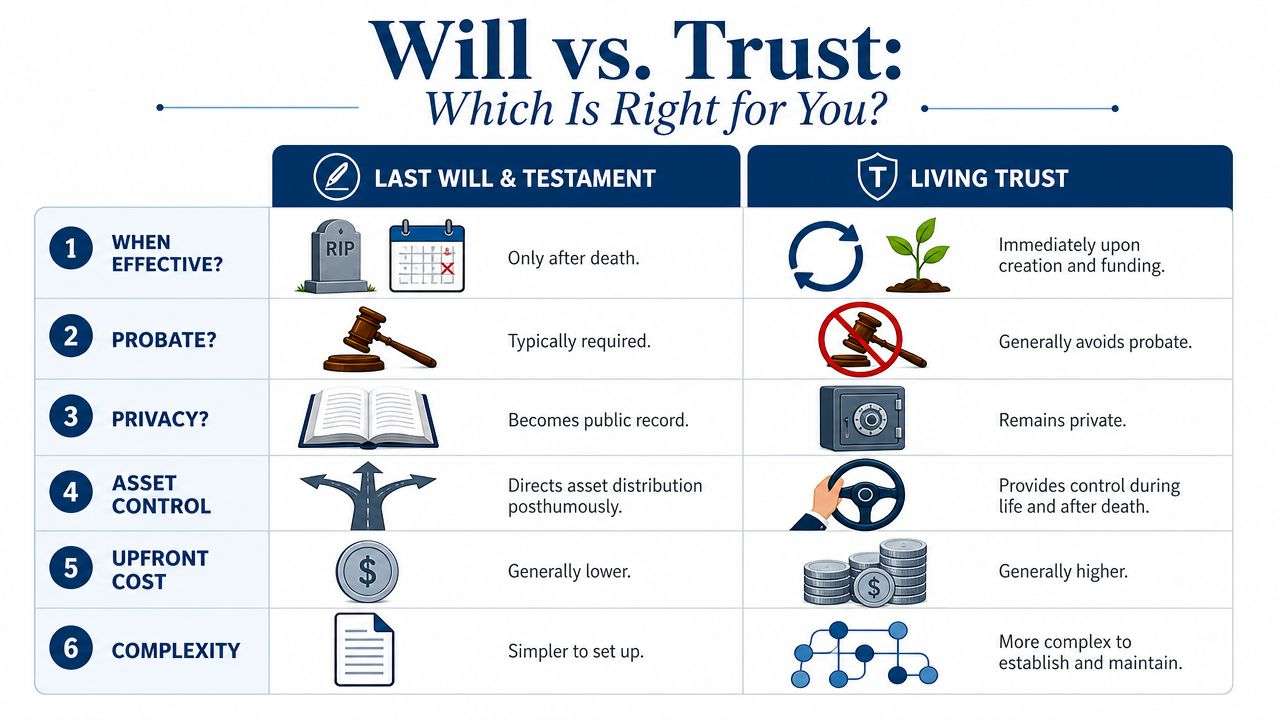
The short version is straightforward. A will sets out your wishes on death. A trust can hold assets under rules you set, either during your lifetime, on death, or both. For UK homeowners, that difference matters most where the main assets are the home, the mortgage protection plan, and any life cover meant to support the family rather than disappear into delay or confusion.
Will vs Trust at a Glance
| Feature | Will | Trust | Why It Matters |
|---|---|---|---|
| When it takes effect | On death | Can operate during lifetime and after death | Control can start earlier with a trust |
| Probate | Usually forms part of the probate process | Certain trust assets may sit outside probate if set up correctly | This can affect timing and administration |
| Privacy | Terms may become more visible during estate administration | Trust administration is usually more private | Some families want less public detail |
| Setup | Usually simpler and cheaper to put in place | Usually more involved, with trustee duties and ongoing review | Cost and complexity need to match a real need |
A useful plain-English companion read on wills vs trusts can help if you want a consumer-level explanation before speaking to a solicitor or adviser.
After that, it often helps to hear the topic discussed visually:
Which one fits the job
For many families, the answer is a will supported by selected trust planning, not a full replacement of one with the other.
A will is often enough where the household structure is simple, the beneficiaries are clear, and there is no need to control how money is used after death. A trust starts to earn its keep where there are young children, a second marriage, concerns about a vulnerable beneficiary, or life insurance that needs to reach the right people without waiting for the whole estate to be sorted.
Property is often the deciding factor. If most of the family wealth sits in the house, the planning should reflect that. The same applies if later-life borrowing is part of the picture. Homeowners considering this route should understand how equity release works before assuming that it will alone deal neatly with the final position.
The best setup is the one that matches the asset, the family, and the intended handover timing. In practice, that means using a will for overall direction and adding trusts only where extra control, speed, or protection is worth the added administration.
How Estate Plans Affect Your Property, Mortgage, and Equity Release
Often, the home is where estate planning becomes real. You can have a valid will and still get an unexpected result if the property is owned in a way that automatically transfers it elsewhere.
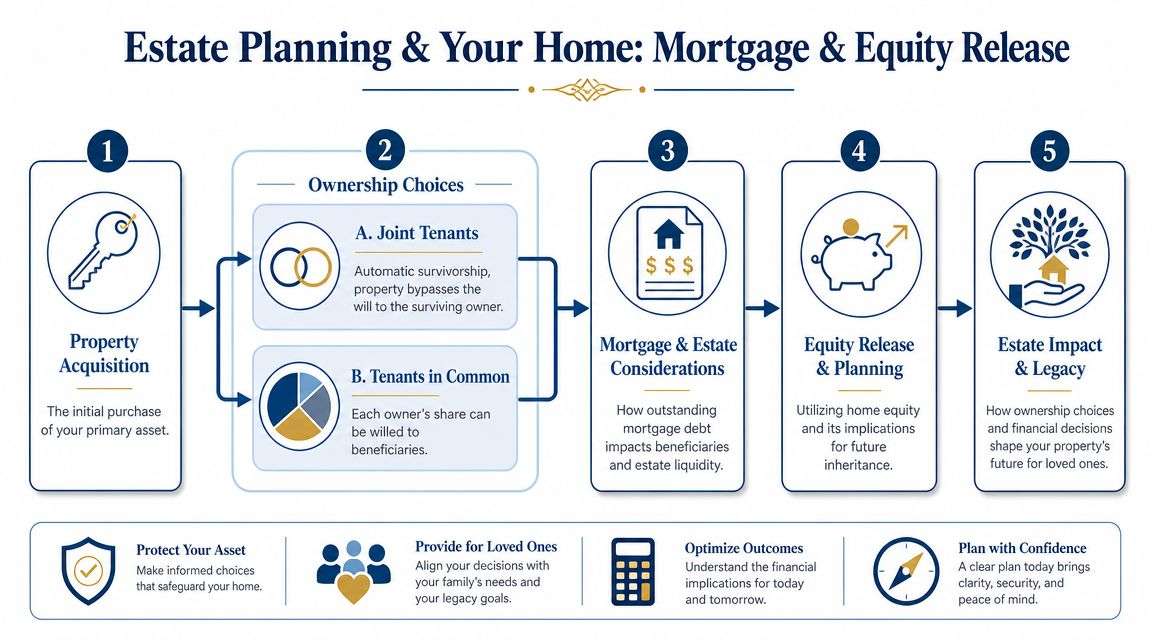
Ownership can override intention
A major source of confusion is the mismatch between asset ownership and what the will says. Some assets pass outside the will altogether, especially where they are jointly owned or have named beneficiaries. For homeowners, the legal title structure can override the wording in the will, which is why this catches so many families out, as explained in this discussion of asset ownership and beneficiary mismatches.
The classic property example is the difference between:
Joint tenants, where survivorship may send the property automatically to the surviving owner
Tenants in common, where an owner’s share can usually be directed under their will
That’s not a minor detail. It can completely change who inherits the value tied up in the property.
The mortgage still needs dealing with
A will doesn’t make the mortgage disappear. If there is borrowing secured against the property, the estate or surviving household still needs a workable plan for it.
That’s where joined-up advice matters. The questions usually include:
Will the surviving person be able to maintain payments?
Is there life cover intended to clear or reduce the debt?
Does the ownership structure support the intended outcome?
If later-life borrowing exists, how does that affect what is left behind?
For older homeowners in Chelmsford, Colchester or elsewhere in Essex, this becomes particularly relevant where there is equity release or a Retirement Interest-Only mortgage. If you’re reviewing that side of planning, this guide to how equity release works is a useful starting point.

“Trusts are an ideal way to protect the value of life insurance policies from the potential of inheritance tax, and ensure that payment is made timely, and to the right persons, too.”
The practical takeaway for homeowners
If your property is your biggest asset, don’t review the will in isolation. Check the title deeds, the mortgage balance, the life cover, and any beneficiary nominations at the same time.
That single review often reveals the gap.
Using Trusts to Protect Your Estate From Tax and Other Risks
A trust earns its place when it solves a real family or property problem.
For UK homeowners, that usually means one of three things. Keeping life insurance outside the estate so funds can be paid faster. Controlling who benefits from a share of the home. Reducing the risk that assets end up somewhere you never intended after a remarriage, later-life relationship, or a child inheriting too early.
The practical point is simple. Your house and your protection policies often carry most of the financial weight in the estate. If those two areas are not set up properly, a will on its own may not deliver the outcome you expect.
Where trusts can make a real difference
A trust can be useful where a straight gift would be too blunt.
For example, if a life policy is meant to clear a mortgage or give the surviving family breathing space, writing that policy into trust can help direct the proceeds to the intended people without waiting for the full estate administration process. That matters if monthly payments still need covering or a family needs access to funds before probate is completed.
Property raises a different issue. A trust can be used to protect a share of the home for children from an earlier relationship while still allowing a surviving spouse or partner to remain in the property. For many blended families, that is the trade-off. Security for the survivor, with protection for the children’s inheritance.
Trusts are also used where beneficiaries need money released in stages, or where an outright inheritance would be unwise because of age, vulnerability, or family circumstances.
Tax matters, but it is not the only reason
Inheritance tax often gets all the attention, but in practice, I find families are just as concerned about control.
They want to know:
who gets the money
when they get it
whether a payout bypasses unnecessary delay
whether part of the estate could be redirected by future events, such as remarriage or a change in wills
That is why trust planning needs to be tied back to the asset itself. A trust holding life cover does one job. A trust linked to a share of the home can do another. Using the wrong structure, or one without a clear purpose, creates paperwork without addressing the actual risk.
Common mistakes homeowners make
Problems usually come from mismatches between documents and assets.
A policy may still name an old intention. The property may be owned in a manner that does not conform to the will. Parents may assume children will be “looked after” without setting out how that should work if the survivor later changes course.
Older plans are another weak spot. A trust drafted years ago can still be valid but may no longer fit the current mortgage, the home’s present value, or the family setup.
Good estate planning is coordinated. The will, the trust, the property ownership, and the protection policies need to point in the same direction. Even firms reviewing workflows behind the scenes are pushing for that kind of joined-up process, which is one reason tools such as estate planning software for lawyers are getting attention.
A trust is not automatically the right answer. Used well, it gives control where a simple will leaves too much to chance.
Your Estate Planning Checklist and How EHF Can Help
If you want wills and trusts explained in the most practical way, reduce it to a checklist and work through it calmly.
A sensible homeowner checklist
List what you own and owe. Include the house, savings, policies and the outstanding mortgage.
Check how the property is owned. This can affect whether your will can direct your share.
Review who should inherit. Also, think about timing. Should they receive assets outright, or with some control?
Look at each policy and nomination. Don’t assume your will covers everything.
Read your existing will properly. If it was organised years ago, check whether it still matches your current family and finances.
Where coordinated advice helps
Mortgage advice, protection advice and legal planning often sit in separate conversations. That separation is where mismatches happen.
A more joined-up approach usually means:
The mortgage liability is understood
The life cover is pointed at the right problem
The will reflects current wishes
Any trust is used for a clear reason rather than because it sounds clever
For firms managing estate planning workflows, even the systems used in legal practices are moving towards more structured processes. If you’re curious about that operational side, this review of estate planning software for lawyers shows how professionals try to keep planning accurate and organised.
If you’re in Chelmsford, Braintree, Colchester, or elsewhere in Essex, the key next step is not to guess. It’s reviewing your current setup properly and fixing the weak points before your family ever has to rely on it.
If you’d like practical help connecting your mortgage, life insurance, will and trust arrangements, speak with EHF Mortgages and then take the next steps below :





