
If you’ve got Type 1 diabetes, the surprising bit is this: the diagnosis itself usually isn’t what decides the outcome. The detail that matters most is the quality of your evidence.
💡 Top tip: get your latest HbA1c, review dates, insulin details and any recent readings organised before you apply. That simple step can make the process smoother and help a broker properly place your case. I’ll explain exactly why later in the article.
A lot of people around Chelmsford and across Essex assume life insurance for type 1 diabetes means either a refusal or a sky-high premium. In practice, the market is more nuanced than that. Coverage is often available, but the insurer wants a fuller picture before pricing the risk.
That means the primary question isn’t “can I get life insurance?” It’s “how will this insurer assess my diabetes, and what can I do to present the strongest case?”
Can You Get Life Insurance with Type 1 Diabetes
Yes, you usually can.
For UK applicants, Type 1 diabetes is not an automatic no. In fact, mainstream underwriting has moved away from blanket refusals and towards evidence-based assessment. If you want a useful starting point, look at how major insurers describe the process. Legal & General states that life insurance for people with diabetes is generally available in the UK, but Type 1 cases are usually assessed more strictly, with requests for details such as the diagnosis date, the last diabetic review, insulin information, HbA1c results, and any complications, according to its guide to life insurance and diabetes.
That’s the first thing to understand. Insurers usually do not decide based on the label alone. They’re deciding based on control, consistency and complications.
If you’re comparing options, a broker-led route into life insurance advice is normally far more useful than trying to force a complicated medical history through a basic online quote form. Generic systems often don’t leave enough room for context.
What applicants often get wrong
The biggest mistake is applying too early, too vaguely, or with poor information.
People often say things like:
“My diabetes is well controlled” without having the latest HbA1c to hand
“I had a review recently” but can’t give the date
“I use a pump” without explaining how stable things have been
“No real issues” when the insurer will still ask about complications and severe hypos
Practical rule: Don’t rely on reassurance. Rely on evidence.
The good news is that if your records show stable management and no major complications, you’ve got a much stronger footing than many people think.
How Insurers View Type 1 Diabetes
Insurers price life cover by asking one basic question. How much uncertainty does this case bring compared with a standard application?
Type 1 diabetes creates more underwriting work because it’s a lifelong condition, and insurers want to understand whether there are signs of future risk, especially where blood sugar control has been difficult, or complications have developed. That’s why a Type 1 application often feels more like a medical application than a standard life insurance quote.

It’s an underwriting exercise, not a judgement
A simple analogy helps. If someone insures a house, the insurer wants to know whether the property is near a flood-risk area. That doesn’t mean the house can’t be insured. It means the insurer needs better details before it offers terms.
Life insurance for type 1 diabetes works in much the same way. The insurer will often want to know:
Diagnosis date
Last diabetic review
Insulin details
Latest HbA1c
Whether any complications exist
Whether a GP report is needed
The modern UK position is much more individual than many applicants expect. A major UK provider makes clear that Type 1 cases may not get a point-of-sale decision because underwriters may need to review medical evidence first. That matters because it shows the decision often rests on clinical control rather than diagnosis alone.
Why Type 1 is usually treated more cautiously
Underwriters generally view Type 1 diabetes as a higher-risk condition than Type 2. That doesn’t always mean refusal. It usually means one of three things:
More questions at the application stage
A request for GP or nurse evidence
A higher premium than a standard-life applicant
The insurer isn’t trying to catch you out. It’s trying to work out whether your file supports standard processing, loaded terms, or a specialist review.
From a practical adviser’s point of view, that distinction matters. If you know the insurer will ask for clinical details, you can prepare for it instead of being frustrated when the first quote changes later.
Key Underwriting Factors Insurers Scrutinise
Diabetes UK’s guidance is one of the clearest public summaries of what underwriters want. It says UK insurers typically ask for the latest HbA1c, medication list, diabetes diagnosis date, blood pressure, cholesterol, height and weight, plus details of any complications. It also notes that pricing and acceptance depend heavily on the history of controls and complications in its life insurance guidance for people with diabetes.
That lines up with what happens in real cases. The better organised and more stable the file, the easier it is for an underwriter to make a clean decision.
The factors that move pricing the most
Some details carry more weight than others.
| Factor | What insurers look for | Why it matters | Favourable indication |
|---|---|---|---|
| HbA1c | Latest result and whether control appears stable | Gives a snapshot of diabetes control | Recent result with evidence of ongoing management |
| Diagnosis date | When Type 1 diabetes was diagnosed | Helps underwriters assess duration of condition | Clear history with regular follow-up |
| Blood pressure and cholesterol | Latest recorded figures | Shows broader cardiovascular profile | Up-to-date readings and treatment compliance |
| Complications | Eye, kidney, foot or heart issues | Complications can increase underwriting concern | No complications disclosed |
| Height, weight and smoking | Overall health profile and lifestyle risk | Insurers price the whole case, not diabetes in isolation | Non-smoker with stable general health |
HbA1c is important, but context matters too
Applicants often fixate on one result. Underwriters rarely do.
They want to know whether the figure is recent, whether it reflects a settled management pattern, and whether there’s a matching story in the rest of the file. Someone with a current HbA1c and regular reviews presents far better than someone who says things have improved but offers nothing current to support it.
That’s also why related issues matter. If blood pressure is part of your overall health picture, it’s worth understanding how diabetes and hypertension can interact. This explainer on high blood pressure in diabetes gives useful patient-level context.
Complications change the shape of the case
A straightforward Type 1 application with no complications can move quite differently from one involving retinopathy, kidney issues, cardiovascular concerns or a history of severe hypoglycaemia.
Insurers are not only asking whether diabetes exists. They are asking whether it has already affected other systems in the body. Once complications arise, the likelihood of a fuller GP report increases sharply, and pricing usually becomes less forgiving.
Underwriter mindset: stable control with no end-organ complications is a very different file from unstable control with emerging diabetic complications.
What tends to help and what tends to hurt
A useful way to think about it is this:
Helpful evidence includes recent HbA1c data, regular reviews, clear insulin information, no smoking, and no complication history
Less helpful evidence includes old readings, gaps in follow-up, unclear medication history, recent severe hypos, and incomplete disclosure
Harder cases often involve multiple risk factors at once, not just diabetes alone
If you want a fair result, your job is to reduce ambiguity. The underwriter prices uncertainty, and messy cases look riskier than well-documented ones.

What Medical Evidence You Need to Provide
The biggest delay in these applications usually isn’t the insurer. It’s missing or outdated medical information.
For Type 1 diabetes, insurers are particularly interested in the factors that tend to move pricing in practice: HbA1c, disease duration, smoking status, complications and any recent severe hypoglycaemia, as summarised in this overview of life insurance approval for Type 1 diabetes. That’s why good preparation matters so much.
Here’s the core checklist.
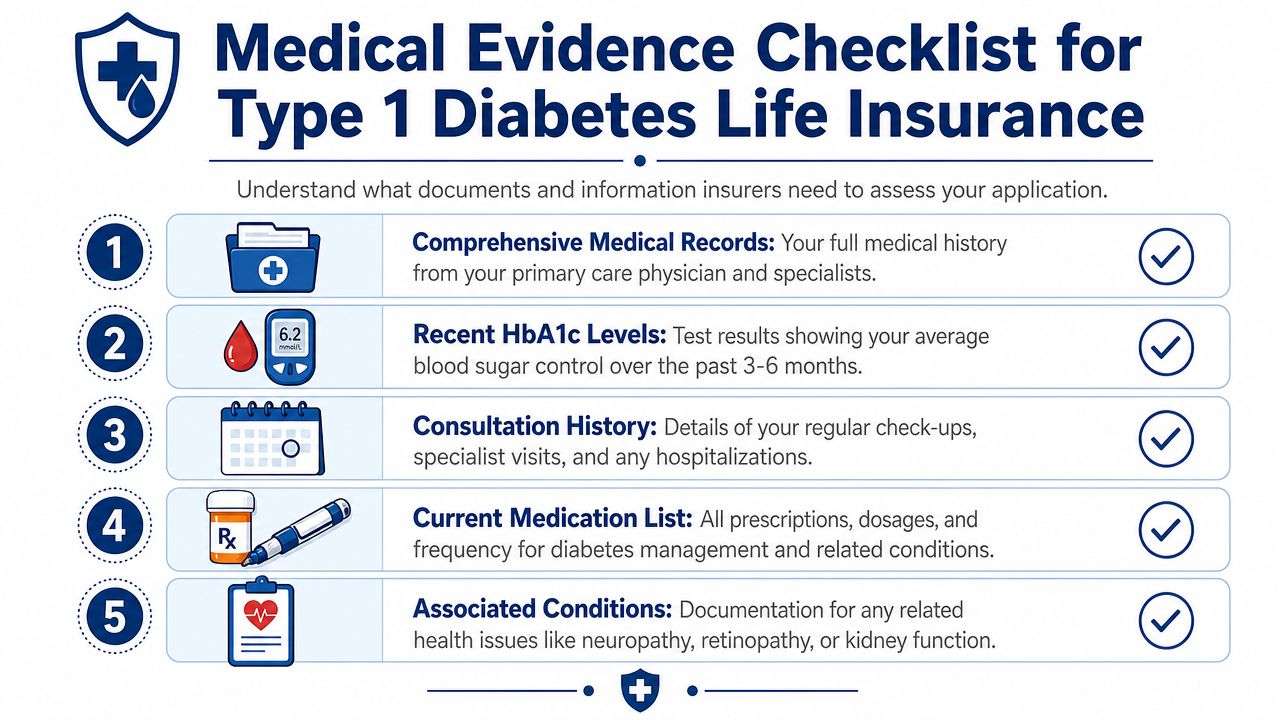
What you should gather before applying
Latest HbA1c result. The recent is always better than the historic.
Date of your last diabetic review. Underwriters want to know your care is current.
Medication and insulin details. Include injections, pump use, and any other relevant medication.
Any recent blood glucose records. Meter or monitoring data can help if it is current and consistent.
Complication history. Be ready to disclose eye, kidney, foot, heart or nerve issues if they apply.
Hospital admissions. These nearly always matter if they are recent.
One point that catches people out is the age of evidence. Underwriters typically want to understand your readings and how long ago they were. If the information is too old, there’s a strong chance the insurer will contact your GP or diabetes nurse for basic checks.
Why recent records carry more weight
If your control has improved, old paperwork won’t tell that story properly.
A current HbA1c, up-to-date review notes and recent monitoring records give an underwriter something they can rely on. Without that, the file can stall while medical evidence is requested from your GP. That doesn’t always mean a bad outcome, but it usually means a slower one.
If you need help getting copies of your records before applying, Finally Seen’s guide to making a subject access request to your GP is a practical place to start.
A short video can also help if you want a quick overview before dealing with forms and medical questions.
“Well controlled” only helps you if you can document it.
Don’t overshare random data
Applicants sometimes send screenshots, app exports and months of mixed readings without any explanation. That usually doesn’t help.
Give the insurer relevant, recent, readable information. A clean summary often works better than a pile of unfiltered downloads.
Policy Types and Likely Premium Impacts
Once the underwriting view is clear, the next issue is product fit. The policy itself is usually straightforward. Pricing is where Type 1 diabetes has the greatest impact.
UK insurers generally treat Type 1 diabetes as a higher-risk condition than Type 2, which often leads to higher premiums or substandard terms. Diabetes-focused guidance also notes that specialist brokers can improve access, as direct routes and comparison sites can be harder for people with diabetes, and that the most favourable applications usually show recent HbA1c data with no end-organ complications in this review of life insurance for diabetics.
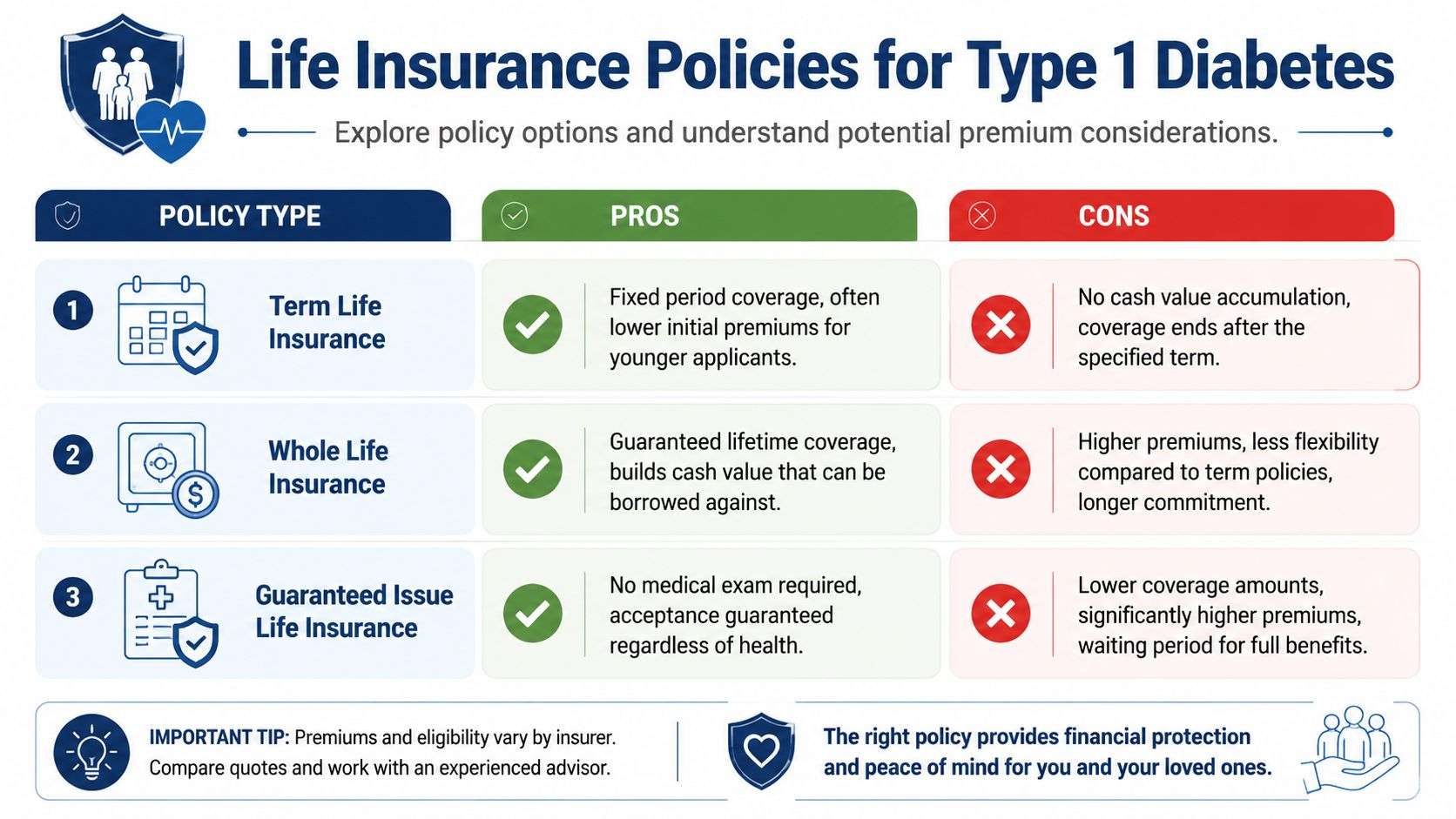
Which type of cover usually fits best
Many individuals with Type 1 diabetes still end up looking at the same core policy types as everyone else.
| Policy type | Where it fits | Main strength | Main trade-off |
|---|---|---|---|
| Level term | Family protection, interest-only mortgage, income replacement | Fixed cover amount | Premium may still be loaded |
| Decreasing term | Repayment mortgage cover | Often suitable for mortgage debt | Cover falls over time |
| Whole of life | Long-term estate or funeral planning | Lifelong cover | Usually costs more |
| Guaranteed issue | Last resort where underwriting is difficult | Minimal medical questions | Usually less flexible and less cost-effective |
For many homeowners in Braintree or Colchester, the first decision is whether the cover is there to protect family income or just to clear a mortgage. That changes the product recommendation straight away.
What do substandard terms mean in plain English
This phrase worries people more than it should.
Substandard terms usually mean the insurer will still offer cover, but not at the standard rate available to someone without the condition. In other words, acceptance may be possible, but the premium reflects the insurer’s assessment of extra risk.
That’s why shopping by headline price rarely works in life insurance for type 1 diabetes. Two insurers can react very differently to the same medical history. One may want a GP report and come back cautiously. Another may understand the case better from the outset.
Why specialist placement matters
Going direct can be expensive.
Some insurers and underwriting teams are better at handling diabetic cases. In day-to-day practice, providers such as Guardian, Royal London and Vitality are often worth considering because their approach can be more workable than a blunt mainstream route for certain applicants.
If you’re also thinking about broader protection, it helps to understand how critical illness insurance cover works alongside life cover, because the two are often confused but solve different problems.
A cheap quote that later changes after underwriting isn’t a bargain. It’s just an incomplete answer.
Finding the Right Cover with Specialist Insurers
The best route for Type 1 diabetes cases is usually not a comparison site.
Comparison tools are designed for speed. Medical underwriting for diabetes needs context. Those two things don’t sit comfortably together. If the form only asks broad questions, it can’t distinguish between a well-managed applicant with clean reviews and somebody with a much more difficult clinical picture.
Why broker placement beats going it alone
A specialist broker can do two things that matter.
First, they can properly frame the case before a full application is submitted. Second, they know which insurers are more likely to assess a specific diabetic profile sensibly. That matters because the underwriting questions may be similar across the market, but the appetite behind them often isn’t.
For a Type 1 applicant who is otherwise low-risk, the value is often in knowing:
Which insurer is likely to ask for more evidence straight away
Which one is more comfortable with the insulin pump or the CGM users
Which applications are more likely to benefit from pre-underwriting discussion
When it makes sense to wait for updated health data before applying
Good cases still need a good presentation
I’ve seen applicants in Chelmsford who assumed their healthy lifestyle would carry the whole case, only to find the insurer focused instead on missing review dates or unclear diabetic history.
That’s why presentation matters. A good case badly packaged can perform worse than a slightly more complex case with clear evidence and proper explanation.
The insurers are worth checking first
The names that regularly come up for diabetic-friendly consideration include:
Guardian for a more thoughtful underwriting approach in some protection cases
Royal London, where broader protection planning is part of the conversation
Vitality when lifestyle, engagement and medical profile make it worth exploring
That doesn’t mean they’ll always be cheapest or best. It means they are often sensible places to test rather than assuming the first high-street quote is competitive.
“The right insurer for Type 1 diabetes is rarely the one with the shortest online form.”
“For Type 1 diabetes, the best results usually come from matching the medical profile to the right underwriter, not from chasing the fastest quote.”
If your records are strong, a specialist route can help you avoid being over-penalised. If your records are mixed, it can help you avoid unnecessary declines and decide whether to apply now or wait until the evidence is better.
Your Next Steps to Get the Best Terms
If you want the short version, focus on preparation and timing.
Life insurance for type 1 diabetes is often available in the UK, but the best outcomes usually go to applicants who treat the process like underwriting rather than admin. The more current and organised your evidence is, the easier it is for an insurer to assess you fairly.
The actions that make the biggest difference
Get current evidence together. Have your latest HbA1c, review dates, insulin details, and complication history ready before any application starts.
Be accurate about severe hypos and admissions. Underwriters will care about recent events, so vague answers can create more problems than honest ones.
Don’t assume comparison sites are enough. They’re built for speed, not nuance.
Think about the purpose of the policy. Mortgage protection, family cover and long-term planning may point to different policy structures.
Review the amount of cover properly. If you’re unsure where to start, this guide on how much life insurance you may need is a useful primer.
A final point. If your clinical picture has recently improved, it may be worth considering whether applying now or waiting for updated evidence would give you a better chance of fair terms. That decision can save frustration.
The right result usually comes from three things. Current medical evidence, honest disclosure, and insurer selection that fits the case. Get those right, and the process becomes far less daunting.
If you’re ready to discuss your options with EHF Mortgages, the next step is simple. Use the button below to get personalised guidance tailored to your circumstances and find out how to approach the market effectively.





