
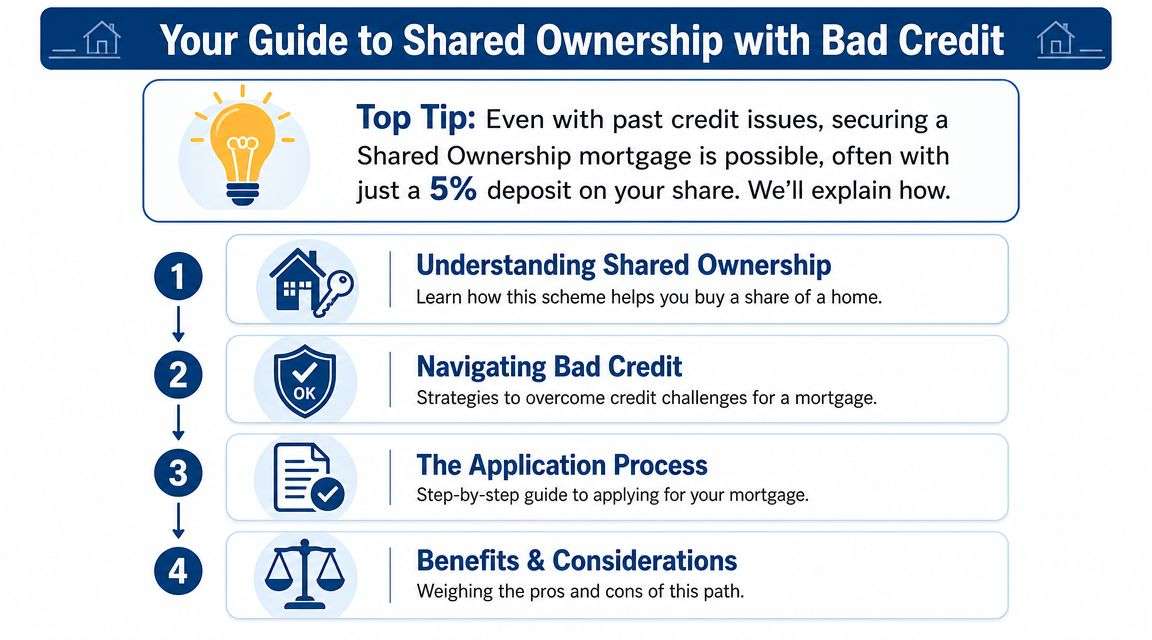
💡 Top Tip: Even with past credit issues, a bad credit mortgage shared ownership application can still work, often with a deposit starting from 5% of the share you’re buying, not the full property price, as explained by Charcol’s shared ownership bad credit guide. I’ll explain how that works properly later, because it’s one of the points many buyers in Chelmsford, Colchester and across Essex misunderstand.
A lot of people assume bad credit shuts the door on homeownership. In practice, shared ownership can reopen it, provided the case is structured properly and the monthly costs are viewed with clear eyes.
That matters because shared ownership isn’t just about getting accepted. It’s about making sure the mortgage, rent, service charge and day-to-day living costs still feel manageable after you move in.
Your Guide to Shared Ownership Mortgages with Bad Credit
Bad credit does not rule out shared ownership in Essex. It usually means the case needs tighter packaging, a realistic budget, and the right lender from the start.
In Chelmsford and Colchester, I often speak to buyers who assume they need a clean credit file before they can even enquire about a shared ownership home. That is rarely the actual situation. The better starting point is this. Can the purchase work on a month-to-month basis once the mortgage, rent, service charge, council tax, and regular living costs are all accounted for?
Shared ownership lets you buy part of a property and pay rent on the rest. That can make the first step onto the housing ladder more realistic, especially in parts of Essex where full open-market prices have outpaced local wages. For a buyer looking at a flat near Chelmsford city centre or a newer development on the Colchester side of town, buying a smaller share can reduce the mortgage required at the outset and broaden the range of lenders to consider.
What shared ownership actually means
You buy a share of the property. A housing association or other provider keeps the remaining share. Your monthly housing costs usually include several separate payments:
Mortgage payment on the share you buy
Rent payment on the unsold share
Service charge if the building or estate has shared costs
Usual home costs such as council tax, utilities and insurance
This is the part many buyers underestimate.
A shared-ownership flat can look affordable on a mortgage calculator, but feel tighter once service charges and rent are added in. That matters in newer Essex developments, where communal heating, lift maintenance, parking areas or estate charges can change the numbers more than buyers expect. If you want a plain-English overview of leasehold costs before viewing properties, this guide to UK ground rent for investors is useful background reading.
Why can it still work with credit issues?
The practical advantage is straightforward. You are borrowing against the share you buy, not the full property value. That often reduces the loan size and lowers the cash deposit required.
Lenders still assess risk carefully. They will look at what went wrong on the credit file, whether the issue has been settled, and whether your recent conduct is stable. In broker terms, shared ownership can make the property side easier, but the credit story still has to make sense.
I see this regularly with Essex applicants who had a missed payment during a job change, a default from a few years ago, or historic debt problems that are now resolved. Those cases are not automatic declines. They just need clearer evidence, better lender selection, and realistic expectations on rates and deposits.
If you want to get a feel for the current market, reviewing available shared ownership mortgage deals helps set expectations before you start applying.
Where buyers in Essex get caught out
The biggest mistake is treating shared ownership as a shortcut rather than a structure. Approval is only part of the decision.
A buyer in Chelmsford might be comfortable with the mortgage payment alone, only to find that the rent and service charge leave very little room for travel, childcare, or everyday spending. A buyer in Colchester may focus on getting accepted with past credit issues, but overlook future rent reviews or the cost of staircasing later. Those are fixable problems if they are spotted early. They become expensive problems if they are ignored.
Shared ownership can be a solid route to homeownership with bad credit. It works best when the numbers are checked with discipline, and the property is chosen with open eyes.
How Bad Credit Affects Your Mortgage Eligibility
Bad credit isn’t one single thing. Lenders separate missed payments, defaults, CCJs, debt management plans, IVAs and bankruptcy because each one tells a slightly different story about risk.
In real underwriting, two details matter most. How serious was the issue, and how recent was it? A historic blip is viewed very differently from a live or recent problem.

What lenders usually look at
Shared ownership eligibility is also shaped by scheme rules. Household income must usually be under £80,000, or £90,000 in London, and some applicants must fit scheme-history rules such as being a first-time buyer, an existing shared ownership mover, or a former homeowner who can’t afford a full purchase, according to The Mortgage Centres’ guide to shared ownership with bad credit.
For adverse-credit cases, the same guidance notes that recent blemishes can push deposits up to around 15% or more of the share being bought. It also notes that some lenders won’t proceed where a DMP, IVA or bankruptcy has not been satisfied or discharged for at least 3 years.
Why recent issues matter more
From a lender’s perspective, recent adverse credit can indicate current pressure rather than past difficulty. If a borrower missed payments several years ago but has kept everything clean since, that often reads as recovery. If the issues are fresh, the lender may worry that the strain is ongoing.
That’s why buyers in Chelmsford or Colchester sometimes get very different answers from different lenders. One lender may focus heavily on the event itself. Another may focus on what has happened since.
A lot of applicants also worry too much about the score and not enough about the details. The score matters less than people think. The entries, dates, balances, satisfaction status and the wider file are what underwriters examine.
Bad credit is not a permanent label. It’s a record of past events, and lenders decide how much weight to give those events.
If you’ve had credit issues before, it’s worth understanding how an adverse credit mortgage lender tends to assess the whole picture rather than relying on assumptions taken from high-street bank adverts.

High-Street vs Specialist Lenders
The lender choice often determines whether a shared-ownership case with bad credit receives proper consideration or is rejected at the first filter.
High-street banks usually rely on tighter scorecards and set policy limits. If a client in Chelmsford has an old default, a satisfied CCJ, or missed payments that fall outside those rules, the application may fail before an underwriter considers the wider story. Specialist lenders tend to review more manually. That gives well-explained cases a fairer hearing, especially where recent conduct is clean, and the income holds up.
That flexibility comes with a trade-off. Rates are often higher, fees can be higher too, and lender choice is narrower.
How the two lender types assess a case
Some specialist lenders, including Pepper Money, are known for considering applicants with adverse credit. The advantage is not cheaper borrowing. The advantage is that the lender may consider the age of the issue, whether it has been satisfied, how the account has performed since, and whether the shared ownership purchase is still affordable after rent, service charge, and mortgage are factored in.
“We help many with previous CCJ’s and defaults as specialist lenders are in a great position to help.” – EHF Mortgages
In practice, that difference matters a lot in Essex. A buyer in Colchester with one satisfied default from three years ago and a stable employed income may be outside one high-street lender’s policy but acceptable to a specialist lender that is prepared to look at the case in full. The property, deposit, housing association rules and monthly budget still have to fit, but the conversation is wider than a simple pass or fail.
| Feature | High-Street Lenders | Specialist Lenders |
|---|---|---|
| Credit flexibility | Usually tighter and less forgiving | More flexible where issues are explainable |
| Underwriting style | Often more policy-driven | Often more manual and case-specific |
| Pricing | Usually keener for clean files | Usually higher rates to reflect risk |
| Deposit stance | Can be less flexible on adverse credit | May consider wider profiles with stronger packaging |
| Shared ownership fit | Available, but narrower on bad credit | Often better suited to complex cases |
Where clients go wrong
The common mistake is chasing the lowest advertised rate before checking whether the lender accepts the profile. Shared ownership already limits the panel. Add bad credit, and the shortlist can shrink quickly.
A better approach is to match the case to the lender’s appetite from the start. Older credit issues, a clear explanation, stable income and sensible outgoings can still produce a workable application. Fresh arrears, unpaid defaults or stretched affordability will usually need a different plan, even with a specialist lender.
If you are comparing those options, it helps to understand how a specialist mortgage lender approaches bad credit cases differently from a mainstream bank.
Practical Steps to Boost Your Application
A shared ownership application with bad credit can still be approved. The difference is usually in the preparation.
In Chelmsford and Colchester, I regularly see buyers focus on the credit issue and miss the parts they can control this month. Lenders and housing associations look at the whole case. Clean paperwork, a sensible deposit, stable bank conduct and a clear explanation of past problems all help.
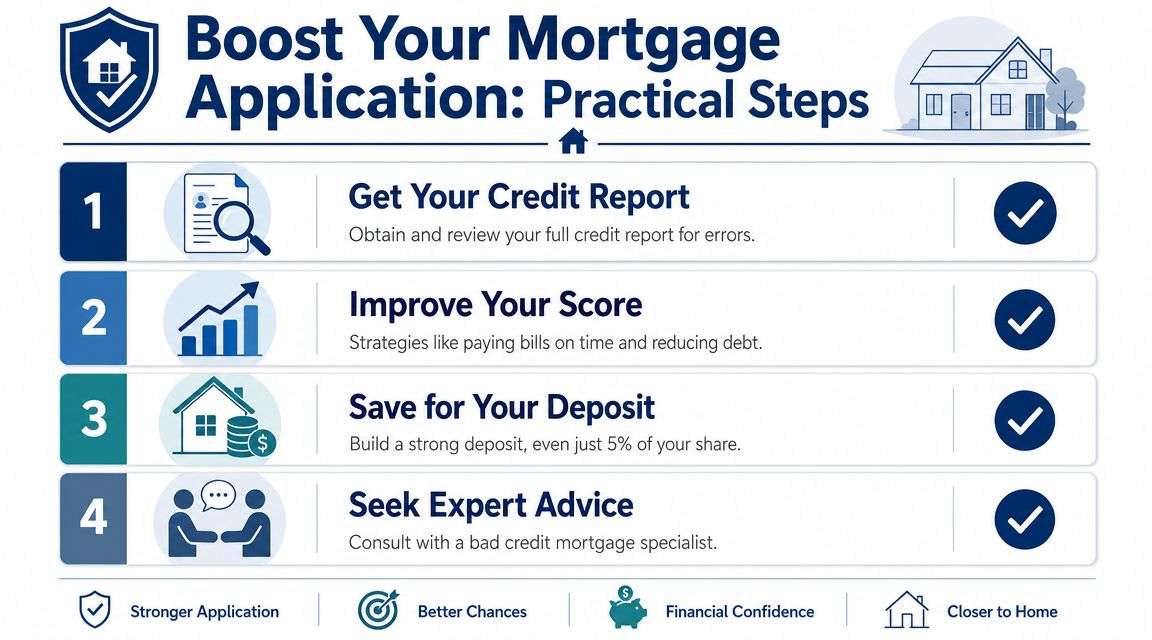
Start with your credit file
Get your credit reports before you look at properties. Check what is showing, whether old debts are marked as satisfied, whether dates are correct, and whether there are errors that need to be disputed.
This sounds basic, but it saves time. A lender will spot mismatches between the application, the credit file and the bank statements. If there is a default you forgot about or an address history issue, it is better to deal with it up front than to have the case stall later.
For Essex buyers, timing matters as well. If a missed payment is very recent, waiting and improving your conduct for a few months can give you a much better choice of lenders than applying in a rush.
Build the deposit sensibly
For shared ownership, the deposit is usually based on the share you are buying rather than the full property value, as noted earlier in the article. If you buy a 25% share, the deposit is normally calculated against that share.
That helps, but it does not remove the pressure on affordability. In practice, many bad-credit shared-ownership cases I see involve a 5% or 10% deposit on the share, depending on the credit history and the lender’s policy at the time. A larger deposit can help, but it does not fix recent arrears, unstable income or poor bank conduct on its own.
Buyers often ask whether they should use every spare pound for the deposit. Usually, no. Keeping a cash buffer for fees, moving costs, and the first few months of ownership can make the application look more sensible than stretching to the absolute limit.
Broker insight: A lender is not just checking whether you can get the keys. They are checking whether the mortgage, rent and service charge still look manageable after you move in.
Package the case properly
A clear, well-documented case is easier for an underwriter to support. That matters more with adverse credit because lenders usually want context, not just a credit score.
The core documents are straightforward:
Income proof, such as payslips, P60s or accounts if you are self-employed
Bank statements showing wages paid in and spending under control
Deposit evidence confirming where the funds have come from
A short credit explanation covering what happened, when it happened, and why it has been resolved
Keep the explanation factual. If a default came after redundancy, separation, illness or a one-off income shock, say so plainly and show that the problem has passed. A half-page note with dates and facts is far better than a long emotional statement.
Well-prepared cases can move quickly, but speed depends on the lender, the housing association, the valuer and how clean the paperwork is from day one.
A quick video can help bring the process to life:
Watch the full monthly cost
Shared ownership applications often come under pressure. The mortgage payment is only one part of the budget. Rent on the unsold share, service charge, ground rent if applicable, utilities, travel and everyday credit commitments all count.
Clients in Chelmsford often find service charges on newer flats higher than expected. In Colchester, the same issue arises in developments where the share price looks affordable at first glance, but the monthly outgoings are tighter once all charges are included. CLS Money’s discussion of bad-credit shared-ownership affordability makes the same practical point. You need to assess the full cost, not just the mortgage rate.
A simple rule helps here. If the budget already feels tight on paper, it will usually feel tighter in real life.
Alternatives if Shared Ownership Is Not Right for You
Shared ownership is useful, but it isn’t automatically the best answer for every buyer with credit issues. Sometimes another route is cleaner, cheaper or less stressful.
That’s important to say plainly. A good property plan is about fit, not forcing one scheme to work at all costs.

Guarantor or family-assisted options
Some buyers are better served by a family-supported arrangement if a parent or close relative is willing and suitable to help. That can strengthen the application where the main weakness is affordability or deposit size rather than severe credit damage.
This route needs care. Family support can solve one problem while creating pressure elsewhere, so everybody involved needs proper advice and clear expectations.
Rent to Buy and similar pathways
For some applicants, renting first through a structured affordable housing program can make more sense than buying immediately. It creates breathing room to steady the credit file, build savings and avoid forcing a mortgage application before the profile is ready.
That may be particularly sensible if the current file still shows very recent issues, unstable bank conduct or unresolved debts.
Waiting can be a strategy, not a setback
Sometimes the strongest move is to pause. If a credit issue is on the cusp of becoming more acceptable to lenders, or if a buyer needs a larger deposit and cleaner bank statements, waiting can yield a far better outcome.
In practice, that can mean stronger lender choice, a more manageable rate, or a less fragile monthly budget. For a buyer in Braintree, Chelmsford or Colchester, the right timing can matter as much as the right product.
How a Specialist Broker Makes the Difference
A specialist broker can turn a shaky-looking shared ownership case into a workable application.
Shared ownership already sits outside the standard purchase process. Add missed payments, a default, a settled CCJ, or a rough patch on bank statements, and lender choice narrows fast. At that point, the difference is rarely the interest rate alone. It is knowing which lenders will consider the case at all, how they will read the credit history, and whether the property itself fits policy.
That judgment comes from casework, lender updates, and day-to-day broker conversations. Public lender pages only tell part of the story.
Knowing lender’s appetite
Two lenders can look similar on paper and behave very differently in practice. One may accept an older default if recent conduct is clean. Another may allow a satisfied CCJ but take a stricter view on unsecured borrowing. A third may be comfortable with a repaired credit file if the deposit is stronger, the income is steady, and the shared ownership scheme meets its rules.
That matters because bad credit is not one single category. A buyer in Chelmsford with one historic issue and stable salaried income is a very different case from a buyer in Colchester with recent missed payments and rising credit card balances. Good advice starts by properly separating those cases, not lumping them together under “adverse credit”.
Lenders are careful for a reason, as noted earlier. A broker’s job is to match that caution with the right application strategy rather than sending the case to the wrong place and hoping for the best.
Packaging the case properly
Underwriters do not just assess a credit score. They assess a story backed by evidence.
A good broker presents that story clearly by:
explaining what went wrong and whether it was a one-off or a pattern
showing what has improved since then
highlighting stable income, clean recent account conduct, or a sensible deposit
checking the housing association terms, lease details, and property type before the case goes in
filtering out lenders that are likely to decline on policy
That last point saves a lot of trouble. A failed application can mean more delay, another credit search, and extra pressure if the property deadline is tight.
I have seen Essex buyers lose time by applying too early with the wrong lender, especially for shared-ownership homes, where the mortgage, lease, rent, and service charge all need to line up. In Chelmsford, newer developments can raise questions about service charges. In Colchester, scheme-specific criteria or property construction can affect which lenders remain in the mix. Those details matter more in specialist cases than many buyers expect.
Saving avoidable damage
Speed helps only when the case is ready.
A specialist broker will usually slow the process down at the start, check the documents thoroughly, and test the case against lenders’ criteria before a full application is submitted. That can mean asking for one more payslip, waiting for a credit file update, or clearing up a bank statement issue first. It is a better trade-off than rushing into a decline.
The practical value is simple. Fewer wasted applications, fewer surprises from underwriting, and a clearer route to a lender that fits both the credit profile and the shared ownership property.
Your Shared Ownership Questions Answered
A few questions come up repeatedly when buyers are weighing up bad credit mortgage shared ownership. Here are the ones that usually matter most.
Can I staircase later if I start with bad credit
Usually, yes. Staircasing means buying additional shares in the property later on. If your credit profile improves over time, that later stage can also become an opportunity to review your mortgage options and potentially access a better deal than the one available at the start.
The key point is that your starting mortgage doesn’t freeze your future forever. Shared ownership can be a first step, not the final shape of ownership.
Does bad credit change the rent on the unsold share
No. Your bad credit history doesn’t set the rent for the part you don’t own. That rent is determined under the shared ownership arrangement with the housing association or provider.
What bad credit affects is the mortgage side. It can influence lender choice, pricing, deposit expectations and the amount of scrutiny applied to affordability.
Will a CCJ automatically mean a decline?
Not necessarily. A CCJ is not always fatal to a case. Lenders usually want to know when it was registered, whether it has been satisfied, and what the rest of the file looks like.
One older, settled issue is very different from a recent pattern of missed commitments. That’s why two applicants who both say “I have a CCJ” can receive completely different outcomes.
How do lenders view service charges in shared ownership
They matter more than many buyers expect. Lenders do not just look at the mortgage payment in isolation. They assess the whole outgoing position, including rent on the unsold share and any service charge.
If the service charge is high, that can limit borrowing or make a case feel less comfortable, even if the deposit and credit side look acceptable. This is one of the big practical checks that gets overlooked in online summaries.
Shared ownership can absolutely be a workable route if your credit history isn’t perfect. The buyers who tend to do best are those who understand the trade-offs, prepare properly, and choose their lender carefully. If you’re in Essex and trying to work out whether your case is viable, the best next step is a proper review of your credit profile, deposit position and full monthly affordability.
If you’d like specific guidance from EHF Mortgages, including help with shared ownership and adverse credit cases in Chelmsford, Braintree, Colchester and across Essex, use the contact page to start the conversation.





