
 Top tip: if you need to raise money but you’re sitting on a good fixed mortgage deal, a second charge mortgage can sometimes work out cheaper than remortgaging the whole lot. I’ll show you how to think about that properly later.
If you’re a homeowner in Chelmsford, Braintree, Colchester or elsewhere in Essex, this situation may feel familiar. You want funds for home improvements, debt consolidation, school fees, or a high one-off cost, but your current mortgage rate is one you really don’t want to lose. That’s where many people start looking at second charge mortgage rates and quickly run into confusion.
The main problem is that most guides stop at the definition. They tell you what a second charge mortgage is, but not how to judge whether it’s the right move for your budget. That’s the part that matters.
This guide takes a practical approach. We’ll look at how second charge mortgages work, why the rates are usually higher than a standard mortgage, what affects the rate you’re offered, and when a second charge may still be the lower-cost option overall.

Introduction
A second charge mortgage is often worth considering when you need extra borrowing but don’t want to disturb your main mortgage. That’s especially relevant if your current lender would charge an early repayment charge to leave your deal.
People often assume the cheapest headline rate always wins. It doesn’t. With secured borrowing, the key question is total cost, including fees, the rate on the new borrowing, and the cost of replacing your existing mortgage if you remortgage.
Practical rule: don’t compare a second charge against your current mortgage rate. Compare it against the full cost of remortgaging your whole balance.
That difference catches people out all the time. A remortgage may offer a lower rate on paper than a second charge, but if it means refinancing your entire mortgage onto a higher rate and paying to exit your current deal, it can be the more expensive choice.
By the end, you should have a clearer way to judge the options in plain English, without getting lost in lender jargon.
What Are Second Charge Mortgages and Their Rates
A second charge mortgage is a secured loan that sits behind your existing mortgage. You keep your main mortgage where it is, and take a separate loan secured against the same property.
A simple way to think about it is this. Your home has one main borrowing arrangement already attached to it. A second charge adds another, smaller borrowing arrangement alongside the first, rather than replacing it.
Why are the rates usually higher
Second-charge mortgage rates are usually higher than first-charge mortgage rates because the second lender takes a second-ranking security position. If the property is sold or repossessed, the first-mortgage lender is repaid first, and the second-charge lender is repaid only after that. That added risk is a core reason pricing is higher, and FCA consumer guidance also notes these loans are often used when borrowers want to raise capital without changing an existing mortgage, especially if an early repayment charge would make remortgaging costly, as outlined in this consumer guidance on mortgage interest rate changes.
That point matters because it explains two things at once. First, why the rate can look expensive compared with a mainstream mortgage. Second, why the product still makes sense for some households.
When people tend to use them
In everyday advice conversations, second charge mortgages usually come up when someone wants to:
Keep an existing fixed rate rather than replacing it
Borrow a specific amount for a clear purpose
Consolidate debts into one secured payment
Fund home improvements without a full remortgage
Raise capital when a further advance from the current lender isn’t suitable
If you want a fuller basic explanation before going deeper, this guide on what a second-charge mortgage is provides a useful overview.
A second charge isn’t automatically a last resort. Often it’s simply a way to avoid changing a first mortgage that still works well.
Where people get confused
The usual misunderstanding is this. Borrowers compare the second charge rate with the rate on their current mortgage and decide it looks too high. That comparison isn’t really fair because the current mortgage may have been taken out in a different rate environment and reflects a very different risk profile for the lender.
The better comparison is between three routes:
Keep the current mortgage and add a second charge
Remortgage the whole property
Use unsecured borrowing instead
Once you compare those on a like-for-like basis, the picture often changes.

Typical Rates and Example Repayments in 2026
If you’re searching for second charge mortgage rates in 2026, the first thing to know is that pricing can move quite a bit depending on your equity and your circumstances. Market examples show rates around 8.10% to 9.20% for some 5-year fixed products at up to 65% to 75% LTV, and broader market commentary placed typical second mortgage rates in the 7% to 9% range in 2025, with more equity generally helping pricing, according to this UK lender update on second charge rate reductions.
That means there isn’t one single market rate. There’s a range, and where you land within it depends on your case.
A representative repayment view
To keep things simple, the table below uses a representative APR of 8.5%. It’s not a quote, and your own figures may differ, but it helps illustrate how the term affects the monthly payment.
| Loan Amount | 5-Year Term | 10-Year Term | 15-Year Term | 20-Year Term |
|---|---|---|---|---|
| £25,000 | Higher monthly payment | Lower than 5 years | Lower again | Lowest monthly payment |
| £50,000 | Roughly double the £25,000 pattern | Lower than 5 years | Lower again | Lowest monthly payment |
| £75,000 | Highest monthly payment in table | Lower than 5 years | Lower again | Lowest monthly payment |
What the table is really telling you
The longer the term, the lower the monthly payment tends to be. That helps affordability on paper, but it also means you’re paying interest over a longer period.
A shorter term does the opposite. The monthly payment is heavier, but you clear the balance more quickly.
So when people ask me in Chelmsford whether a second charge is affordable, I usually steer them away from one narrow question. It’s not just “can I manage the payment?” It’s also “does the term fit the purpose of the borrowing?”
Matching the term to the reason for borrowing
Here is a practical perspective:
Home improvements: a medium to longer term may help spread the cost sensibly
Debt consolidation: affordability matters, but the total cost still needs close checking
Short-term planned expense: A shorter term may reduce the long-run cost if your budget can handle it
Key point: the cheapest monthly payment isn’t always the cheapest borrowing choice.
The other thing to remember is that a second charge quote should never be judged on rate alone. Fees, lender criteria, and how the new payment fits alongside your existing mortgage all matter.
Factors That Determine Your Second Charge Rate
Two borrowers can apply for the same loan amount and get different pricing. That’s normal. Lenders price second-charge cases by risk and consider several moving parts rather than a single score.

Loan-to-value
Loan-to-value, commonly abbreviated as LTV, is one of the biggest drivers. It reflects how much of your borrowing is secured against your home relative to the property value.
If you have more equity, the lender has more protection. That often supports better pricing. If the available equity is tighter, the lender may view the case as higher risk and price it accordingly.
“More equity usually gives you more room to access lower pricing.”
This is why two homeowners in Colchester with similar incomes can still see different rates. One may have built up much more equity than the other.
Credit history
Your credit file tells the lender how you’ve managed borrowing in the past. Late payments, defaults, or a recent pattern of financial pressure can affect the options available.
That doesn’t always mean a decline. It may mean the case fits a more specialist lender and a different price band. In plain terms, cleaner credit usually gives you a wider choice.
Loan amount and term
The size of the loan and the repayment term both affect affordability. A modest borrowing need may suit a second charge particularly well if remortgaging the whole property would mean changing a large first mortgage for the sake of a smaller extra sum.
The term matters too. A longer term can soften the monthly payment, but lenders still need to be comfortable that the arrangement makes sense for your income and circumstances.
Property type and condition
Standard-construction homes are usually simpler for lenders to assess. If the property is unusual, non-standard, or needs work, the lender may take a more cautious view.
That doesn’t automatically stop a case. It just means lender choice may narrow, and pricing can be affected.
Income and personal circumstances
Lenders also look closely at how stable and provable your income is. Employed income is often straightforward, but self-employed income, variable earnings, or multiple income streams may need a more careful presentation.
They’ll also consider what the borrowing is for. Home improvements may be viewed differently from debt consolidation because the purpose affects how lenders assess overall risk and resilience.
A useful way to prepare is to ask yourself these questions before you apply:
How much equity do I really have once my main mortgage is taken into account?
Is my credit file up to date and free from avoidable issues?
Can I prove my income clearly with the right paperwork?
Does the loan purpose make sense when explained?
Is the payment comfortable if rates or household costs change?
Those five answers won’t replace lender underwriting, but they do tell you how strong your starting position is.
Second Charge vs Remortgage: Making the Right Choice
This is usually the key decision. Not “is a second charge good or bad?” but “which route costs less overall for what I need right now?”
The second-charge market remains relatively niche, with 15,500 regulated completions in 2024, gross advances of £1.2bn, and an average loan size of about £77,000, suggesting many borrowers use these loans for specific borrowing needs rather than broad market shopping. The same market commentary also highlights an important practical point: even a slightly higher second-charge rate can still be cheaper than breaking a low fixed-rate first mortgage and refinancing the entire balance, particularly where early repayment charges apply, as noted in this overview of second-mortgage borrowing decisions.
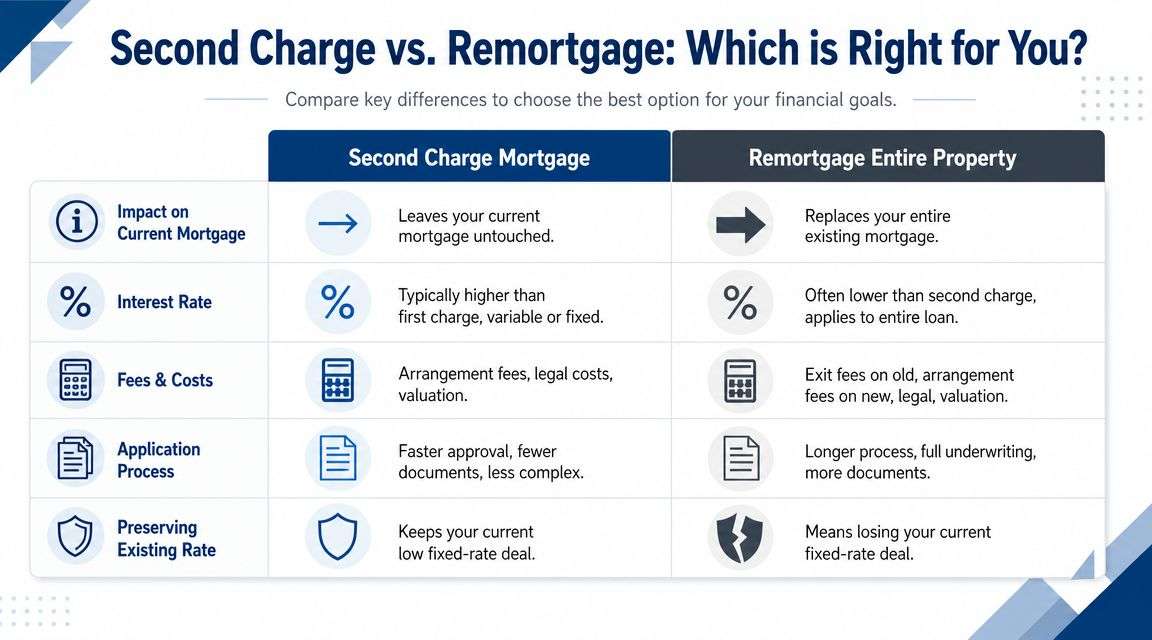
A practical comparison
Say you already have a large mortgage on a low fixed rate and only need extra borrowing for a clear purpose, such as £50,000. You now have two broad options.
| Option | What happens to the current mortgage | Main cost issue | Best suited to |
|---|---|---|---|
| Second charge | Stays in place | Higher rate on smaller new loan | Borrowers protecting a good first mortgage |
| Remortgage | Entire mortgage replaced | New rate applies to whole balance | Borrowers whose current deal no longer suits |
| Further advance | Same lender adds borrowing | Depends on lender terms | Borrowers accepted by current lender |
| Unsecured borrowing | No charge on property | Usually higher monthly payment | Smaller, shorter-term needs |
When a second charge can win
A second charge can make sense when:
Your current fixed rate is strong and worth keeping
An early repayment charge applies if you leave now
You only need a modest extra amount compared with your full mortgage
Your current lender won’t offer a suitable further advance
You want a separate term for the extra borrowing
The key is that you’re borrowing a smaller amount at a higher rate, rather than moving the whole mortgage to a new, higher rate.
When remortgaging may be better
Remortgaging can still be the right call if your current deal is ending, the early repayment charge is no longer an issue, or the overall package is cleaner and cheaper once all costs are considered.
This is also where practical admin matters. If you’ve never switched lenders before, it helps to understand the mortgage discharge costs and timelines involved in closing one mortgage and replacing it with another, because timing and exit costs can shape the decision more than people expect.
Don’t ask which rate is lower. Ask which route leaves you paying less overall for the borrowing you actually need.
If you’re comparing options for releasing equity from your home, this guide on how to remortgage to release equity can help frame the alternative route.
The decision framework I use with clients
When someone in Braintree asks me which route to choose, I strip it back to four checks:
What amount do you need?
What happens if you disturb the current mortgage?
What are the full fees and charges on each route?
Which option still fits within your monthly budget?
That approach keeps the discussion grounded. It stops the decision from being driven by a headline rate that doesn’t tell the full story.
How to Get Competitive Rates and Specialist Advice
If you want a good outcome, preparation matters. Second charge cases tend to run more smoothly when the paperwork is tidy, and the purpose of the loan is clear.

Get your documents ready early
Start with the basics:
Proof of identity: passport or driving licence
Proof of address: recent utility bill or bank statement
Income evidence: payslips, accounts, tax documents, or SA302s
Mortgage details: latest statement for the first mortgage
Purpose of borrowing: a clear explanation of what the funds are for
That may sound obvious, but delays often come from missing paperwork rather than lender appetite.
Look beyond the rate
Fees deserve proper attention. The FCA’s review of the second charge market found intermediary fees were commonly 10% to 12.5% of the loan amount, with some firms charging 2.5% to 15%, which is why transparent cost breakdowns matter so much, as set out in the FCA’s review of second charge mortgage fees and outcomes.
That’s a strong reminder to ask for the full cost picture, not just the rate. Arrangement fees and intermediary fees can materially change the effective APR, especially on smaller loans.
Why specialist advice helps
Second charge lending is a specialist part of the market. Some lenders are more flexible on certain property types, some work better with self-employed income, and others are more open to complex credit histories.
A broker can help you compare those options, sense-check whether a second charge is appropriate, and identify whether a remortgage, further advance, or unsecured route might be better. If you’re looking into lenders that handle more complex cases, this page on a specialist mortgage lender is a useful starting point. EHF Mortgages also arranges second charge borrowing as part of its wider mortgage and specialist finance service.
Here’s a short explainer that many borrowers find useful before they start comparing options:
Tailored advice for different borrowers
Homeowners over 55
If you’re over 55, a second charge might still be suitable, but it’s sensible to compare it with later life lending options as well. The right route depends on income, future plans, and whether you want monthly repayments or more flexibility.
Landlords
A second charge on a buy-to-let property needs a different lens. The lender will usually focus on the property, rental position, and the wider portfolio picture if you own more than one property.
Borrowers with adverse credit
Specialist lenders may still consider cases with historic credit issues, but the explanation behind those issues matters. Clean recent conduct can help, even where the older credit profile isn’t perfect.
Self-employed applicants
For self-employed borrowers, presentation is half the battle. Up-to-date accounts, tax calculations, and a clear income story make a big difference. If your income has changed recently, it helps to explain why in a simple way.
Advisor’s view: the strongest applications aren’t always the highest earners. They’re the ones where the paperwork clearly supports the story.
Common Questions About Second Charge Mortgages
How much can I borrow with a second-charge mortgage?
It depends on three main things: your available equity, your income, and the lender’s maximum LTV for the case. The lender looks at your first mortgage balance, the property value, and whether the combined borrowing still fits its criteria. A larger property value doesn’t automatically mean a larger loan if affordability is tight.
How quickly can I receive the funds?
Timing varies by lender and by how straightforward the case is. If your documents are ready and the valuation and legal work move smoothly, the process is usually quicker and less disruptive than many people expect. Cases can take longer if there are credit issues, property complications, or missing paperwork.
Are the arrangement fees high?
They can be. Some fees are added to the loan, while others are paid separately, so you need the full breakdown before deciding. This is one reason total cost matters more than a headline rate.
There’s also a broader financial planning point worth considering: whether the borrowing supports family goals or long-term security. When people are reviewing major borrowing decisions, it can be sensible to read about protecting family assets with life insurance alongside the mortgage discussion, especially if you want your wider protection planning to keep pace.
If you’d like specific guidance on whether a second charge, remortgage, or another option fits your situation, speak to EHF Mortgages. A proper comparison should look at your existing mortgage, fees, affordability, and long-term plans, not just the headline rate.





