
💡 Top tip: the mortgage with the lowest interest rate often isn’t the cheapest deal overall. Fees, deposit size and how long you expect to keep the mortgage can change the answer completely. I’ll show you exactly why later in the article.
If you’re buying your first home in Chelmsford, Braintree, Colchester or elsewhere in Essex, mortgage comparison can feel far more complicated than it should. Most first-time buyers start by looking at the rate. That’s understandable, but it’s rarely the best place to stop.
The three things that matter most are the overall cost of the mortgage, the monthly payment, and the deposit required. Those three always interact. A lower deposit can help you buy sooner, but it can mean higher monthly payments. A lower rate can look attractive, but a product fee can wipe out the benefit. A longer fixed deal can give peace of mind, but it may not suit someone planning to move again fairly soon.
Your Essential First-Time Buyer Mortgage Guide
Starting your mortgage comparison with the interest rate is understandable, but it is rarely the best place to stop.
A first-time buyer in Essex usually needs to weigh three things at once. Overall cost, monthly payment, and deposit size. Push one in your favour, and one of the others often shifts with it. A smaller deposit can get you moving sooner, but it usually means fewer lender options and a higher monthly commitment. A larger deposit can improve the rate and lower the payment, but it may delay the purchase by months or longer.
That trade-off is even sharper in Chelmsford, Braintree, Colchester, and other parts of Essex, where purchase prices can stretch affordability. I regularly speak to buyers who could technically borrow enough, but the better question is whether the deal still feels comfortable after bills, childcare, travel costs, and the odd surprise expense. The right mortgage has to work in real life, not only on an agreement in principle.
Practical rule: compare the mortgage you can live with, not just the mortgage you can technically get.
A quick example shows why the headline rate alone can mislead. On an Essex purchase, one buyer may choose a 5% deposit to buy now and keep some savings back. Another may wait, build to 10% or 15%, and get access to lower rates and a wider range of products. The first route can make sense if rents are high or the property is in the right place. The second can make sense if the monthly payment at 95% loan-to-value would leave the budget too tight. Neither option is automatically better. The right answer depends on timing, cash reserves, and how much room you need each month.
There are also real-world complications that comparison tables often miss. Gifted deposits are common among first-time buyers, but not all lenders treat them the same way. Some are comfortable with close family gifts and straightforward paperwork. Others are stricter on the source of funds, declarations, or who can provide the gift. I also see buyers who need extended affordability because one applicant has variable income, probationary employment, or committed credit that will soon be reduced. In those cases, the best deal on paper is often not the best deal you can secure.
Use the first comparison as a filter:
| Comparison point | Lower deposit route | Larger deposit route | Main trade-off | Best for |
|---|---|---|---|---|
| Deposit needed | Smaller upfront cash | More upfront cash | Buying sooner versus waiting for stronger terms | Buyers with limited savings |
| Monthly payment | Often higher | Often lower | Faster purchase versus more monthly breathing room | Buyers focused on affordability |
| Product choice | More limited | Broader choice | Fewer lender options versus greater flexibility | Buyers with stronger deposits |
| Fees impact | Can outweigh a small rate saving | Still important | Headline deal versus true cost | All first-time buyers |
| Fixed term choice | Needs careful budgeting | Still needs planning | Payment certainty versus future flexibility | Buyers with tight or changing budgets |
That is the lens to use throughout the rest of your comparison. Start with what you need the mortgage to do, then measure each deal by total cost over the initial period, the monthly payment you will make, and the deposit you need to put it in place.
Understanding the Main Mortgage Types
Before comparing deals, it helps to know what kind of mortgage you’re looking at. Most first-time buyers will come across fixed-rate, tracker, and standard variable rate mortgages.
Fixed-rate mortgages
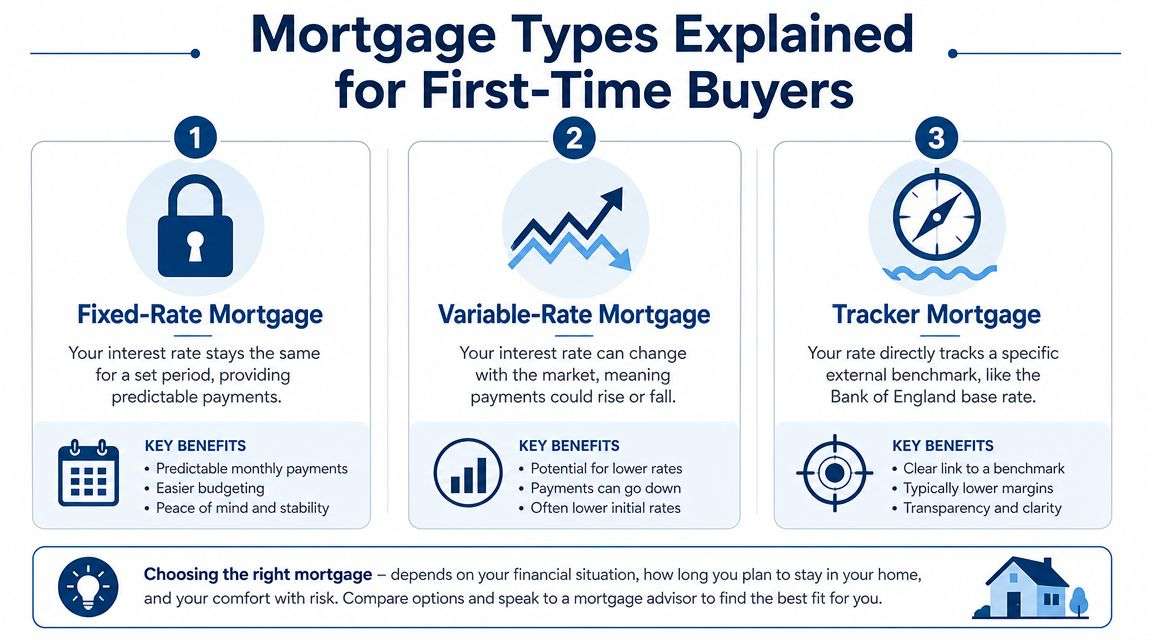
A fixed-rate mortgage means your interest rate stays the same for a set period. Your monthly payment stays predictable during that initial fixed term, which is why many first-time buyers prefer it.
In a higher-rate environment, the choice between a two-year fix and a five-year fix has become one of the biggest decisions a buyer makes. Some people want shorter-term flexibility. Others would rather lock in payment certainty for longer.
Tracker mortgages
A tracker mortgage follows an external benchmark, commonly the Bank of England base rate. If that benchmark changes, your mortgage rate changes too.
That can work well for a buyer who is comfortable with monthly payment movement and wants a product that may respond more directly to market shifts. It doesn’t suit everyone. If your budget is already tight, even a modest increase in payment can become uncomfortable quickly.
A tracker can be useful for the right buyer, but it only works if your budget has room for rates to move.
Standard variable rate mortgages
A lender’s standard variable rate, often shortened to SVR, is usually the rate you move onto when an initial product ends unless you remortgage or switch products. It can change at the lender’s discretion.
SVR is usually not where first-time buyers want to stay for long. It can be useful as a temporary fallback if you need flexibility and want to avoid locking into a new fixed deal immediately, but in most cases, buyers should understand what the reverting rate is before they take any initial mortgage offer.
Which type suits which buyer
A simple way to look at it:
Fixed-rate mortgage: best for buyers who value payment stability.
Tracker mortgage: best for buyers who accept changing payments.
SVR: usually a fallback position rather than a planned long-term choice.
The key is not to treat these products as interchangeable. The mortgage type affects how safe the payment feels month to month, and that matters just as much as the headline price.
Comparing Key Mortgage Deal Features
Here, the first-time buyer mortgage comparison becomes more useful. Once you’ve narrowed down the mortgage type, key differences between deals usually sit in the details.
Why the headline rate can mislead
The most useful benchmark when comparing mortgages is APRC, not just the headline rate. The Financial Conduct Authority stresses that a product with a lower initial rate can still cost more once arrangement fees, valuation fees and other charges are included, which is why like-for-like comparison matters, as explained in the FCA-style mortgage rate comparison guidance.
That’s why a fee-saver product can beat a lower-rate deal for one buyer, while the reverse is true for another. It depends on loan size, term, deposit and how long you’ll keep the mortgage.
Mortgage Feature Comparison for First-Time Buyers
| Feature | What It Is | Impact on Cost | Good to Know | EHF Insight |
|---|---|---|---|---|
| Arrangement fee | Fee charged for the mortgage product | Increases true cost, especially on smaller loans | A lower rate with a fee isn’t always better | Always add it into the initial deal period comparison |
| Valuation fee | Charge for the lender’s property assessment | Adds to upfront buying costs | Some deals include it, some don’t | Useful to check early if funds are tight |
| Cashback | Money paid back on completion | Can reduce upfront pressure | It doesn’t always mean the deal is cheaper overall | Treat cashback as one feature, not the deciding factor |
| Early repayment charge | Penalty for leaving the deal early or overpaying too much | Can be expensive if plans change | Important if you might move or remortgage soon | Flexibility matters as much as price |
| Reverting rate | Rate after the initial deal ends | Can increase later payments sharply | You need to know what happens after the fixed or tracker period | Never compare initial rate in isolation |
The features buyers often miss
Many buyers focus on the initial monthly payment and stop there. That’s risky. A proper comparison should also include:
How long you’ll keep the deal: if you expect to move or refinance during the initial period, fees and early repayment charges matter more.
Whether overpayments are allowed: useful if you expect income to improve and want flexibility.
Whether the mortgage is portable: important if a move is possible in the near future.
How the fee is paid: adding fees to the loan changes the total cost over time.
A lower rate with a hefty fee can lose its advantage surprisingly quickly if you’re only planning to keep the mortgage for a short initial period.

How Lenders Assess Your Eligibility
The best-looking mortgage on a comparison table is useless if the lender will not accept the case. Eligibility shapes the actual shortlist, and for first-time buyers, it often matters just as much as the headline rate.

Deposit and deposit source
Lenders look at two separate questions. How much deposit do you have, and where has it come from?
Deposit size affects the range of deals available, but buyers in Essex often find the source of funds causes the bigger delay. A deposit built up in savings is usually straightforward. A gifted deposit from parents can work perfectly well too, but the lender will want the gift confirmed, the money evidenced, and the solicitor satisfied that no repayment is expected. If any part of the deposit comes from a builder, that needs even more care because some lenders are stricter about incentives and purchase structure.
That interaction matters in practice. On a flat in Chelmsford or a starter home in Witham, a buyer with a smaller deposit and clean paperwork can be easier to place than a buyer with more money but an unclear gift trail.
Credit profile
Credit scoring affects more than a yes or no. It affects which lenders are realistic, how much they may offer, and whether the cheapest products are still available.
I see this regularly. Two first-time buyers can have similar salaries, similar deposits and be buying at a similar price point, yet one gets a wide choice, and the other is restricted because of missed payments, recent unsecured borrowing, heavy credit use, or a very thin credit file. Online best-buy tables do not show that difference.
A clean file helps, but lender interpretation varies. One late payment from years ago may be ignored by one lender and queried by another. Payday loan use, gambling transactions, or overdraft dependence can quickly narrow options.
Affordability and income
Affordability is where lender policy becomes very case-specific. Lenders assess income, regular commitments, childcare, travel costs, credit balances and general living expenditure. They also test whether the mortgage still looks affordable if rates rise.
This is often the point that changes the comparison entirely. A deal with the lowest rate is irrelevant if the lender will not use enough of your overtime, bonus, or commission income to secure the loan amount you need.
For Essex buyers, the three-way balance between overall cost, monthly payment and deposit becomes very clear here. A buyer purchasing at the upper end of their budget may need to make a larger deposit to keep the loan amount within policy limits. Another buyer may keep more savings back for legal fees, furnishing and moving house, then choose a slightly higher-rate product because the monthly payment still works and the case fits lender rules.
Non-standard income needs careful lender selection. Some lenders are more comfortable with probationary employment, maternity return-to-work cases, multiple jobs, or self-employed income with a shorter trading history. Others are noticeably better for buyers who need extended affordability.
“Extended affordability for a First-Time Buyer: Santander allowed the borrower to exceed 5x income on a newly built property, along with a builder’s deposit and other incentives. No other lender would help my clients.”
That is a good example of the trade-off. The lowest rate on the market was not the deciding factor. The successful lender was the one whose criteria matched the client, the property, and the incentive structure.
If you are buying a newly built home, the process has extra pressure points around deadlines, incentives and lender policy. Our guide to the new build home buying process explains those in more detail.
For a closer look at the buying process itself, this short video is useful:
Government Schemes and New Build Homes
Government support, savings products and builder incentives can change which mortgage is the better deal. A lower rate does not automatically win if the deposit is structured differently, the lender restricts incentives, or the monthly payment stops working once the full purchase costs are added up.
For first-time buyers in Essex, I usually bring the comparison back to three things. Overall cost, monthly payment, and deposit. Those three move together. Increase the deposit, and the rate may improve, but you might leave yourself short on legal fees, furnishing, and moving house. Choose a longer fixed term, and the payment may feel safer, but the total cost over the deal period can be higher. Use a gifted deposit or builder contribution, and the lender’s criteria become just as important as the product fee.
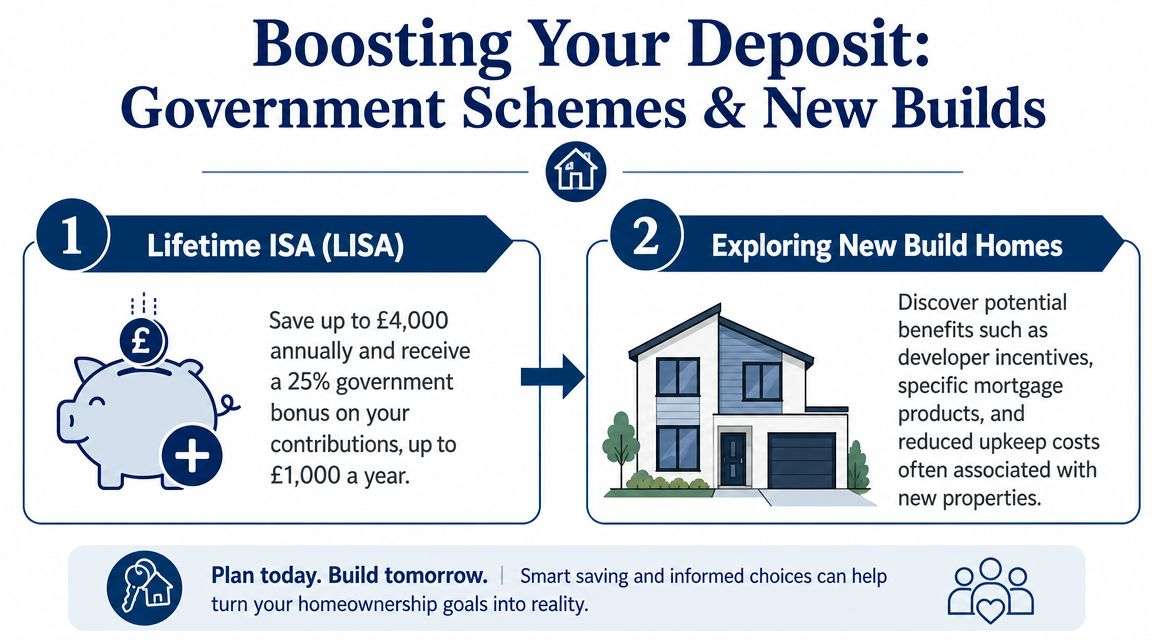
A Lifetime ISA can help with the deposit, but it does not solve affordability on its own. The lender still looks at income, credit profile, outgoings, the property, and where the deposit funds come from. Gifted deposits are common, but they must be properly evidenced, and some lenders are more straightforward than others when family support is involved.
New build mortgages need extra care
New build cases need closer scrutiny because the property, the timeline, and the lender’s policy all have to align.
A typical example is a buyer reserving a flat or house in Chelmsford or the wider Essex area with a 5% personal deposit, plus a builder incentive toward costs. On paper, one lender may show the cheapest monthly payment. In practice, that lender may reduce the acceptable incentive value, impose tighter loan-to-value limits, or struggle to meet the builder’s exchange deadline. Another lender with a slightly higher rate may accept the full structure and get the case through on time. That is often the better option because the purchase is complete.
The points I check first are usually these:
Developer incentives: cashbacks, deposit contributions and extras are not all treated the same by every lender.
Valuation approach: new builds can attract more cautious valuations, especially where incentives are involved.
Deadline pressure: reservation periods and exchange targets can be tight, so lender speed matters.
Property limits: some lenders are stricter for new-build flats, higher loan-to-values, or certain developments.
If you are buying from a developer, read our guide to the new build home buying process before you commit. It explains how the mortgage offer, reservation deadline and legal work need to stay in step.
Shared ownership and specialist structures
Shared ownership, family-assisted purchases and other specialist arrangements can help buyers get onto the ladder, but they add more moving parts to the comparison. Lease terms, rent, staircasing plans, deposit source and lender appetite all affect the deal. A product with a sharp headline rate can still be poor value if the lender is awkward on the lease, restrictive on gifted deposit rules, or too tight on affordability.
I also see cases where a buyer needs extended affordability on a new build or has a deposit made up from savings plus family help. Those are very workable cases, but only with the right lender. The best mortgage in that situation is the one that fits the property, the deposit structure and the buyer’s income pattern without causing delays at underwriting.
A Step-by-Step Checklist for Comparing Offers
The cheapest-looking mortgage often costs more.
Once the illustrations start arriving, compare each deal against the same three tests. What does it cost overall during the fixed period? What will the monthly payment look like in your actual budget? How much deposit does the lender need for that rate? Those three points move together, and a good comparison keeps all of them in view.
A practical five-step method
Line up the same facts for every lender
Use the same purchase price, deposit amount, term and income details each time. If one quote assumes a 10% deposit and another assumes a 15% deposit, it is not a fair comparison.Check the mortgage illustration line by line
Rate, monthly payment, product fee, valuation fee, cashback, early repayment charges and the rate after the initial deal period all matter. If you want help reading one properly, this guide to what a mortgage illustration is breaks down the key sections.Work out the cost over the period you expect to keep the deal
A two-year fix should be judged over two years. A five-year fix should be judged over five. Add the monthly payments for that period, then add any fees you will pay. Subtract cashback if it is genuine cash back to you.Check the payment against real life, not lender maths
Leave room for council tax, utilities, travel, food and a basic emergency buffer. I regularly see buyers approved for a payment they would rather not live with.Stress-test the awkward parts of the case
If the deposit is gifted, if income includes overtime or bonus, or if affordability is tight and you need a longer term, make sure the lender is comfortable with that before you treat the quote as usable.
A worked Essex example
Take a first-time buyer purchasing a flat in Colchester for £250,000 with a 10% deposit. The loan is £225,000.
Two deals might look like this:
Deal A: lower fixed rate, £999 product fee
Deal B: slightly higher fixed rate, no product fee
On a screen, Deal A often wins because the rate is lower. In practice, the answer depends on the loan size, the fixed period and how the fee is paid.
If the buyer chooses a two-year fix and adds the fee to the loan, the lower rate may only save a modest amount each month. That can leave Deal B cheaper overall across the two years, especially on a smaller loan. If the same buyer takes a five-year fix, or the loan is larger, Deal A may pull ahead because the monthly savings have more time to outweigh the fee.
That is the comparison that matters. Total cost first, monthly payment second, headline rate third.
Deposit size changes the options
A deposit affects more than whether a lender will say yes. It changes the deals available.
A buyer with 5% down may secure a mortgage, but the rate range is usually tighter than it is at 10% or 15%. A buyer with 15% down may get a lower rate, but tying up every spare pound in the deposit can leave nothing for legal costs, moving costs or the first broken boiler. I would rather see a buyer complete with a slightly higher rate and proper reserves than stretch the deposit too far and struggle in month one.
UK Finance has reported that the average first-time buyer deposit remains substantial in many parts of the country, which is one reason buyers need to compare deposit bands carefully rather than assuming a bigger deposit always produces the best overall outcome.
Cases that need a closer check
Some first-time buyer cases need more than a simple rate comparison.
A gifted deposit is a common example. One lender may accept a family gift with straightforward evidence. Another may ask more questions, limit who can gift, or move more slowly at underwriting. The same applies if you need a longer mortgage term to keep the payment affordable, or if part of your income comes from overtime, commission or a second job.
In those cases, the best deal is the one that gets through underwriting cleanly at a payment you can live with and a total cost that makes sense. That is a better result than chasing the sharpest rate on a deal that does not fit the case.
Quick sense check: if one mortgage only wins because the rate is lower, and loses on fees, payment comfort or deposit fit, keep comparing.
Why a Local Broker Makes the Difference in Essex
Essex buyers don’t all fit one neat profile. Someone buying in Chelmsford may have a family gift for the deposit. Someone in Braintree may be self-employed. Someone in Colchester may be buying a new build with incentives attached. The mortgage market doesn’t treat those cases the same way.
That’s where local advice matters. A broker comparing the wider market can filter by real lender criteria, not just by headline rate. That matters especially for buyers who don’t fit the standard online assumption of salaried income, perfect credit and a plain purchase.
Many first-time buyer guides assume a straightforward applicant, but a significant number of buyers have variable income or are self-employed. One of the most useful comparison points in those cases is whether lenders are more flexible on income proof, such as accepting one year of accounts instead of two, as noted in this housing guidance reference.
For buyers who want specialist support, these first-time buyer mortgage brokers can help properly assess the wider market.
A local broker also understands how affordability pressure shows up differently across Essex. In some cases, keeping the monthly payment manageable is the priority. In others, it’s getting the right lender for a gifted deposit, a new build, or a more generous affordability model. The best result often comes from aligning all three core comparison points. Overall cost, monthly payment and deposit.
If you’re ready to compare your options properly and want personalised advice from EHF Mortgages, the next step is simple. Get in touch: click the link below to make an appointment.





