
Buying in the UK while living abroad is more possible than often assumed. The surprise is that many applications don’t fail because the client is a non-resident. They fail because the case is initially assigned to the wrong lender.
💡 Top tip: if you can put down a larger deposit, your options usually improve sharply. That can mean access to lenders that would otherwise say no, and in some cases, better pricing too. I’ll explain why that matters later.
For anyone searching for a UK mortgage as a non-resident, the process can seem more intimidating than it really is. The rules are tighter, the paperwork is heavier, and lenders want clearer evidence. But with the right preparation, non-resident borrowing is absolutely achievable.
Your Guide to Securing a UK Property Investment
A high-street decline does not always mean the case is weak. It often means the case was presented to the wrong lender, with the wrong packaging, in the wrong order.
That is the part many overseas buyers do not see at first. A bank may say no because the salary is paid in dirhams, bonuses make up too much of the total income, or the deposit has come from several family and savings accounts. A specialist lender may still say yes once those points are documented properly and the underwriter can follow the story from income to deposit to property.
I see this regularly with non-resident investors looking at property in Essex. One applicant can have strong income, a sensible deposit, and a clean credit profile in their home country, yet still hit a wall with a mainstream lender because there is no UK credit footprint or the documents have not been translated to the lender’s standards. The solution is rarely guesswork. It is about choosing a lender whose criteria match the case and presenting the file in a way that answers the underwriter’s questions before they ask.
What usually makes or breaks the application
Lenders tend to focus on five pressure points:
Deposit strength: larger deposits usually widen lender choice and reduce pricing pressure.
Income evidence: the lender needs to see how income is earned, how consistent it is, and whether the documents support it.
Country of residence: Some countries are acceptable to one lender and excluded by another.
Property strategy: a long-term let, holiday let, or home for family use can lead to very different lending options.
Paper trail: bank statements, certified ID, translations, and source-of-funds evidence need to line up cleanly.
A case can look good on paper and still fail if one of those areas is weak.
The wider UK mortgage market is large, but non-resident lending sits in a narrower part of it. That matters because success depends less on broad market size and more on lender fit. The practical question is not whether money is available in the UK. The practical question is which lender will accept your residency, income type, deposit trail, and property plan without forcing the case into criteria it does not meet.
If you are buying from overseas in Chelmsford, Braintree, Colchester, or elsewhere in Essex, start with underwriting logic rather than headline rates. The cheapest deal on a comparison table is no use if the lender will decline foreign currency income, reject gifted deposits, or stall on overseas bank statements. A broker adds value by closing that gap between the first no and the right yes.
Are You Eligible for a UK Non-Resident Mortgage
Eligibility is rarely about one single box being ticked. Lenders look at the whole profile, then decide how comfortable they are with the risk.
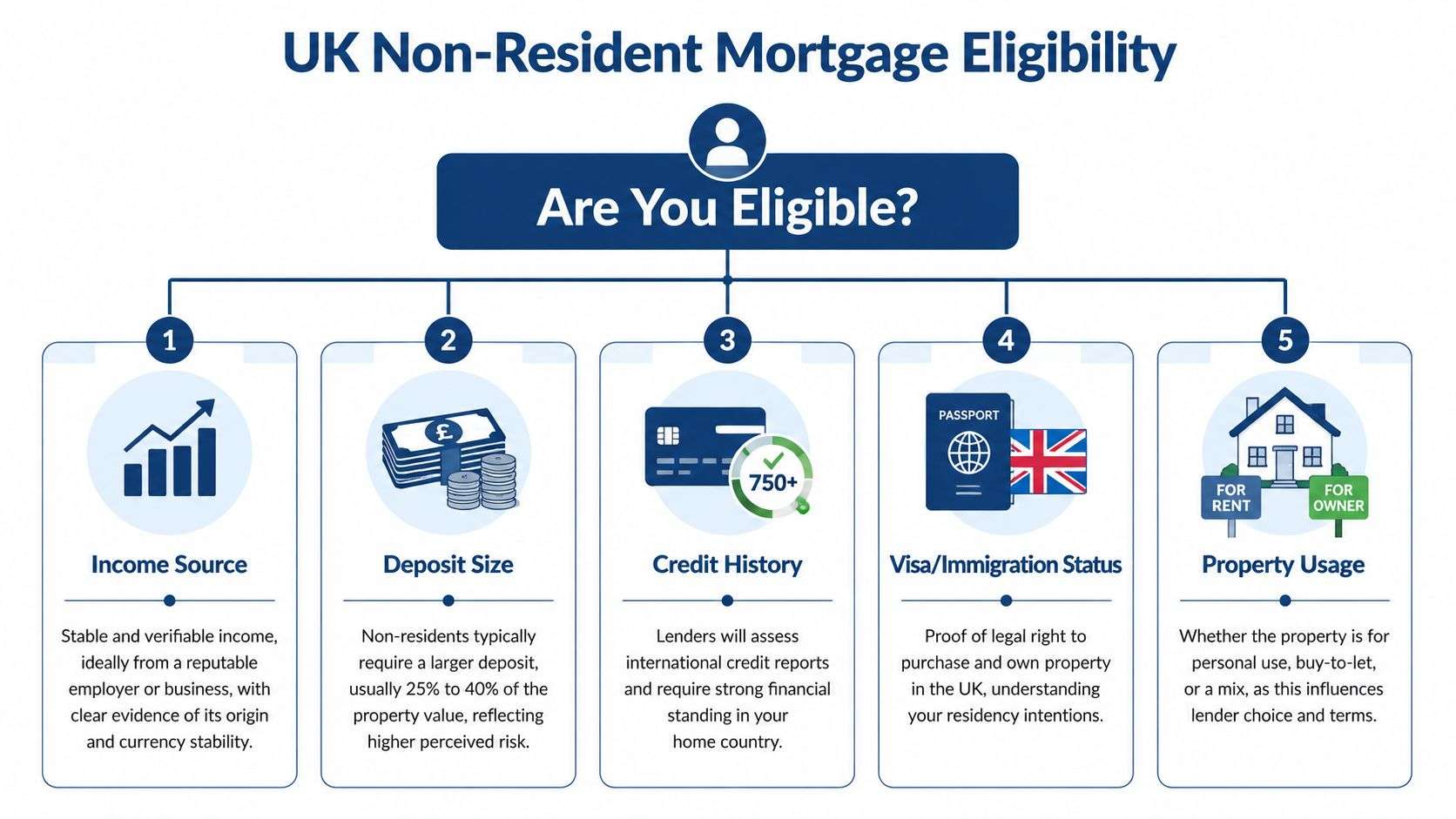
The core lender tests
For many applicants, the starting point is whether the lender even accepts residents of the country they live in. That can be an immediate pass-or-fail issue before income is reviewed.
One useful benchmark comes from HSBC’s non-UK resident mortgage criteria. According to HSBC UK’s 2026 criteria for non-residents, applicants must reside in an approved country, have a minimum annual income of £75,000, and typically can borrow up to 75% loan-to-value, meaning a 25% deposit.
That doesn’t mean every lender uses the same thresholds. It does show how mainstream lenders think about risk in this area.
What lenders look at in real life
The most important questions usually look like this:
Where do you live now? If you’re based in a country the lender doesn’t support, the case often stops there.
What does your income look like: salaried income from a recognisable employer is usually easier to place than income spread across dividends, consulting, and foreign contracts.
Can the deposit be proved cleanly? Lenders want a clear audit trail for every major contribution.
Do you have UK ties: visa status, time spent in the UK, and future plans can all affect lender appetite.
What are you buying: a home to live in and an investment property are not treated the same.
A non-resident case becomes easier when the lender can understand it quickly.
Common eligibility misunderstandings
Many applicants assume that no UK credit history means no mortgage. That isn’t always true. It does reduce mainstream options, but it doesn’t automatically end the case.
Another common misunderstanding is around income. High income helps, but lenders still need it to be stable, verifiable, and acceptable in the context of the country and currency involved. A high figure on paper won’t rescue a case if the evidence is weak.
For buyers with long-term visas or stronger UK connections, lender choice can improve. For buyers with no UK footprint, lender selection becomes even more important.

Finding the Right Lender and Loan Type
The right lender can turn a non-resident case from an instant decline into a workable approval.

For non-resident borrowers, the biggest mistake is applying by brand recognition. High street names are familiar, but that does not mean they are suitable. Lender choice depends on where you live, how you earn, what currency you are paid in, the property type, and how clearly the paperwork supports the case.
I often see clients come to us after a bank has said no, assuming the whole market will say the same. That is rarely true. More often, the first lender was the wrong fit.
How the lender types compare
| Lender type | Best suited to | Main strength | Main trade-off |
|---|---|---|---|
| High street bank | Clean, straightforward cases | Pricing can be competitive | Criteria can be rigid |
| Specialist lender | Complex income or residency | More flexible underwriting | Rates and fees can be higher |
| Private bank | High-value or asset-backed cases | Tailored approach | Usually needs larger assets or income |
| Building society | Niche scenarios | Manual assessment | Smaller lending ranges and tighter geography |
The gap between a high street no and a specialist yes usually comes down to policy, not risk alone. One lender may outright decline foreign-currency income. Another may accept it if the currency is stable, the income history is consistent, and the exchange route is clear. One may reject an applicant with no UK credit footprint. Another may rely more heavily on overseas credit, profession, and deposit strength.
That is why lender research matters so much in this part of the market.
Where high street lenders usually fit
High street lenders tend to work best where the case is easy to explain. Salaried income from a recognised employer, a standard property, a good deposit, and a country of residence already on the lender’s accepted list can produce very good terms.
A recent case involved an Italian client buying a London flat. She worked for a large organisation, had a high income, and was putting down around 35% of the purchase price. The challenge was not affordability on paper. It was placing the case with a lender willing to look past the lack of previous UK residence and focus on the full picture. In that scenario, a high-street lender was the right fit for the case, and the mortgage was completed for over £500,000.
Clean cases belong in the mainstream if the criteria line up. Forcing a more complex case into a mainstream box usually wastes time.
Where specialist lenders earn their place
Specialist lenders are often the solution where the facts are sound, but the presentation needs more care. That includes self-employed applicants with overseas company accounts, contractors paid through different structures, clients buying unusual properties, and borrowers paid in currencies that some banks will not accept.
In those cases, the job is not just about finding a lender with a broader policy. It is packaging the application so the underwriter can quickly follow the story. Bank statements need to clearly show salary credits. Tax documents need to match the income used. If funds have been converted, the costs and trail should make sense. Even small issues, such as unexplained transfers or inconsistent employer references, can slow a case down.
Currency is a good example. Lenders do not only look at the headline income. They also look at what arrives after conversion and whether exchange costs affect affordability. Suby on PayPal currency fees gives a useful example of how conversion charges can eat into the amount that lands, which matters when an underwriter is checking net position and payment history.
If your case sits outside standard bank policy, a broker should know which specialist mortgage lenders for complex non-resident cases are worth approaching and which ones will decline it on first review.
A quick overview of the buying route is helpful here:
Choose the lender based on policy fit, not on headline rate alone. The best outcome usually comes from the lender most likely to understand the case the first time.
Deposit and Affordability: What You Need to Prepare
For non-resident applicants, the deposit is not just a contribution. It is one of the clearest signs of risk to the lender.
A small deposit narrows the choice quickly. A stronger deposit usually gives the underwriter more comfort, especially where the applicant has foreign income or a limited UK history.
Why does the deposit carry so much weight
Mainstream and specialist lenders both want to know how exposed they are if the case becomes difficult. A larger deposit reduces that exposure.
For buy-to-let, the benchmark is clear. Wise’s guide to non-resident buy-to-let mortgages states that lenders typically require a minimum 25% deposit and will stress-test the rental income so that it covers 125-145% of the mortgage payment at a notional rate.
That has two practical effects. First, you need enough cash to meet the lender’s minimum equity requirement. Second, the property itself must generate sufficient income to pass the stress test.
“Because our client’s deposit was around 35% of the purchase price, we were able to approach a High Street lender… her employment, good income, but importantly, the deposit, were crucial to her success.”
Affordability is wider than salary
For residential borrowing, affordability is based on your income and outgoings, but lenders often look harder at overseas earnings. They want to know whether the income is regular, whether the currency is acceptable to them, and whether the documents line up cleanly.
For buy-to-let, the rent itself takes centre stage. Even a high-earning client can hit a wall if the expected rent doesn’t pass the lender’s stress test.
Broker’s view: the case usually gets stronger when deposit, income, and paperwork all support each other. One strong area won’t always fix a weak one.
What to prepare before applying
Focus on the points lenders test first:
Deposit trail: show where the funds came from and how they moved.
Income evidence: salary, accounts, contracts, or tax documents need to tell a consistent story.
Currency awareness: exchange rates and transfer fees can affect how funds appear on statements. If you’re moving money across borders, this guide to PayPal currency fees and conversion costs is useful for understanding how transfer charges can distort the paper trail.
Borrowing sense-check: before viewing a property seriously, run the figures through a proper mortgage affordability guide.
Clients often underestimate how much trouble an unclear deposit trail causes. The money may be perfectly legitimate, but if the statements are hard to follow, incomplete, or in mixed formats, the lender can’t move forward with confidence.
Your Essential Documentation Checklist
Most non-resident applications are document-heavy. The lender must verify identity, income, deposits, and source of funds to standards that satisfy underwriting and anti-money-laundering checks.
The biggest practical issue is usually not income. It’s the deposit evidence. Overseas statements can be difficult to read, may be in another language, and often don’t show the transaction history in the format a UK underwriter expects.
Non-Resident Mortgage Document Checklist
| Document Category | Required Documents | Purpose | Key Consideration |
|---|---|---|---|
| Identity | Passport, visa or residency evidence where relevant | Confirms identity and legal status | Names and dates must match exactly |
| Income | Payslips, employment contract, tax returns, company documents if self-employed | Shows affordability and income stability | Foreign documents may need clear translation |
| Banking | Recent bank statements | Verifies income receipt and spending pattern | Statements must be readable and complete |
| Deposit | Savings statements, sale evidence, gift evidence where relevant | Proves funds are available and traceable | Source of funds must be clear from start to finish |
| Address and credit support | Proof of address and any foreign credit evidence available | Supports identity and profile assessment | Consistency across countries and formats matters |
What lenders are really checking
Lenders are not just collecting paperwork for the file. They are checking whether the documents tell one coherent story.
That means:
Identity consistency: your name, address history, and date details need to match across all documents.
Income consistency: what appears in your bank statements should make sense against payslips, contracts, or accounts.
Deposit consistency: if money was moved between accounts, gifted, or built up over time, the paper trail needs to show that clearly.
Poorly presented documents can make a good case look risky.
Where delays usually happen
Three issues crop up repeatedly:
Statements in another language without a clear translation.
Large incoming credits that are not explained.
Partial bank records that cut off key transactions.
If the application is being prepared properly, these can usually be fixed before submission. That’s far better than waiting for the lender to raise them later, because by that stage the file often slows down sharply.
Tax and Legal Considerations for 2026
Mortgage approval and tax planning often overlap more than borrowers expect. The legal right to buy property is one thing. Showing lenders a clean and understandable financial profile is another.
One development worth noting is the effect of tax reform on underwriting. Enness Global’s note on UK mortgages for non-residents explains that the April 2025 abolition of the non-dom tax regime has indirectly tightened access to mortgages, with lenders applying enhanced source-of-funds scrutiny to non-residents with mixed UK-foreign income streams.
Why this matters in practice
If your income or assets span more than one country, lenders may ask more questions than they would have previously. That doesn’t mean the case is unworkable. It means the file needs to be better organised from the start.
For self-employed applicants and business owners, keeping tax records in order becomes even more important. If you’re tracking upcoming compliance changes, this guide to key MTD dates for UK businesses is a useful supplementary read.
You should also budget carefully for purchase costs before applying. Anyone buying an investment property should review how the duty side works, and a stamp duty on BTL calculator is a sensible place to sense-check that part of the numbers.
Legal ownership can be straightforward. Explaining the money behind it is where the real work often sits.
Common Pitfalls and Expert Solutions
The most common mistake is applying to the first recognisable lender instead of the right lender. Non-resident cases are less forgiving than standard UK applications. If the lender’s system doesn’t like the country, credit profile, or income structure, the case may fail before a human really assesses it.

A major pressure point is UK credit history. Skipton International’s non-resident mortgage guide cites a 2025 survey finding that up to 70% of non-resident buy-to-let inquiries are rejected by mainstream lenders due to a lack of a UK credit file. That is exactly why lender selection matters so much.
The pitfalls I see most often
Wrong lender first: an instant decline can waste valuable time.
Untidy source-of-funds evidence: the money may be fine, but the proof isn’t.
Overconfidence on affordability: overseas income often needs more explanation than clients expect.
Assuming all banks treat non-residents the same: they don’t.
What usually fixes the case
The answer is usually not magic. It is matching the application to the lender that wants it, then packaging the file properly.
That matters whether the property is in London, Chelmsford, Braintree, Colchester, or elsewhere in Essex. The successful cases are usually those where the deposit is sensible, the paperwork is organised, and the lender’s choice reflects the borrower’s real profile rather than their preferred brand.
If you’ve got what you needed from this guide and you’re ready to discuss your own options, speak to EHF Mortgages. They can help you understand which lenders are realistic for your circumstances and what to prepare before you apply.





