
💡 Top tip: Get a Mortgage Agreement in Principle (AIP) before you even start looking at properties. Having this one document in hand shows sellers and estate agents that you’re a serious, credible buyer and tells you exactly what your budget is. We’ll explain more about why this is so important later in the article.

Your First Step To Buying a Home in 2026
Stepping onto the property ladder is one of the most exciting journeys you can take, but it’s easy to feel a bit lost at the start. That’s where a Mortgage Agreement in Principle, also known as an AIP or a Decision in Principle (DIP), comes in. It’s the very first step that turns you from a casual window shopper into a genuine buyer.
Think of an AIP as your ‘green light’ for house hunting. It’s a formal statement from a mortgage lender confirming that, based on an initial check of your finances, they are prepared to lend you a specific amount. This gives you a crystal-clear budget so that you can search for your new home with real confidence.
Navigating This Guide
To help you find exactly what you need, we’ve broken this guide down into key sections. Feel free to use the links below to jump straight to the information you’re looking for.
Why an AIP is Crucial in Competitive Markets
In fast-moving property markets like those in Chelmsford and Colchester, an AIP gives you a real competitive edge. When a seller has several offers on the table, they’ll always lean towards the buyer who has already proven they can secure the necessary finance.
An AIP shows you are organised, motivated, and ready to move forward. For those just starting, getting expert legal advice is also a smart move. You can learn more about services for first-time homebuyers to make sure you’re fully prepared for the process ahead.
Taking this first step sets you up for a much smoother journey, from your first viewing in Essex right through to getting the keys. Now, let’s dive into what an AIP really is and what it means for you.
So, What Exactly Is a Mortgage Agreement in Principle?
A Mortgage Agreement in Principle (AIP), which you might also hear called a Decision in Principle (DIP), is an official thumbs-up from a lender. It’s a statement confirming, in principle, how much they’d be willing to lend you for a property after taking an initial look at your finances. Getting one is the moment you transform from a casual house browser into a serious, credible buyer.
Think of it this way: using online mortgage calculators is like window shopping. An AIP, on the other hand, is like walking into the shop with a pre-approved line of credit. It’s a proper financial check, not just a back-of-the-envelope guess.
This is a game-changer, especially for first-time buyers in a hot market. If you’ve found the perfect place, having an AIP in your back pocket shows the estate agent and seller that you mean business. In fact, 78% of successful first-time buyers had an AIP before making their offer, a huge jump from the 42% of those who did not.
From Initial Check to a Clearer Budget
So, what does a lender actually look at to produce an AIP? It’s more than just plugging numbers into a calculator. A lender will perform a genuine assessment, reviewing your income, your regular outgoings, and the size of your deposit.
This usually involves a ‘soft’ credit check, which is a surface-level look at your credit history that won’t leave a footprint on your file for other lenders to see. Based on all this, they’ll give you an estimated borrowing figure. This number gives you a solid, realistic budget, helping you avoid the disappointment of falling for a home that’s just out of reach. For a deeper dive into how lenders calculate this, check out our guide on how much mortgage you could borrow.
It’s important to remember, though, that an AIP is just the first major step. It’s a strong signal, but it is not a legally binding guarantee of a mortgage.
AIP vs Mortgage Offer: What’s the Difference?
It’s easy to confuse these two, but an AIP and a formal mortgage offer are completely different. Think of the AIP as a provisional green light. The full mortgage offer is the legally binding contract that provides the funds actually to buy the property.
That final offer only comes after a much more rigorous process, which we’ll break down in the next section.
AIP vs Mortgage Offer: Understanding the Key Differences
It’s one of the most common points of confusion for homebuyers, but getting it right is crucial. An Agreement in Principle (AIP) and a formal mortgage offer might sound similar, but they play very different roles in your property journey. Mixing them up can lead to a lot of unnecessary stress and disappointment down the line.
Let’s break it down with an analogy. Think of an AIP as being shortlisted for a job interview. It shows you’re a serious contender and have what it takes on paper. A full mortgage offer, on the other hand, is a signed employment contract. It’s the official, legally binding commitment.
The Preliminary Step vs The Final Commitment
An AIP is really an initial thumbs-up from a lender. They take a look at the basic information you’ve provided, your income, your outgoings, and your deposit, and give you an estimate of what they might be willing to lend you. This step often only involves a ‘soft’ credit check, which is great because it won’t leave a mark on your credit file.
A full mortgage offer is a different beast altogether. This is the real deal, a legally binding promise from the lender to give you the money. It only comes after their underwriters have gone through your finances with a fine-tooth comb. We’re talking about verifying every payslip and bank statement and running a ‘hard’ credit check that is recorded on your credit report.
The process is a dual one, starting with the initial assessment for the AIP before moving towards a full application.
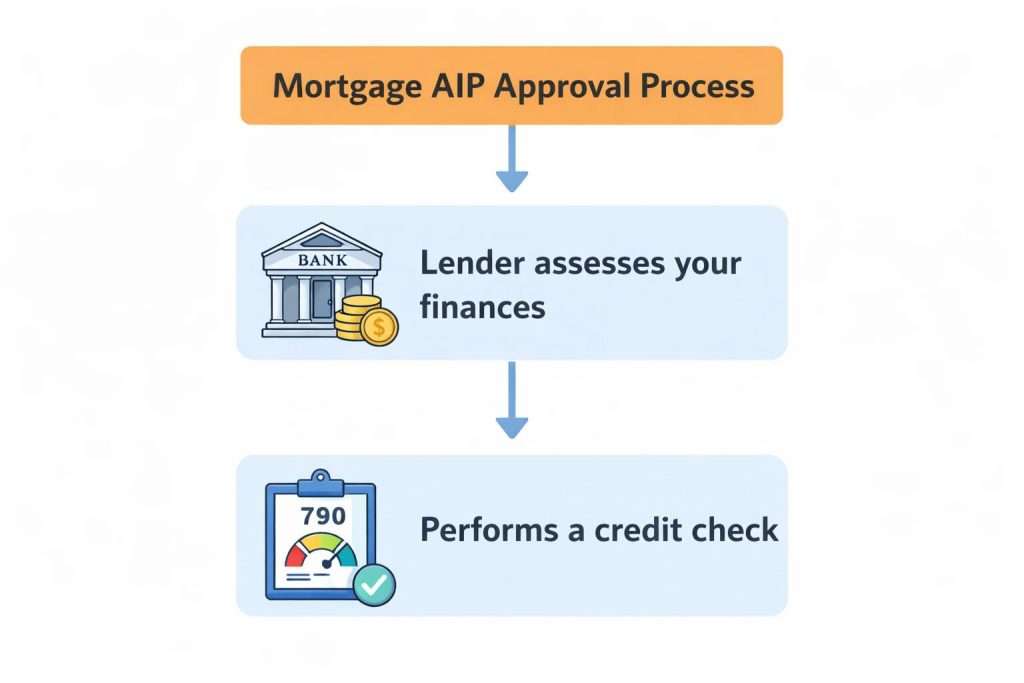
Another critical difference is that a mortgage offer is tied to a specific property. A lender will not give you a binding offer until they’ve had the property you want to buy professionally valued. An AIP isn’t tied to any property, but the offer is entirely dependent on the lender being happy with the home itself, whether it is in Braintree or Chelmsford.
Agreement in Principle vs Full Mortgage Offer at a Glance
To make the distinction crystal clear, this table directly compares the key characteristics of a Mortgage Agreement in Principle (AIP) and a formal Mortgage Offer. It will help you understand their purpose and limitations at different stages of your home-buying journey.
| Feature | Mortgage Agreement in Principle (AIP) | Full Mortgage Offer |
|---|---|---|
| Purpose | Estimates your borrowing potential and shows sellers you’re a serious buyer. | A formal confirmation that the lender will provide the funds for a specific property. |
| Commitment | Not legally binding. It’s an indication, not a guarantee. | A legally binding commitment from the lender to you. |
| Checks | Based on an initial financial review, often using a ‘soft’ credit check. | Requires full, in-depth underwriting, including a ‘hard’ credit check and document verification. |
| Property Specificity | Not tied to a specific property. | Only issued for a specific property after a satisfactory valuation has been completed. |
In short, the AIP gets your foot in the door, while the full mortgage offer is the final, official green light. Understanding this sequence helps you manage your expectations and navigate the buying process with confidence.
How Lenders Assess Your Agreement in Principle
So, you’ve decided to get a Mortgage in Principle. But what actually happens behind the scenes? When you apply, a lender takes a peek into your financial life to work out whether you’re a good candidate for a mortgage and, if so, how much they might be willing to lend you.
This isn’t just a finger-in-the-air guess. Lenders use a defined process to arrive at a figure, combining automated checks with their initial underwriting rules. Think of it as them building a financial snapshot of your reliability before they commit to a full, in-depth investigation later on.

Soft Checks vs Hard Checks
A crucial part of this process is the credit check, and it’s vital to know which type of check a lender will use. There are two kinds:
Soft Credit Check: This is the most common type of credit check for an AIP arranged through a mortgage broker. It gives the lender a top-level view of your credit history without leaving a visible footprint on your report. Other lenders cannot see it, so it will not affect your credit score.
Hard Credit Check: Some lenders, particularly if you apply to them directly, will perform a hard check. This is a much deeper dive into your credit history, and it leaves a mark on your credit report that other lenders can see. Racking up too many hard checks in a short time can lower your credit score, as it might look like you’re desperately seeking credit.
Working with a broker like EHF Mortgages ensures we stick with lenders who only perform soft checks for the AIP stage. This protects your credit file while giving you the budget clarity you need to start house-hunting. Lenders will primarily assess your financial health, including the factors that affect your credit rating.
The Information Lenders Scrutinise
To calculate your potential borrowing amount, lenders need a clear picture of your finances. They’ll ask for specific details to feed into their affordability models, and the information you provide is the bedrock of your AIP.
It is not a binding offer, and its accuracy is only as good as the data you give it. The final figure can sometimes change. While accuracy often hovers around 85-90%, about 15% of AIPs see adjustments after a full property survey reveals unexpected issues.
Lenders use all this data to apply an income multiple, typically around 4.5 times your annual salary, to get a baseline figure. From there, they’ll adjust this amount based on your fixed outgoings and the size of your deposit. The deposit size also determines your Loan to Value (LTV), which you can learn more about in our guide to the loan-to-value ratio.
The Benefits and Limitations of a Mortgage AIP
Getting an Agreement in Principle (AIP) is one of the smartest first moves you can make when you decide to buy a property. Think of it as a dress rehearsal for your mortgage application. It gives you a huge confidence boost and a serious advantage in a busy market, but it’s just as important to know what it cannot do.
An AIP transforms you from a window shopper into a ready-to-go buyer. You’ll have a clear idea of your budget, so you can stop dreaming about properties you cannot afford and start focusing on the ones you can. More importantly, it shows estate agents in competitive areas like Braintree and Colchester that you mean business. When they see you have an AIP, they know you’re not just kicking tyres, you’re a credible buyer who is ready to make a move.
The Key Advantages of an AIP
Securing an AIP before you start house-hunting properly really does shift the goalposts. It’s what takes you from being a spectator to a genuine contender in the property market.
Establishes Your Budget: An AIP gives you a clear, lender-approved estimate of what you can borrow. This stops you from wasting time viewing homes that are financially out of reach.
Boosts Your Credibility: It’s proof that a lender has run the initial numbers and is happy to consider lending to you. Sellers and estate agents will immediately see you as a serious prospect.
Gives You a Competitive Edge: Imagine a seller has two similar offers on the table. The buyer with an AIP already in place almost always goes to the top of the pile.
For property investors in Essex juggling complex buy-to-let portfolios, an AIP is essential for moving on deals quickly. In fact, data shows 72% of BTL investors with an AIP successfully negotiated 5-7% below the asking price, compared to just 3% of those without. You can find more insights on why an AIP is a crucial first step for home buyers on unbiased.co.uk.
Understanding the Limitations
While it’s a powerful tool, an AIP isn’t a cast-iron guarantee of a mortgage. You have to be realistic about its limitations.
“An Agreement in Principle is your golden ticket to the property market, but it’s not the deed to the house. It proves you’re a serious player, but the final whistle only blows with a formal mortgage offer.”
An AIP is not a legally binding contract. A lender can still change their mind, and knowing why helps you stay one step ahead. It’s estimated that around 10-12% of AIPs don’t convert into a full mortgage offer at the final underwriting stage.
This can happen if:
Your financial situation changes (e.g., you change jobs, take out a new car loan, or build up credit card debt).
The full underwriting process uncovers something unexpected, often because documents like payslips or bank statements do not quite match the initial application.
The property valuation comes in lower than the price you’ve offered.
This is exactly where an experienced broker makes all the difference. We know what lenders are looking for and can spot these potential roadblocks from a mile off, helping you build a rock-solid application from day one.
Your Step-by-Step Guide to Getting an AIP
Getting your mortgage Agreement in Principle might sound like a huge hurdle, but it is a surprisingly straightforward process when you have the right support. When you work with a broker like EHF Mortgages, we turn what can feel like a complex task into a clear, manageable plan. We’ll handle the heavy lifting so you can focus on the exciting part: finding your perfect home.

Here’s a simple five-step guide to obtaining your AIP through us.
Step 1: Initial Consultation
The journey starts with a free, no-obligation chat. This is our opportunity to get to know you and understand your specific circumstances. Whether you’re a first-time buyer in Chelmsford, a landlord looking to expand your portfolio, or exploring later-life lending, we listen carefully to build a complete picture of your goals.
Step 2: Gathering Your Documents
To get an accurate AIP, we’ll need to review some key financial documents. Having everything ready beforehand makes the entire process quicker and smoother.
Typically, we’ll ask for:
Proof of ID: A valid passport or driving licence.
Proof of Address: A recent utility bill or bank statement will suffice.
Proof of Income: Your last three months’ payslips and your most recent P60.
Bank Statements: Usually, the last three months’ worth give a snapshot of your finances.
If you’re self-employed or have a more complex income structure, do not worry. We’ll guide you on exactly what’s needed, such as your SA302s or company accounts.
💡 Top tip: It would be worth obtaining a copy of your credit report, just to ensure that there are no credit issues in the background that may end up with a declined mortgage request – use CheckMyFile to obtain a copy of your credit report and ensure you are on top of your financves
Step 3: Broker Assessment and Market Search
Once we have your information, our expertise really comes into play. We assess your financial profile against lender criteria from across the entire market, which includes both high-street banks and specialist lenders you might not find on your own.
This whole-of-market access is a massive advantage. We can pinpoint the lenders most likely to view your application favourably, saving you time and protecting your credit score from unnecessary hard checks. If you are unsure how to choose the right expert, our guide to choosing a mortgage broker can help.
Step 4: Submitting the AIP Application
Once the best lender is identified, we handle the application for you. We make sure every detail is presented correctly to minimise any risk of delays or rejections down the line. It is at this stage that our experience with unique and complex cases truly shines.
Step 5: Receiving Your AIP Certificate
After submission, the lender will issue the AIP certificate, which usually arrives within 24-48 hours. This document confirms the amount they are prepared to lend in principle and is typically valid for 30 to 90 days.
And just like that, you have the official backing you need to start making confident offers on properties.
Frequently Asked Questions About Mortgage AIPs
It’s only natural to have a few questions when you’re navigating the mortgage process. To help you move forward with confidence, we’ve put together some quick, clear answers to the most common queries we hear about the Agreement in Principle.
How Long Does a Mortgage Agreement in Principle Last?
An AIP is typically valid for 30 to 90 days, though this varies by lender. If it expires before you’ve had an offer accepted on a property, do not panic; it can usually be renewed quite easily.
Just bear in mind that a renewal might trigger a fresh look at your finances or even a new credit check. A good broker will help you manage the timing perfectly, ensuring there’s no unnecessary hassle and your buying power stays strong right when you need it.
Does Getting an Agreement in Principle Affect My Credit Score?
This is a crucial question, and the answer is: it depends on the lender’s approach.
Soft Check: Most brokers and many lenders use a ‘soft’ credit check to produce an AIP. This type of search isn’t visible to other lenders and does not affect your credit score.
Hard Check: Some lenders, particularly if you apply to them directly, will run a ‘hard’ credit check. Making multiple applications within a short period can negatively impact your credit file.
This is exactly why working with an experienced broker is so valuable. We know which lenders use soft checks, allowing us to establish your budget while keeping your credit file protected.
Can My Mortgage Agreement in Principle Be Withdrawn?
Yes, an AIP is not a legally binding promise and can be withdrawn by the lender. This might happen if your financial circumstances change, for example, if you take on new debt or switch jobs.
It could also be cancelled if something unexpected crops up during the full mortgage application, or if the property valuation comes in lower than the price you have offered.
Ready to take the next step towards your new home with clarity and confidence? EHF Mortgages can help you secure the best Agreement in Principle for your situation.





