
💡 Top Tip: Get your mortgage ‘Decision in Principle’ before you even start house-hunting. It proves to sellers you’re a serious buyer and gives you a clear budget. We’ll explain more about this golden ticket later in the article.
Table of Contents
- What a First-Time Buyer Mortgage Broker Actually Does
- The Real Benefits of Using a Broker for Your First Mortgage
- Your Step-by-Step Mortgage Journey with a Broker
- Navigating First-Time Buyer Schemes and Common Pitfalls
- How to Choose the Right Mortgage Broker in Essex
- Your Questions About First-Time Buyer Mortgages Answered
Your 2026 Journey to Homeownership Starts Here
Buying your first home is one of those huge life moments. The idea of getting the keys to your own place in Chelmsford or anywhere else in Essex is incredible, but let’s be honest – the path to get there can feel like a maze of interest rates, lender rules, and confusing jargon. It is completely normal to feel a mix of excitement and nerves.
This guide is here to cut through the noise and turn that confusion into confidence. We’ll show you how a specialist first-time buyer mortgage broker acts as your personal guide, walking you through every single step, from working out your budget to picking up the keys. Think of a broker as the most valuable person on your team.

To help you navigate your home-buying journey, it is also a great idea to have a solid first-time house-buying checklist on hand to keep everything organised.
“For the majority of buyers, securing a mortgage is the most critical part of the home-buying puzzle. For first-time buyers, this figure rises to over 90%, making expert guidance more important than ever.”
Sorting out your first mortgage does not have to be a nightmare. With the right person in your corner, you can walk into the property market feeling confident, knowing you have an expert finding the best possible deal for your situation.
What a First-Time Buyer Mortgage Broker Actually Does
Think of a mortgage broker as a personal shopper for your first home loan. Instead of you spending endless hours knocking on the digital doors of every bank and building society out there, a specialist first-time buyer mortgage broker brings the entire market straight to you. Their job is to take a complicated and frankly overwhelming process and make it simple and successful.
A good broker is much more than just a deal-finder; they are your professional guide, translator, and advocate all rolled into one. They start by getting a crystal-clear picture of your finances – your income, outgoings, deposit savings, and credit history. This deep dive is vital because it lets them match you with lenders whose criteria you can actually meet.
For instance, if you’re self-employed or have a smaller deposit, many high-street banks might show you the door. A great broker knows exactly which lenders are more flexible and have an appetite for applicants in your specific situation, saving you from the sting of rejection.
Whole of Market / Independent Access vs Tied Brokers
It is so important to understand that not all mortgage advisers are created equal. The main difference comes down to the range of products they can offer you, which directly impacts the kind of deal you will get for your first home in places like Braintree.
A ‘tied’ or ‘multi-tied’ adviser, the kind you will often find in a bank, can only offer products from one lender or a very small, hand-picked panel. This massively limits your choices. In stark contrast, a ‘whole-of-market’ broker has access to thousands of mortgage products from a wide range of lenders across the UK.
Here is a quick comparison that shows why this matters so much for first-time buyers:
| Feature | Tied Adviser (e.g., Bank) | Whole-of-Market Broker |
|---|---|---|
| Product Range | Restricted to one lender’s products | Access to thousands of deals |
| Best Rate | Only the best from their limited selection | The best from the entire market |
| Specialist Lenders | Usually no access | Can connect with niche lenders |
| Exclusive Deals | No, just standard products | Yes, often have broker-only deals |
This broad access means a whole-of-market broker can frequently find more competitive interest rates and deals than you can by going direct. These are often **’intermediary-only’ deals**, which lenders reserve exclusively for brokers.
“A whole-of-market broker works for you, not the lender. Their duty is to find the most suitable mortgage for your circumstances from the entire marketplace, ensuring you get unbiased advice and the best possible terms.”
Your Personal Mortgage Strategist
Beyond finding great rates, a broker’s job is to translate dense financial jargon into plain English. They will explain the difference between a fixed and a tracker mortgage, what ‘LTV’ means for your interest rate, and how different product fees can affect the total cost of your loan.
They handle all the tedious paperwork, chase the lender on your behalf, and solve problems before they can slow your application down.
Essentially, they quarterback the entire process from that first chat through to completion day. For first-time buyers in towns like Colchester, having this expert in your corner turns a potentially stressful ordeal into a clear, managed, and even exciting journey.
The Real Benefits of Using a Broker for Your First Mortgage
Knowing what a broker does is one thing, but understanding the real-world difference it makes is another entirely. For a first-time buyer, the advantages of working with a specialist broker go way beyond just finding a mortgage; it is about saving you time, money, and a huge amount of stress during one of the biggest purchases of your life.
Let’s get into why it is such a game-changer.
The most obvious benefit is the sheer amount of time you save. Instead of you spending countless hours – or even weeks – researching lenders, trying to compare confusing rates, and painstakingly filling out one complex application after another, your broker does all the heavy lifting. They manage the whole process, from submitting the application to chasing up solicitors and the lender’s underwriters.
This is a massive help, especially in a busy property market. In 2024, first-time buyers accounted for a record 54% of all mortgage home purchases in the UK, with 341,068 people getting onto the property ladder. You can read more about this huge market rebound in Halifax’s detailed review. With that much competition, having an expert steering your application through the system gives you a serious edge.
Significant Cost Savings and Market Access
Yes, a broker’s service comes with a fee, but the money they can save you often dwarfs the cost. Because whole-of-market brokers have access to thousands of mortgage products – including exclusive Intermediary-only deals – they can often find interest rates and fee structures that you simply cannot get by going direct.
A tiny difference in an interest rate might not seem like a big deal, but on a 25- or 30-year mortgage, it can easily add up to thousands of pounds in savings. A good broker also helps you sidestep products with sneaky hidden costs, such as hefty arrangement fees or painful early-payment charges that aren’t always obvious.
Here is a quick breakdown of how a broker saves you money:
- Access to Better Rates: They can find lower interest rates through exclusive deals or by matching you with lenders who are more likely to approve your specific circumstances.
- Avoiding Hidden Fees: They are experts at reading the small print and will steer you clear of mortgages with expensive setup costs or restrictive terms.
- Preventing Costly Mistakes: They ensure your application is spot-on, helping you avoid delays or rejections that could cost you your dream home in Essex.
A broker’s advice is built around your financial situation. They do not just find the cheapest rate; they find the right product for your long-term goals, which is always the most cost-effective approach. Stress Reduction and Expert Advocacy.
Buying your first home is incredibly exciting, but the mortgage process can be a real headache. Lenders ask for mountains of paperwork, unexpected problems pop up, and getting everyone (estate agents, solicitors, lenders) to communicate can feel impossible. A first-time buyer mortgage broker acts as your single point of contact and your champion throughout.
“Your broker is your professional problem-solver. When a lender has a query or an issue arises during underwriting, they are the ones who step in to resolve it, shielding you from unnecessary anxiety.”
They do the chasing, translate confusing jargon from the lender, and keep you in the loop at every stage. This kind of support is invaluable, turning what could be an overwhelming ordeal into a clear, manageable process. It lets you focus on the fun parts, like planning your move to Colchester, while they sort out the complexities behind the scenes.
Finally, using a regulated broker gives you a crucial layer of protection. Mortgage advice in the UK is regulated by the Financial Conduct Authority (FCA). This means the advice you get must be suitable for your needs, and if it is not, you have a formal complaints process to fall back on. This ensures you are not sold a product that is not right for you and gives you peace of mind that your financial future is in safe hands.
Your Step-by-Step Mortgage Journey with a Broker
Getting a mortgage for the first time can feel like tnavigatinga foreign country without a map. A great first-time buyer mortgage broker is your personal guide and translator, turning what seems like a complex maze into a clear, straightforward path. They do the heavy lifting at every stage, making your journey to getting the keys as smooth as possible.
Let’s break down exactly what to expect, from that first chat right through to completion day.
1. Initial Consultation and Fact-Finding
Your journey starts with a simple, no-obligation chat. This is where your broker gets to know you – your financial situation, your goals, and what you are looking for in a home, perhaps in areas like Chelmsford. They will ask about your income, regular outgoings, deposit size, and credit history to build a complete picture.
Think of this as the foundation for everything that follows. Your role is just to be open and honest about your finances, as this detailed ‘fact-find’ is essential for getting things right from the very start.
2. Affordability Checks and Getting a Decision in Principle
Once your broker has a clear understanding of your finances, they will work out exactly how much you can realistically borrow. With this information, they will secure a Decision in Principle (DIP), which you might also hear called an Agreement in Principle (AIP). This is essentially a conditional thumbs-up from a lender, confirming they are likely to lend you a certain amount.
A DIP is a game-changer. It shows estate agents and sellers that you are a serious, credible buyer, giving you a massive advantage when you find a property you want to offer on.
3. The Search and Recommendation
With your DIP sorted, your broker gets to work, searching the entire market to find the best mortgage products for you. They will compare hundreds of deals, weighing up interest rates, fees, and the small print in lender criteria to find the perfect fit. You will then be presented with a shortlist of recommendations, with all the pros and cons explained in plain English.
The whole point is to take the stress out of the decision-making, as this visual shows.
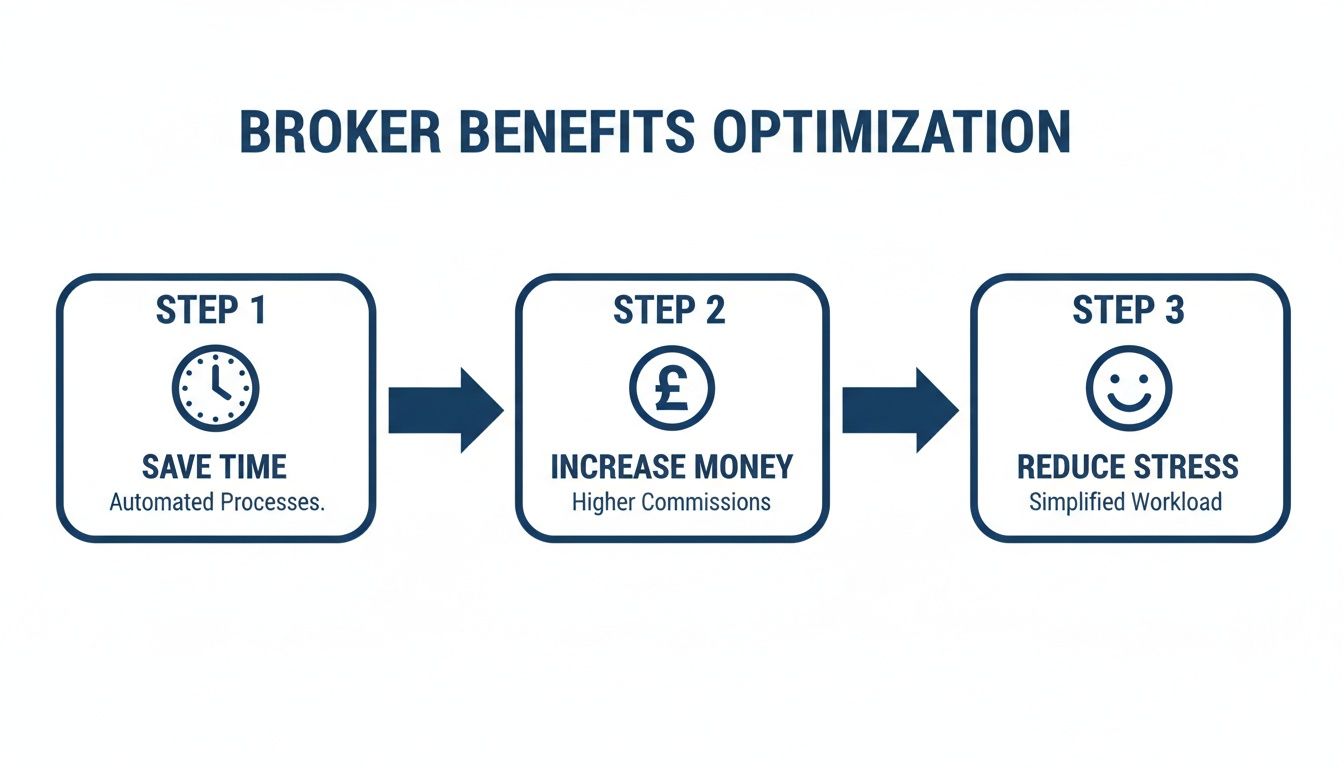
It is all about streamlining the process so you can focus on the exciting part – finding your home.
4. Application Submission and Underwriting
After you have chosen a mortgage deal, your broker will help you pull together all the necessary documents and submit the full application. This is where their expertise really shines, as they will ensure every detail is spot-on to avoid frustrating delays. The application then heads to the lender’s underwriting team, which will conduct a detailed review and arrange for property. valuation
Having all your paperwork ready is vital for keeping things moving. Here is a quick checklist of the essential documents you will need.
Essential Documents for Your Mortgage Application
Gathering these documents in advance will make the application process much smoother.
| Document Category | Examples |
|---|---|
| Proof of Identity | Passport or Driving Licence |
| Proof of Address | Recent Utility Bills or Council Tax Statement |
| Proof of Income | Payslips (last 3-6 months) & your latest P60 |
| Proof of Deposit | Bank Statements Showing Saved Funds or a Gifted Deposit Letter |
Having these on hand means your broker can act quickly once you have found the right mortgage deal.
5. The Mortgage Offer and Completion
If the underwriters are happy and the property valuation is all in order, the lender will issue a formal mortgage offer. This is the legally binding document that sets out the full terms of your loan. From here, your solicitor takes over to handle the final legal work. A key milestone after finding a home is signing the purchase agreement; looking at real estate purchase agreement templates can give you an idea of what to expect at this stage.
Finally, on completion day, the lender transfers the funds to the seller, and you officially become a homeowner! For a better idea of how long all this takes, you can learn more about how long a mortgage application takes in our article.
Navigating First-Time Buyer Schemes and Common Pitfalls
For many first-time buyers, government schemes are a brilliant way to get a foot on the property ladder, especially when saving for a huge deposit feels like an impossible task. But figuring out which scheme is right for you needs careful thought, as each comes with its own set of rules, benefits, and long-term implications.
This is where a good first-time buyer mortgage broker is worth their weight in gold. They will quickly tell you what you are eligible for, explain the small print without the jargon, and help you decide if a scheme genuinely fits your needs.
Understanding Your Scheme Options
While the original Help to Buy scheme has now ended, there are still several great options out there to help you buy your first home. It is vital to weigh up the pros and cons of each before you commit. A broker can give you the full breakdown, but here are two of the most popular routes.
- Shared Ownership: This scheme lets you buy a share of a property (usually between 10% and 75%) while paying rent on the rest. It is a fantastic way to get onto the ladder with a smaller deposit and mortgage, and you can buy more shares over time – a process known as ‘staircasing’.
- Mortgage Guarantee Scheme: While not a “scheme” for buyers in the traditional sense, this government initiative gives lenders the confidence to offer 95% mortgages by guaranteeing a part of the loan. For you, it means you could get a mortgage with just a 5% deposit, making homeownership a much more achievable goal.
These schemes are proving incredibly popular. In fact, Bank of England statistics from Q1 2025 showed that mortgages with a high loan-to-value (LTV) – those over 90% – accounted for 6.7% of all lending, the highest level since 2008. These figures really highlight the strength of the first-time buyer market, which you can read more about in the UK’s latest mortgage lending trends.
Avoiding Costly First-Time Buyer Mistakes
Getting your first mortgage is not just about finding the right deal; it is also about avoiding the common pitfalls that can catch out even the most organised buyer. A good broker helps you sidestep these issues, saving you time, money, and a lot of stress, especially when you are buying in competitive areas like Braintree and Colchester.
One of the biggest mistakes is underestimating the true cost of buying a home. The property price is just the starting point. You also need to budget for:
- Stamp Duty Land Tax (SDLT)
- Solicitor’s Fees and Legal Costs
- Mortgage arrangement and valuation fees
- Surveys and removal costs
“A broker provides a full cost breakdown from day one, so there are no nasty surprises. This clarity ensures your budget is realistic and covers every expense, not just the deposit.”
Another classic error is not checking your credit score early enough. Your credit history is a huge deal for lenders, and any old mistakes or defaults on your report could lead to a flat-out rejection. A broker will always advise you to check your file with agencies like Experian or Equifax months in advance. This gives you plenty of time to fix any errors and boost your score. You can read more about first-time buyer mortgages in our dedicated guide.
Finally, picking the wrong type can be an expensive long-term mistake. A broker makes sure the product you choose fits your attitude to risk and your plans, whether that is a secure fixed-rate deal or a more flexible tracker mortgage. Their guidance is crucial for making a decision you will still be happy with years down the line.
How to Choose the Right Mortgage Broker in Essex
Picking the right first-time buyer mortgage broker is genuinely one of the biggest decisions you will make on your journey to owning a home. It is not just about finding an adviser; it is about finding a partner. The right choice can dramatically affect the mortgage deal you secure, the fees you pay, and how smoothly the whole process feels. In a competitive market like Essex, a true local expert is invaluable.
Your goal should be to find someone who is in your corner, acting as your advocate rather than just a salesperson. This means looking for a broker with real local knowledge, a completely transparent approach, and a solid track record of helping people in your exact situation. From Colchester to Chelmsford, the right adviser makes all the difference.

Your Broker Selection Checklist
To help you sort the experts from the rest, here is a practical checklist of what to look for. Ticking these boxes will give you the confidence that you are choosing someone who really has your best interests at heart.
- Whole-of-Market or Independent Access: This one is non-negotiable. It means your broker can search through thousands of products from a huge range of lenders, not just a restricted little panel.
- Clear and Transparent Fees: A good broker will lay out their fee structure right from the start. Always ask for a written breakdown of any charges so there are no nasty surprises down the line.
- Positive Client Reviews: Check for genuine testimonials on platforms like Google or VouchedFor. A consistent stream of happy clients is a fantastic sign of reliable service.
- Deep Local Knowledge: An adviser who lives and breathes the Essex property market can offer priceless insights into local lender quirks and property hotspots in your target area.
“Finding the right broker is about more than just qualifications; it is about finding an adviser who communicates clearly, understands your goals, and is committed to guiding you through every step of the process.”
Essential Questions to Ask a Potential Broker
Before you sign on the dotted line, it pays to have a few questions ready. The way they answer will tell you a lot about their expertise and how they operate. Our guide on how to choose a mortgage broker has more tips, but here are the essential questions to get you started.
This quick table shows what to ask and, more importantly, why it matters.
| Question to Ask | Why It Is Important |
|---|---|
| How many lenders are on your panel? | This confirms if they are truly ‘whole-of-market’ or just have limited options. |
| What are your fees, and when are they payable? | Make sure you understand all the costs involved upfront, with no hidden extras. |
| Are you directly authorised by the FCA? | This is your peace of mind, confirming they are properly regulated and meet high professional standards. |
| How will you keep me updated? | This sets clear expectations for communication so you are never left in the dark. |
Taking a bit of time to research and chat with potential first-time buyer mortgage brokers is a step you will not regret. It puts you in control, helping you select a genuine expert who will work tirelessly to get you the keys to your first home.
Your Questions About First-Time Buyer Mortgages Answered
Stepping into the world of mortgages for the first time can feel like learning a new language. It is completely normal to have a long list of questions, and getting straight answers is key to feeling in control of your property journey.
To help clear things up, we have put together a few of the most common questions we hear from first-time buyers we work with.
How Much Deposit Do I Really Need as a First-Time Buyer?
There is a persistent myth that you need a whopping 20% deposit to get on the ladder, but that is rarely the case these days. For years, the average deposit for a first-time buyer has actually hovered between 6% and 9%.
In fact, plenty of lenders now offer great mortgage products for those with a deposit as low as 5% (or less with up to 100% LTV schemes). A good first-time buyer mortgage broker knows exactly which lenders are comfortable with these higher loan-to-value (LTV) deals and can walk you through how the deposit size affects your interest rate.
Can I Get a Mortgage if I Am Self-Employed or a Contractor?
Absolutely. Getting a mortgage when you are your own boss is very common, but the way lenders assess your income is a bit different. Instead of payslips, they will usually ask to see at least two years of your accounts or your official tax calculations (SA302s and Tax Year Overviews from HMRC).
This is where a broker with experience in self-employed mortgages becomes invaluable. They know which lenders have more flexible criteria and, crucially, how to package your application to give you the best shot at approval.
“A Decision in Principle is your golden ticket. It shows estate agents and sellers in competitive areas like Chelmsford that you are a serious, credible buyer, putting you in a much stronger negotiating position.”
What Is a Decision in Principle and Why Is It Important?
A Decision in Principle (DIP) – sometimes called an Agreement in Principle (AIP) – is an official statement from a lender confirming how much they would likely be willing to lend you, based on a few initial details.
While it is not a formal mortgage offer, it is a vital first step. It gives you a clear, realistic budget for your house hunt and shows sellers and estate agents that you are a serious buyer with your finances ready to go, which can make all the difference when you put in an offer.
How Long Does the Mortgage Application Process Take?
This can vary quite a bit, depending on the lender’s current workload and the straightforwardness of our application. As a general rule of thumb, you can expect it to take anywhere from two to six weeks from the moment you submit the full application to getting the formal mortgage offer in your hands.
An efficient mortgage broker can really help streamline this. We make sure your application is spot-on from the start, chase the lender for you, and iron out any bumps in the road to keep things moving forward as smoothly as possible.
At EHF Mortgages, we specialise in guiding first-time buyers through their journey to homeownership with confidence and clarity. If you are ready to take the next step or have a few more questions, our friendly team is here to offer free, no-obligation advice.
Your first home in Essex is closer than you think. Let’s start the conversation today and turn your property dreams into a reality.





