
What Is Mortgage Payment Protection Insurance in the UK for 2026
💡 Top Tip: Don’t get Mortgage Payment Protection Insurance (MPPI) mixed up with the life insurance your lender might push. They’re completely different things, and we’ll explain why later in the article.
Ever thought about what would happen to your home if your income suddenly stopped? Mortgage Payment Protection Insurance (MPPI) is a specific type of cover designed to handle your monthly mortgage repayments if you can’t work. It’s for those unexpected life curveballs, like an accident, sickness, or being made redundant.
Think of it as a dedicated financial safety net, built just for your mortgage.
Table of Contents
- What Is Mortgage Payment Protection Insurance in the UK?
- How MPPI Works: A Simple Analogy
- Who Truly Needs Mortgage Protection?
- Understanding MPPI Exclusions and Limitations
- Comparing MPPI With Other Protection Policies
- How To Arrange Your Mortgage Protection
- Your MPPI Questions Answered
What Is Mortgage Payment Protection Insurance in the UK?

What Is MPPI?
At its heart, MPPI is all about safeguarding your home. If a life event you did not see coming stops you from earning, this policy steps in. It ensures your mortgage is paid, preventing the stress of falling into arrears or, in the worst-case scenario, repossession.
For homeowners here in Chelmsford and across Essex, having that kind of protection brings incredible peace of mind. It frees you up to focus on getting better or finding a new job, without the constant fear of losing the roof over your head.
Understanding Your Safety Net
MPPI is what we call a ‘living benefit’. Unlike life insurance, which pays out when you pass away, MPPI is there to support you while you’re alive. It’s built for temporary setbacks, giving you the breathing space you need to get back on your feet.
This specialist policy is designed to cover your monthly mortgage payments if you’re off work due to an accident or illness, or if you’re involuntarily unemployed. Typically, MPPI will cover your payments for up to 12 months per claim, with benefits often capped at £2,500 per month. Some policies can even cover your utility bills, offering more comprehensive household support. You can read the latest government statistics on mortgage interest support to put the figures in context.
Core Principles Of MPPI
To really get your head around mortgage payment protection insurance, it helps to understand a few of its fundamental principles.
- Targeted Cover: Its main job is to cover your mortgage payment and nothing else. This focus makes it a straightforward and often affordable option.
- Defined Benefit Period: Policies pay out for a set period, usually 12 to 24 months. It’s designed to see you through short- to medium-term income loss.
- Specific Triggers: To make a claim, a specific event must occur. This is usually a doctor signing you off work or you receiving a formal redundancy notice.
“MPPI is your financial stand-in when you can’t work, ensuring your largest monthly outgoing is covered so you can protect your home and your credit rating.”
How MPPI Works: A Simple Analogy
Think of Mortgage Payment Protection Insurance (MPPI) as a financial safety net, specifically designed to catch your biggest monthly outgoing: the mortgage. If you’re suddenly unable to work due to illness, an accident, or redundancy, the policy steps in. It covers your mortgage payments directly, keeping your home safe while you focus on getting back on your feet.
For many homeowners, from Braintree to beyond, it’s a sensible backup plan for life’s unexpected curveballs.

Key Policy Triggers Explained
So, what actually triggers the policy? A claim is usually triggered by one of three life events, which are often bundled together in a package known as ‘ASU’ cover:
- Accident: An injury stops you from being able to do your job.
- Sickness: A new illness means you’re signed off from work by a doctor.
- Unemployment: This refers to involuntary job loss, such as being made redundant. Crucially, it won’t pay out if you resign or are dismissed for misconduct.
This clear structure means you know exactly where you stand and when you can rely on the policy for support.
How The Payout Process Works
Once you make a successful claim, the process is straightforward. The benefit, the monthly amount agreed upon to cover your mortgage, is typically paid directly into your bank account.
Better still, this payment is tax-free. This gives you full control over your mortgage payments without any extra hassle during what’s already a stressful time.
“The two most important features of any MPPI policy are its ‘deferment period’ and ‘benefit period’. Understanding these determines when your cover starts and how long it lasts.”
Getting these two elements right is fundamental to tailoring a policy that truly works for you.
Understanding Deferment and Benefit Periods
Every MPPI policy is built around two crucial timeframes. Getting your head around these is essential before you sign on the dotted line, as they directly control when you get paid and for how long.
Deferment Period: The initial waiting time. It’s the gap between the day you stop working and the day your first payment arrives. It’s often designed to match your employer’s sick pay policy, with common choices being 30, 60, or 90 days.
Benefit Period: The maximum length of time the policy will pay for any single claim. For most MPPI policies, the term is 12 or 24 months, a period designed to give you a proper buffer to recover or find a new job.
For homeowners from Colchester to Chelmsford, choosing the right combination is key. A longer deferment period can lower your monthly premium, but it means you’ll need to save enough to bridge that initial gap yourself.
Who Truly Needs Mortgage Protection?
While anyone with a mortgage could benefit from a safety net, for some people, mortgage payment protection insurance is not just a ‘nice-to-have’. It’s an essential part of a responsible financial plan.
If you fall into one of the groups below, this type of cover should really be a high priority.

The Self-Employed and Contractors
When you’re self-employed, a contractor, or a small business owner in areas like Chelmsford, there’s no employer sick pay to fall back on. If you can’t work, your income can stop. Overnight.
Think about a self-employed electrician from Colchester who has a bad fall and cannot work for three months. Without protection, the mortgage payments quickly become an impossible weight. MPPI is built for exactly this scenario, stepping in to cover your home loan while you get back on your feet.
Families and Single-Income Households
If you have dependents or you’re the main breadwinner, your family’s financial stability rests on your shoulders. A sudden illness or unexpected job loss could have a devastating impact, creating huge stress at a time when you need to focus on recovery.
This is especially true if you do not have a hefty savings pot. An income shock can burn through savings in no time, putting your home at risk. The low uptake of protection cover in the UK leaves millions exposed; in fact, analysis suggests that by 2026, 1 in 4 homeowners could be at risk of losing their property due to an unprotected health crisis. You can read more about these shocking homeowner statistics.
For homeowners already struggling, it’s vital to know about things like your lender’s loan modification options. These can be crucial in managing financial distress and potentially saving your home. But prevention is always better than a cure. MPPI is a proactive way to ensure your payments are met, protecting both your home and your credit score.
This protection ensures that a temporary setback does not snowball into a long-term financial disaster. It provides the stability you need to keep your family in their home while you navigate a difficult period.
Understanding MPPI Exclusions and Limitations
No insurance policy on the market covers absolutely everything, and mortgage payment protection insurance is no different. Getting to grips with the typical exclusions and limitations from the outset is crucial, as it helps you choose the right cover and avoids any unwelcome surprises if you ever need to claim.
Every policy has its own specific small print, which is why reading the documents carefully is so important. That said, most MPPI policies share a common set of circumstances where they won’t pay out. Understanding these helps you see the real value of getting expert advice before you commit.
Common Policy Exclusions
While the exact details vary between insurers, some exclusions are almost universal. Knowing what they are will help you determine whether a standard MPPI policy is genuinely the right fit for your personal situation.
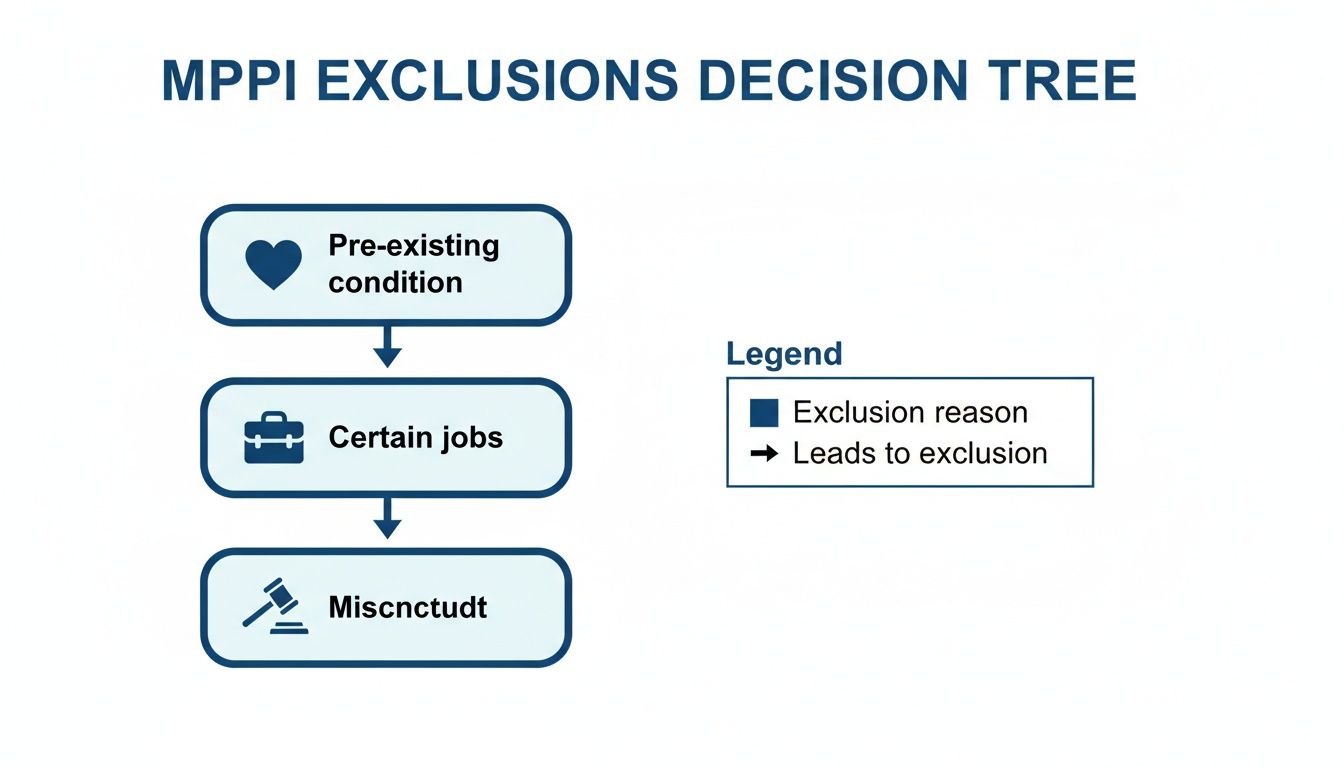
Here are some of the key reasons a claim might be declined:
- Pre-existing Medical Conditions: Any illness or injury you were aware of before taking out the policy is almost always excluded.
- Voluntary Redundancy or Dismissal: The unemployment part of the cover is designed for involuntary job loss only. It won’t pay out if you choose to leave your job, are fired for misconduct, or resign.
- Certain Types of Employment: If you’re on a temporary or short-term contract, you might find you’re not covered for unemployment. This is a vital detail for contractors in areas like Braintree to check.
- Self-inflicted Injuries: Claims that arise from injuries you cause to yourself intentionally will always be excluded.
“The ‘Initial Exclusion Period’ is a critical detail. Most policies have a clause preventing you from claiming unemployment within the first 60 to 120 days of the policy start date.”
This waiting period is there to stop people from taking out cover when they already know redundancy might be just around the corner.
The Importance of Full Disclosure
When you apply for mortgage payment protection insurance, you have to be completely honest about your health and your job. Hiding a known medical condition could invalidate your entire policy, leaving you without cover right when you need it most.
Navigating these details really highlights why professional guidance is so valuable. A broker can help you find a policy that truly aligns with your specific needs, ensuring the protection you’re paying for is one you can actually rely on. To get a better picture of the different types of protection available, have a look at our guide on life and critical illness insurance.
Comparing MPPI With Other Protection Policies
Mortgage Payment Protection Insurance is a specific tool for a very specific job: covering your mortgage if you can’t work. But it’s just one piece of the puzzle. To build a financial safety net that truly protects you and your family, you need to understand the whole picture.
Think of it this way: while MPPI is an excellent, focused solution, it should not be your only line of defence. Policies like Income Protection, Critical Illness Cover, and Life Insurance each play a different, vital role. The right mix for you comes down to your personal circumstances, your budget, and what level of risk you’re comfortable with.
MPPI Vs Other Protection: What Is The Difference?
To really get to grips with what’s what, let’s break down the main types of protection side by side. Each one is designed to kick in under different circumstances and offers a unique kind of support. This should make it much clearer which policy does what, helping homeowners in places like Braintree identify where their cover gaps might be.
Here’s a straightforward comparison:
| Type Of Cover | What It Covers | Benefit Type | Typical Benefit Period | Who It Is For |
|---|---|---|---|---|
| MPPI | Mortgage payments due to accident, sickness, or unemployment. | Monthly Payout | 12-24 months | Those needing specific, short-term mortgage cover. |
| Income Protection | A portion of your salary if you cannot work due to illness or injury. | Monthly Payout | Long-term (until retirement) | Anyone whose lifestyle depends on their income. |
| Critical Illness | Diagnosis of a specific serious illness (e.g., cancer, heart attack). | Lump Sum | One-off Payout | Those wanting a lump sum to clear debts or adapt their home. |
| Life Insurance | Pays out upon death or diagnosis of a terminal illness. | Lump Sum | One-off Payout | Anyone with financial dependents. |
As you can see, each policy serves a different purpose. Getting the right advice helps you layer these protections to create a plan that fits you perfectly, without paying for cover you do not need.
Building Your Financial Safety Net
The table really highlights the key differences. MPPI is highly targeted and often more affordable, but Income Protection offers much broader, longer-term cover for your lifestyle, not just your mortgage. You can learn more by reading our complete guide on what income protection insurance is .
Alongside insurance, a smart strategy also involves building a robust emergency fund to cover unexpected costs beyond your mortgage payments.
The real-world value of having protection is undeniable. Recent figures show that UK insurers paid out a record £8 billion in protection claims, underscoring the vital role this support can play for families facing hardship.
With the average income protection claim hitting £25,133, often used to keep up with mortgage repayments, it’s clear this is not just a ‘nice to have’. For some, a policy costing just £22 a month could secure a monthly income of £1,800. That’s less than the price of a weekly takeaway for peace of mind that could save your home.
“The best protection strategy often involves a combination of policies, tailored to cover different risks. An adviser’s role is to help you build that layered defence affordably.”
Thinking about what you need is the first step. The next step is getting clear, impartial advice to find a solution that genuinely fits your life.
How To Arrange Your Mortgage Protection
Sorting out the right mortgage payment protection is one of the smartest moves you can make to protect your home and your family’s future. It’s a lot more straightforward than you might think, especially when you have someone experienced to guide you through the maze of policies and providers. The first step is always the same: getting a really clear picture of where you stand financially.
Putting a cover in place is a simple process, but it’s crucial to get it right. It’s all about matching a policy to your specific circumstances, so you have genuine peace of mind without overstretching your budget. After all, protecting your biggest asset is what this is all about.
Assess Your Financial Needs
Before diving into policies, you need to figure out exactly what you’re protecting. This means taking a moment to calculate your essential monthly costs, with your mortgage payment right at the top of the list.
Ask yourself these questions:
- What’s your monthly mortgage payment? This is the absolute minimum your policy needs to cover.
- What’s your employer’s sick pay policy? Knowing how long you’d be paid if you were off sick helps you decide on the right ‘deferment period’ – the time you wait before your policy starts paying out.
- How much do you have in savings? Your financial cushion also plays a big role in how long you can comfortably wait before your payments begin.
Answering these questions gives you a solid foundation, helping you understand the level of cover you need and for how long.
“Using an independent, whole-of-market broker is the most effective way to compare policies. We have access to deals you won’t find on comparison sites and can identify policies with fewer exclusions.”
Work With An Expert Adviser
You could go straight to an insurer, of course, but working with an experienced broker like us at EHF Mortgages brings some serious advantages to the table. We’ve helped clients across Essex, from Colchester to Chelmsford, find policies that are not just competitive but genuinely suited to their needs. Our job is to help you sidestep the common traps, like policies riddled with sneaky exclusions that could make your cover worthless when you need it most.
We take the hassle out of the whole process, from handling the application to double-checking all the fine print. By searching the entire market, we find the best mortgage protection insurance options at premiums that make sense, giving you total confidence in your decision.
Your MPPI Questions Answered
Our clients often have a few questions about Mortgage Payment Protection Insurance. Let’s clear up some of the most common ones with straightforward answers.
Is MPPI The Same As PPI?
Not at all. The old, mis-sold Payment Protection Insurance (PPI) scandal rightly left a bad taste in people’s mouths. That stuff was often tacked onto loans without proper explanation and came with sky-high costs.
Modern MPPI is a completely different beast. It’s a transparent, standalone insurance policy that’s properly regulated and designed with one clear purpose: to cover your mortgage payments if you can’t work. Think of it as a specific, valuable tool for your financial toolkit.
How Much Does MPPI Cost?
There’s no single price tag for MPPI, as the cost is personal to you. Your premium is calculated based on a few key factors, such as your age, health, occupation, and, of course, the size of your monthly mortgage payment.
That said, many people are pleasantly surprised by how affordable it can be, especially when you weigh it against the peace of mind of securing your biggest monthly outgoing.
Can I Get MPPI If I Am Self-Employed?
Yes, absolutely. In fact, if you’re self-employed in Braintree or the surrounding areas, MPPI can be a crucial part of your financial safety net.
Without access to employer sick pay, your income stops the moment you can’t work. MPPI steps in to provide that vital income stream, ensuring your mortgage payments are made while you focus on getting back on your feet.
“You are never obliged to take the protection policy offered by your mortgage lender. Shopping around with an independent broker almost always results in finding a more suitable and cost-effective policy.”
This freedom to choose is your biggest advantage. By comparing what’s out there, you can secure cover that genuinely fits your life and budget, rather than just settling for the first option you’re given.
Protecting your home is one of the most important financial decisions you’ll ever make. If you are ready to discuss your options and get tailored advice, our expert team is here to help you secure the right cover for your peace of mind.





