
The first piece of advice i give most borrowers asking about their credit records is to Stop being fixated on that three-digit credit score! Instead, shift your focus to presenting a crystal-clear picture of your income and showcasing your recent positive financial habits. It’s a common belief among entrepreneurs that the door to homeownership is firmly shut, but I am here to tell you that securing home loans for self employed with bad credit is absolutely possible. We will explain more later in this article.
Table of Contents
- Why High Street Banks Say No and Specialists Say Yes
- What Lenders See When They Look at Your Credit Report
- How to Build a Bulletproof Mortgage Application
- Future Opportunities for Self Employed Home Buyers
- Why a Specialist Broker Is Your Strongest Ally
- Frequently Asked Questions
Why High Street Banks Say No and Specialists Say Yes
If you have ever had a mortgage application turned down by a high street bank, you know how gut-wrenching it can feel. But the reason is often surprisingly simple. Big banks are built for speed and simplicity. They rely heavily on automated computer systems that use algorithms to make lightning-fast decisions.
These systems are programmed to hunt for the perfect straightforward applicant. Think salaried employee spotless credit file. Your application with its self-employed income, and a few past credit bumps, just does not fit into their neat little boxes. The algorithm flags it as a risk and spits out an automatic “no”, often before a human even lays eyes on it. It is a rigid one-size-fits-all model that unfortunately leaves a lot of talented entrepreneurs out in the cold.
This is a real hurdle especially when you consider that self-employed people in the UK already face an uphill battle. Research shows they are the least likely group to get mortgage approval, with only a 76% likelihood compared to 89% for applicants who just have bad credit. You can read the full research on mortgage approval rates to see just how tough the landscape can be.

The Power of a Human Underwriter
This is where specialist lenders completely change the game. Their entire business model is built around getting to grips with complex financial situations just like yours. Instead of letting a computer call the shots, they use experienced human underwriters to manually review your entire file.
And that is where the all-important difference between your credit score and your credit report comes into play. For a high street bank a low score is a deal-breaker. But for a specialist underwriter it is just the start of the conversation.
They will look right past that three-digit number and dive deep into your full credit report. This hands-on manual assessment is precisely what makes securing home loans for self employed with bad credit a realistic goal.
“A low credit score from an algorithm is rarely used by a specialist lender. They focus on the individual credit accounts in your report. The cards loans and mortgages are reviewed to understand how they have been managed over time.”
Looking Beyond the Numbers
A specialist underwriter pieces together the story behind your credit history. They do not just see a missed payment. They ask the kind of common-sense questions a computer simply cannot.
- When did the issue occur? A slip-up from four years ago is viewed far more leniently than one from last month. Time creates distance, and shows you have established a new more reliable pattern.
- What was the reason? Was there a legitimate reason for the blip like an illness or a tough period for the business? Providing a brief honest explanation can add invaluable context.
- How have you managed your finances since? A solid track record of on-time payments over the last 12–24 months speaks volumes. It shows responsibility and can easily outweigh older mistakes.
This human-centred approach allows them to appreciate the nuance in your financial life. They understand the realities of running a business in Chelmsford, Braintree, or Colchester, and are much more willing to listen to your side of the story.
As specialist brokers, we have spent years building strong relationships with these underwriters. We know exactly who to talk to, and how to frame your application in the best possible light, turning what could be another rejection into a successful approval.
What Lenders See When They Look at Your Credit Report
To get a mortgage when you are self-employed with a few credit issues you need to start thinking like a lender. First forget the term ‘bad credit’. A specialist underwriter rarely looks at your file and thinks in such black-and-white terms. Instead they are piecing together the story of your financial past.
That story is all about the type the age and the value of any credit blip. These three factors determine how seriously an issue is viewed and whether it is a genuine roadblock to getting your mortgage. A single late mobile phone payment from four years ago is just a minor footnote. A recent and unpaid County Court Judgement (CCJ) is a completely different chapter.
The Hierarchy of Credit Issues
Let’s be clear, not all credit problems are created equal. Lenders have a sort of hierarchy for them, and understanding this helps you figure out exactly where you stand.
- Minor Blips: This could be the odd late payment on a credit card or utility bill. While not ideal lenders often overlook them if they are isolated incidents that happened more than 12-18 months ago.
- Moderate Issues: Defaults on unsecured credit like personal loans or credit cards fall into this bucket. Here the lender will pay close attention to the amount and crucially when the default was registered.
- Serious Events: The big ones are things like CCJs bankruptcy or repossessions. These definitely require a much closer look but they are not an automatic ‘no’ especially if they happened several years ago.
For our clients across Chelmsford, Braintree, and Colchester, the main takeaway is this. Time is your greatest ally. Most specialist lenders become much more lenient once a credit issue is more than three years old.
“The impact of a credit problem fades significantly over time. An underwriter is far more interested in your recent track record of on-time payments than a mistake made three or four years ago.”
Reviewing Your Own Financial Story
Before you even think about applying, you absolutely must get your hands on your credit reports. Check all three of the main UK agencies – Experian, Equifax, and TransUnion – as each one can hold slightly different information. You do not want any nasty surprises popping up later. This is also your chance to spot and correct any errors which happens more often than you would think.
When a lender assesses your application, they will dig into your financial health. A key metric they use is your debt-to-income ratio, which gives them a quick snapshot of how well you can manage monthly payments. A healthy ratio, combined with a clean payment history for the last year or two, can powerfully outweigh older financial mistakes. It shows you are responsible now which is what really strengthens your case.
How to Build a Bulletproof Mortgage Application
Getting your mortgage application right is the single most powerful thing you can do when you are self-employed with a few credit hiccups. It is your chance to tell the lender your story proving you are a reliable borrower despite what the paperwork might suggest.
Let’s walk through how to put together an application package, that a specialist lender will not just read but take seriously.
Your first job is to paint a crystal-clear picture of your income. Unlike someone on a PAYE salary with straightforward payslips, you need to show a lender that your business is healthy, and your earnings are both consistent and sustainable.
Assembling Your Income Evidence
Think of this part as creating a financial CV for your business. The aim is to give the lender a professional easy-to-understand overview of your trading history. While some lenders insist on seeing two or three years of records, many specialist lenders are more flexible and might only ask for one full year.
Here are the absolute essentials you will need to gather:
- SA302s and Tax Year Overviews: These are your non-negotiables. As official documents from HMRC, they confirm exactly what you have declared in earnings and paid in tax forming the bedrock of any self-employed application.
- Certified or Audited Accounts: If you operate as a limited company having your accounts professionally prepared and signed off by an accountant adds a massive layer of credibility.
- Business Bank Statements: Lenders typically want to see the last three to six months of statements. This gives them a real-time view of your business’s cash flow, and helps verify the figures you have presented elsewhere.
Having all this organised before you even apply shows you are on the ball. It makes the underwriter’s job easier and that is never a bad thing.
This flowchart shows how lenders tend to categorise credit issues giving you an idea of how your own history might be perceived.
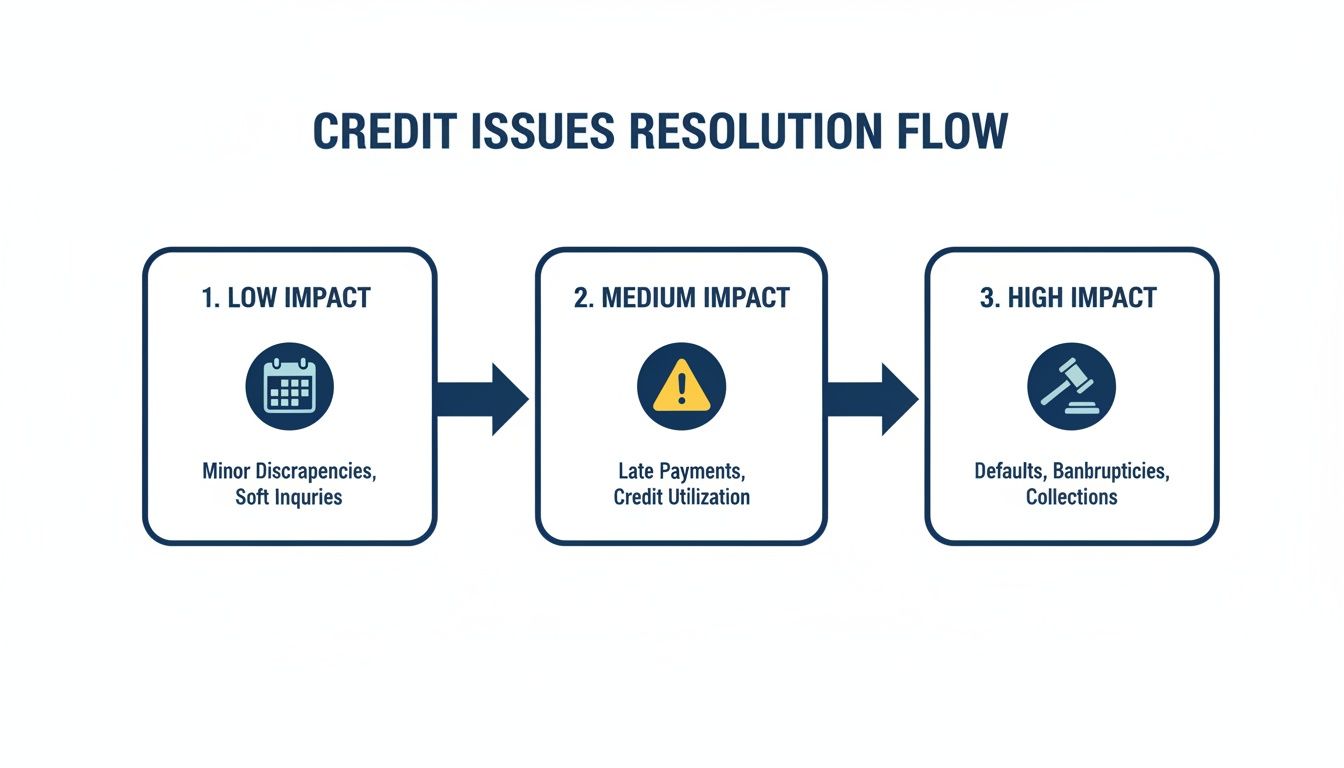
The main takeaway here? The seriousness of a credit blip is all about how severe it was, and crucially how long ago it happened.
Documenting Your Story: High Street vs. Specialist Lenders
When you are self-employed, the documents a lender asks for can tell you a lot about their flexibility. High street banks often have a rigid one-size-fits-all checklist, whereas specialist lenders are usually more interested in the bigger picture. They are prepared to look beyond the standard paperwork if you can provide a solid explanation.
Here’s a quick comparison of what you might expect.
High Street vs Specialist Lender Document Needs
| Document Type | High Street Lender Expectation | Specialist Lender Flexibility | EHF Mortgages Tip |
|---|---|---|---|
| Accounts | 2-3 years of finalised accounts often with no exceptions. | May accept 1 year of accounts especially for established businesses or strong sectors. | Projections from your accountant can help bridge any gaps if you’re just shy of a full year’s trading. |
| Bank Statements | A perfect record with no returned payments or unarranged overdrafts. | More understanding of the occasional blip if there’s a good reason, and it’s not a regular pattern. | Be ready to explain any unusual transactions. Honesty builds trust with the underwriter. |
| Credit History Explanations | Rarely requested the computer often just says ‘no’. | Actively encourage a written explanation to provide context for past credit issues. | A brief factual letter explaining why a problem occurred and what you’ve done since can be incredibly powerful. |
| Future Contracts | Not typically considered in affordability calculations. | May consider confirmed future contracts or a strong pipeline of work to support your application. | Providing copies of signed contracts for upcoming work can significantly strengthen your case. |
Ultimately, a specialist lender is looking for evidence of a viable ongoing business. The more you can provide to support that narrative the better your chances.
Addressing Your Credit History Head-On
Do not be tempted to hide or gloss over past credit problems. A specialist lender is expecting to see them. Your task is to provide context, and demonstrate that you have turned a corner. The best way to do this is with a short honest written explanation.
For instance, if a period of illness or an unexpected client loss led to some missed payments briefly explain what happened. More importantly, focus on the positive actions you have taken since. This could be anything from clearing the debts, maintaining perfect payments for the last 24 months, or building up your savings.
This proactive approach transforms a potential red flag into a story of resilience and recovery.
Strengthening Your Position with a Bigger Deposit
Finally let’s talk about one of the most effective ways to bolster your application for a home loan for self employed with bad credit. Saving up a larger deposit.
From a lender’s point of view a bigger deposit dramatically lowers their risk. It is a powerful signal of your financial discipline and commitment to the purchase. For our clients across Essex in places like Chelmsford, Braintree and Colchester, aiming for a deposit of 15% or more can unlock a much wider choice of specialist lenders and often leads to better interest rates.
Simply put the more skin you have in the game, the more confident a lender will feel about saying yes. If you want to explore this further you might find our guide on understanding your borrowing potential helpful.
Future Opportunities for Self Employed Home Buyers
The mortgage market is not set in stone. It is always shifting to keep up with the UK’s modern workforce. For self-employed borrowers this is fantastic news. A wave of positive changes is creating new opportunities painting a much brighter picture for getting a mortgage, even if you have had credit issues in the past. Lenders are finally starting to recognise the huge value, and growing number of entrepreneurs out there.
This shift means more mortgage products are being designed specifically with freelancers contractors and sole traders in mind. The old rigid lending models that did not really ‘get’ how a business works are slowly being replaced by more flexible common-sense assessments. It is a welcome change for ambitious home buyers across Chelmsford, Braintree, and Colchester.
A Growing Market and Changing Attitudes
One of the clearest signs of this change is the sheer growth forecast for the sector. The self-employed mortgage market is predicted to jump by an incredible 67% growing from £20.9 billion in 2023, to an estimated £34.8 billion by 2029. This boom is being driven by the rising number of entrepreneurs looking for home loans, for those self-,employed with bad credit and lenders are definitely paying attention. You can discover more insights about this market growth and what it means for people like you.
This growth is not just a number. It shows a real change in how lenders think. As more and more people choose to work for themselves, the financial industry has no option but to adapt. This competition for your business is great news as it pushes lenders to come up with more competitive and accessible mortgage deals.
It is also worth remembering that traditional mortgages are not the only path. Self-employed individuals with less-than-perfect credit sometimes find success with alternative routes like owner financing options. These can offer a bit more flexibility when the mainstream lenders say no.
“The future is bright for self-employed home buyers. A combination of regulatory adjustments, and a growing market, , means that knowledgeable brokers can unlock better and more competitive deals than ever before.”
How Regulatory Shifts Are Helping You Borrow
It is not just market trends opening doors. Regulatory changes are also playing a huge part. For instance recent adjustments to affordability stress tests have already started to help many people increase the amount they can borrow. These tests used to be notoriously strict, but recent tweaks have made them far more realistic for today’s borrowers.
The industry is also modernising how it assesses income. Some of the key changes we are seeing include:
- Greater acceptance of a single year’s accounts: While two years of accounts was once the gold standard, more specialist lenders are now happy to consider applicants with just one solid year of trading under their belt.
- Considering retained profits: For limited company directors this is a big one. Some lenders are now willing to include retained company profits in their affordability calculations, not just the salary and dividends you have drawn.
- Flexible income verification: The old reliance on SA302s is fading. Lenders are taking a more holistic view looking at business bank statements and even future contracts to get a true picture of your earnings.
Keeping up with these industry shifts is what we do best. At EHF Mortgages we keep our finger on the pulse of these changes. Our whole-of-market access means we can find exclusive products and lender deals that are not advertised to the public, ensuring our Essex clients always get a look at the best possible options available.
Why a Specialist Broker Is Your Strongest Ally
Trying to find the right lender on your own for a Mortgage for self-employed, with bad credit can feel like searching for a needle in a haystack. It is not just overwhelming. It is risky. Every failed application can leave a fresh mark on your credit file making the next attempt even harder.
This is exactly why partnering with a specialist FCA-authorised mortgage broker like , is such a game-changer. Think of us as your advocates not just advisors. We do not just shuffle your paperwork from one desk to another. We build your case and present your unique financial story to an underwriter who knows how to listen and look beyond the raw numbers.
Access to the Entire Market
One of the biggest advantages we bring to the table is access. We have strong relationships with lenders right across the market, including many specialist firms that do not deal directly with the public. These broker-only deals often come with far more flexible criteria and competitive rates opening up doors that would otherwise remain firmly shut.
With over 35 years of experience in the Essex market from Chelmsford to Braintree and Colchester, we know precisely which lenders are most likely to say “yes” to applications like yours. That inside knowledge saves you time stress and the potential damage of multiple rejections.
Recent studies show that while mortgage access for self-employed borrowers has improved it is still tough out there. Rejection rates for self-employed applicants have dropped from 45% to 24% but lenders remain cautious. Working with a broker ensures your application is positioned for success right from the very start. You can read more about the challenges facing self-employed borrowers to get a feel for the landscape.
Expertise That Gets Results
Our expertise goes far beyond simply finding a lender. We understand the complex criteria each one uses,, from how they assess self-employed income to their specific rules on past credit issues. We use this knowledge to package your application for the highest possible chance of approval.
We help you:
- Frame Your Story: We work with you to provide clear context for any past credit blips, turning potential weaknesses into a narrative of resilience and recovery.
- Highlight Your Strengths: We make sure your stable income and recent positive financial behaviour are front and centre for the underwriter to see.
- Avoid Common Pitfalls: We check every last detail to ensure your application is complete and accurate, avoiding the simple mistakes that can lead to an instant decline.
This meticulous preparation is absolutely crucial. It shows the lender you are a serious organised applicant which can make all the difference. For those in particular fields our specific knowledge is key. You might want to learn more about our specialist mortgages for professionals to see how we adapt our approach.
“A specialist broker is your advocate in a complex market. We understand your personal story and present it to the right underwriter who is equipped to listen and see the person behind the application.”
With a proven track record of finding solutions for first-time buyers and homeowners looking to remortgage, we are ready to guide you. Take the first step towards your new home. Contact our expert team today by visiting our Contact Us page.
Frequently Asked Questions
When you are self-employed and have a few credit hiccups it is only natural to have a lot of questions. We have put together some of the most common queries we hear from entrepreneurs in Chelmsford, Braintree and Colchester to give you the clear straightforward answers you need.
How Long Do I Need to Be Self Employed to Get a Mortgage?
This is a big one. While most high-street lenders will ask to see two or even three years of accounts,, the specialist market is far more flexible. We work with lenders who are happy to consider applications with just one full year of trading history under your belt.
What really matters to them is not just the length of time but the quality of your records. A solid set of professionally prepared accounts or your SA302 tells the underwriter a story of a stable reliable income. And that is what they are truly looking for.
Will a CCJ or Default Automatically Prevent Me From Getting a Mortgage?
Not at all. A past CCJ or default does not have to be a deal-breaker. Specialist lenders do not just run your application through a computer. A real person will manually review your file to understand the story behind the issue.
They will focus on two key things. The date it happened and how much it was for. A small satisfied default from four years ago is a world away from a large unpaid CCJ registered last month. If you can show a clean credit history since the event it massively strengthens your case. The impact of these older blips becomes less important in the overall assessment over time.
“Remember specialist lenders rarely get hung up on the credit score number itself. They are more interested in looking at the individual accounts on your report to see how they have been managed over time.”
How Much Deposit Will I Need with Bad Credit?
Putting down a larger deposit is probably the single most powerful thing you can do to strengthen your application. It immediately lowers the lender’s risk which makes them feel much more comfortable.
While some of our specialist lenders might consider a deposit as low as 10-15% getting to 20% or more will really open doors. A bigger deposit not only gives you access to a wider pool of lenders but can also secure you a more competitive interest rate saving you a significant amount of money in the long run.
Can I Remortgage If I Am Self Employed with Bad Credit?
Yes absolutely. The process for a remortgage is very similar to buying a new home. Lenders will look at your recent income the details of your past credit issues and crucially the amount of equity you have built up in your property.
This is exactly where a specialist broker becomes essential. We know which lenders offer remortgage products designed for situations just like yours and can navigate the market to find the right fit.
Your path to owning a home is probably clearer than you think. At EHF Mortgages we specialise in finding solutions where others cannot. Let our expertise light the way.
Ready to take the first step towards your dream home? Let us help you navigate the journey. Visit our Contact Us page and let’s start the conversation.





