Here’s a top tip: Remortgaging with the same lender can save you significant time and paperwork but is it always the best financial move? We’ll get into how to know for sure later in this guide. This streamlined process is officially called a Product Transfer, and it’s a popular choice for homeowners whose mortgage deals are coming to an end.
Table of Contents
- Your Essential Guide To Remortgaging With Your Lender In 2026
- Product Transfer vs Full Remortgage Unpacked
- The Real Pros And Cons Of A Product Transfer
- Navigating Your Product Transfer Timeline
- Why A Broker Is Your Greatest Asset
- Your Product Transfer Questions Answered
Your Essential Guide To Remortgaging With Your Lender In 2026
With millions of fixed-rate mortgage deals ending soon, many homeowners are facing an unwelcome surprise. If you do nothing, your interest rate will automatically switch to your lender’s Standard Variable Rate (SVR).
This rate is almost always much higher than what you’re currently paying meaning a sudden and significant hike in your monthly payments. For homeowners in areas like Chelmsford Braintree and Colchester this can place a real strain on the household budget.
This is where understanding your options becomes absolutely critical. Instead of just accepting a costly SVR, you can take action and secure a new deal. One of the simplest ways to do this is by remortgaging with the same lender, through what’s known as a product transfer. Think of it as simply renewing your contract rather than starting a completely new one from scratch.
While this guide focuses on sticking with your current lender, you can also explore a broader range of options to understand the full landscape and learn more about mortgages.
Why Is This So Important Now?
The mortgage market is experiencing a significant shift. UK Finance projected that a staggering 1.8 million fixed-rate mortgages would mature in 2026 alone, and this trend is continuing into 2027. This huge volume of activity has made product transfers a dominant feature of the lending market as many people look for a straightforward way to lock in a new rate.
However convenience shouldn’t be the only thing you consider. While staying with your current lender is certainly easier, it might not get you the best interest rate available on the wider market. This is exactly why getting expert advice is so important.
A mortgage broker like EHF Mortgages will not only manage the product transfer for you, but will also compare it against thousands of other deals across the UK Mortgage market. Our goal is to ensure you get the best possible outcome whether that means staying put, or switching to a new lender, for a better deal. For a deeper dive into the basics check out our complete guide to understanding home loans.
Product Transfer vs Full Remortgage Unpacked
When your current mortgage deal comes to an end, you find yourself at a crossroads. Think of it like your mobile phone contract expiring: you can either see what new deals your current provider has, or you can shop around the entire market for a better offer from a competitor. The mortgage world works in a very similar way.
Staying with your current bank or building society is known as a product transfer. This simply means you’re remortgaging with the same lender switching from your old rate to a new one they’re offering. The alternative of a full remortgage involves moving your entire mortgage to a completely new lender for a brand-new deal.
In practice these two paths are quite different. A product transfer is usually much simpler and quicker. Because you’re already a customer the lender often requires very little paperwork, and might not even need to run extensive new affordability checks. This can be a huge advantage if your financial situation has changed recently, perhaps if you’ve become self-employed, or your income has fluctuated.
On the other hand a full remortgage is like applying for a mortgage all over again. It demands a completely new application, a fresh property valuation, and all the associated legal work. While this is certainly more effort it opens up the whole mortgage market to you, meaning you could potentially find a much more competitive interest rate than your current lender is willing to offer.
The flowchart below shows that fork in the road you face when your fixed deal ends illustrating the two main routes you can take.
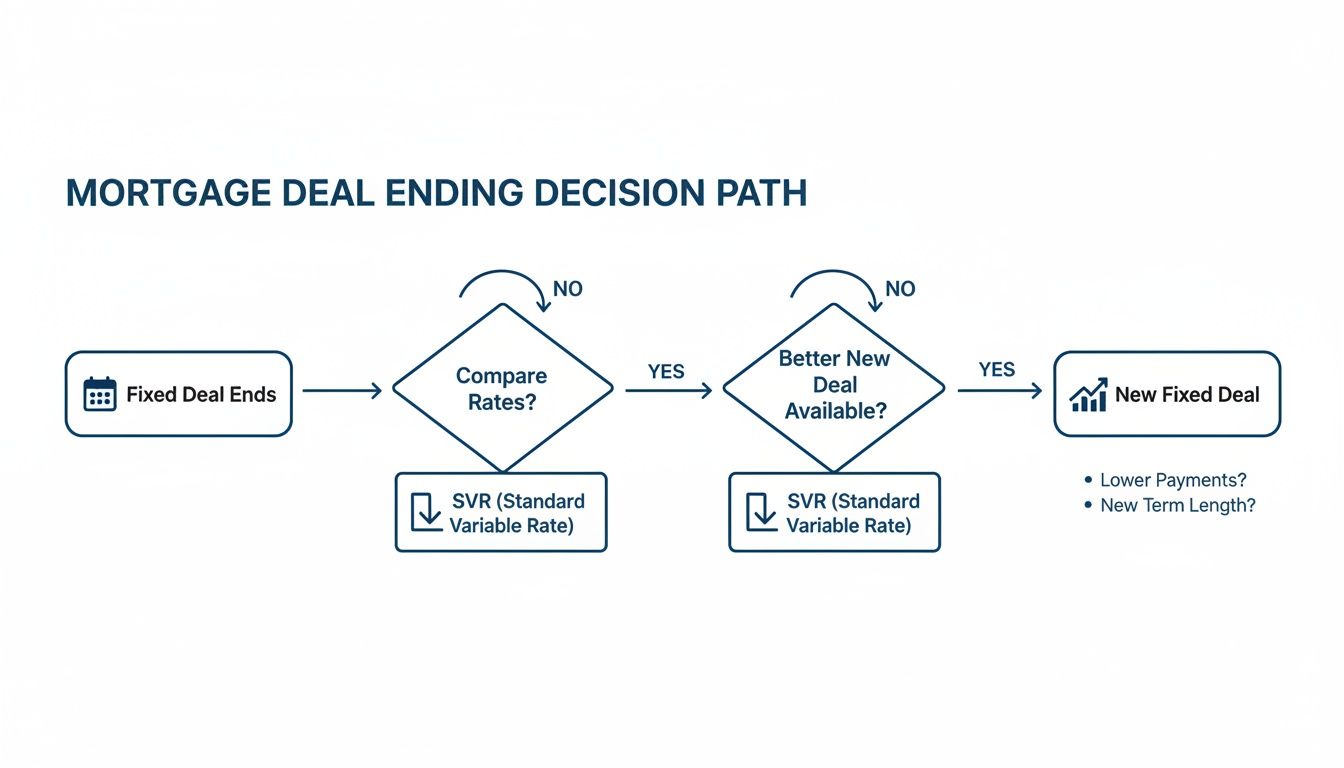
This graphic really brings home that critical decision point: you can either let your deal expire and slip onto a costly Standard Variable Rate, or you can take control and proactively lock in a new deal through a transfer or a full remortgage.
Product Transfer vs Full Remortgage At A Glance
To help homeowners across Chelmsford, Braintree, and Colchester make the right choice, let’s put the two options side-by-side. Getting to grips with the trade-offs in terms of cost speed and paperwork is the first step toward securing the best deal for your circumstances. You can also play around with different scenarios using our online mortgage calculators to get a clearer picture of what your monthly payments could look like.
The table below breaks down the key differences between a product transfer and a full remortgage.
| Feature | Product Transfer (Same Lender) | Full Remortgage (New Lender) |
|---|---|---|
| Affordability Checks | Usually minimal or not required | Full affordability and income checks |
| Credit Checks | Often no new hard credit check | A new hard credit check is always run |
| Legal Fees | Typically none | New solicitor/conveyancer fees apply, may be free with new lender |
| Valuation Fees | Usually not needed | A new property valuation is required, may be free with the new lender |
| Speed & Paperwork | Fast and simple with minimal forms | Slower with a full application process |
As you can see, the convenience of a product transfer is clear. However that convenience might come at the cost of a higher interest rate, which is why it’s always worth exploring what the wider market has to offer.
The Real Pros And Cons Of A Product Transfer
Choosing a product transfer when your mortgage deal ends can feel like the easiest option. For homeowners across Essex, while the simplicity is tempting, it’s vital to look at the whole picture. The path of least resistance isn’t always the one that saves you the most money.

Let’s be clear, the advantages are compelling mostly boiling down to speed and cost. The process is often lightning-fast compared to a full remortgage sometimes needing just a few clicks online with very little paperwork. That alone saves a huge amount of time and stress.
But for many the real pull is the financial side. A typical product transfer means:
- No new legal fees since you’re staying with the same lender.
- No valuation fees as your lender already has your property’s details.
- Minimal or no affordability checks a huge relief if your circumstances have changed.
A Lifeline for Changing Circumstances
That last point can be a game-changer. If you’ve recently become self-employed taken a pay cut or had a few credit blips since your last mortgage application, passing the strict affordability tests for a new lender could be tough.
A product transfer often lets you sidestep those hurdles completely. You can lock in a new rate, without having your finances put under a microscope all over again which provides some welcome stability when you might need it most.
However despite these clear upsides, there are some serious drawbacks to think about. The biggest one? You’re stuck with whatever your current lender is willing to offer you. This means you could be waving goodbye to a much better interest rate available elsewhere on the open market.
Even a slightly lower rate from a different provider could save you thousands over the life of your new deal. On top of that product transfers aren’t very flexible. You generally can’t use one to:
- Borrow extra for that kitchen extension.
- Change the length of your mortgage term.
- Consolidate other debts into your mortgage.
Looking at the Bigger Picture
The remortgage market is incredibly active. By Q3 2025 owner-occupier remortgages made up 28.6% of gross advances in the UK. This flurry of activity is driven by millions of homeowners whose fixed-rate deals are coming to an end, pushing many towards the straightforward option of a product transfer. You can find more market insights from the FCA (https://www.fca.org.uk/data/mortgage-lending-statistics).
This data shows just how many people are in the exact same boat as you. The trick is to look beyond the first deal your lender dangles in front of you. An independent mortgage broker like EHF Mortgages can compare your lender’s renewal offer against thousands of others making sure you aren’t leaving money on the table. We’ll give you a balanced view helping you decide if the simplicity of staying put really outweighs the potential savings of switching.
Navigating Your Product Transfer Timeline
A successful remortgage doesn’t happen overnight. Timing is everything and getting it right is the key to avoiding a costly slip onto your lender’s Standard Variable Rate (SVR). Let’s walk through a practical timeline, so you feel in complete control of the process from start to finish.

The journey to remortgaging with the same lender really should begin about six months before your current mortgage deal ends. This gives you plenty of breathing room to weigh up your options, without feeling rushed into a decision.
This is the perfect window to get in touch with a mortgage broker like us here at EHF Mortgages. We can start reviewing your circumstances, get a feel for your goals, and prepare to compare your lender’s eventual offer against what the rest of the market has to offer.
The Critical 3 to 6 Month Window
Most lenders will send out their product transfer offers somewhere between three and six months before your existing deal finishes. Think of this letter as the starting pistol. Once it lands on your doormat you can see exactly what new rates they’re prepared to offer you.
This is where a bit of smart strategy comes into play. We can help you secure this product transfer offer early on. It acts as a safety net, locking in a rate for you and protecting you against any potential interest rate rises while we continue to hunt for even better deals elsewhere.
Here’s what your timeline should look like:
- 6 Months Out: Start pulling your documents together and give a mortgage broker a call.
- 3-4 Months Out: Keep an eye out for your lender’s product transfer offers.
- 2-3 Months Out: We’ll help you lock in your lender’s best offer as a solid backup plan.
- Up to Completion: Your broker continues to scan the market for better rates right up to the last minute.
This proactive approach means you’re always in the strongest possible position. If the market improves we can help you switch to a better deal, either with your current lender or a new one.
The Power Of Proactive Rate Monitoring
Finding a great mortgage deal isn’t just a one-and-done event. Rates can change daily. At EHF Mortgages we don’t just secure one offer and call it a day. We proactively check for improved mortgage deals right up to your current mortgage expiry. This protects your position should there be any market changes beforehand while ensuring you always have the cheapest deal.
This is a huge advantage for homeowners in Chelmsford, Braintree, and Colchester. What’s more some lenders offer extra flexibility. Lenders like Santander and Nationwide for example, may let you switch to a new cheaper rate ahead of schedule if one becomes available, potentially saving you money even sooner. You can find more general information about remortgaging early from resources like the MoneyHelper service.,
This diligent monitoring ensures you always get the best possible outcome—you’re protected if rates rise but you can still capture savings if they fall.
Why A Broker Is Your Greatest Asset
It’s a common myth that you don’t need advice for a ‘simple’ product transfer. While the process of remortgaging with the same lender is certainly easier, the financial stakes are just as high as a full remortgage. Using an independent broker is your most powerful tool in this situation.
A broker doesn’t just process your lender’s offer for you. We benchmark it against thousands of other products across the entire market, to make sure you’re not missing out on significant savings elsewhere. An informed decision is always better than just an easy one. At EHF Mortgages we check the whole mortgage market for potentially better deals, as well as your current lender’s offer, to ensure you get the right advice.
When A Full Remortgage Is The Better Choice
Sometimes the convenience of a quick product transfer is completely overshadowed by its limitations. An experienced broker can spot these scenarios a mile off, identifying when a full remortgage is clearly the better option for your financial goals. We analyse your situation to see if you could benefit more from switching lenders.
This is especially true if you want to make any significant changes to your mortgage. A full remortgage is almost certainly the best path if you are:
- Looking to borrow more money for home improvements or other large expenses.
- Hoping to consolidate other debts into your mortgage to simplify payments.
- Aiming to shorten your mortgage term to become debt-free sooner.
A product transfer simply isn’t designed for these kinds of changes. A broker’s job is to lay all the cards on the table ensuring your mortgage strategy aligns with your life goals, not just the easiest path. Just as you would meticulously research lenders, it’s important to understand how to choose a financial advisor that’s right for you to guide these big decisions.
Example Savings A Broker Can Find
The difference between your lender’s loyalty offer and the best deal on the open market can be substantial. Even a tiny fraction of a percentage point on your interest rate can add up to thousands of pounds over the fixed term.
The hypothetical table below shows what a difference whole-of-market advice can make. This example is for a £200,000 mortgage over a 25-year term.
| Metric | Lender’s Product Transfer Offer | New Lender Deal (via Broker) |
|---|---|---|
| Interest Rate | 4.75% (5-Year Fixed) | 4.50% (5-Year Fixed) |
| Monthly Payment | £1140 | £1112 |
| 5-Year Cost | £68400 | £66720 |
| Potential 5-Year Saving | £1680 |
As you can see, that slightly lower rate found on the open market leads to some pretty decent savings. A broker’s role is to find these opportunities for you saving you both time and money.
At EHF Mortgages our commitment is to find you the best possible deal. We ensure your decision is based on a complete view of the market, not just a single convenient offer.
Your Product Transfer Questions Answered
Even after getting to grips with the process it’s completely normal to have a few more questions rattling around. This final section is all about tackling the common queries we hear from homeowners across the local area in Essex, giving you the straightforward answers you need to move forward with confidence.
Will A Product Transfer Affect My Credit Score?
One of the biggest plus points of a product transfer is its gentle touch on your credit file. Since you’re already a customer the lender usually won’t need to run a new ‘hard’ credit check.
This is a world away from a full remortgage which always involves a fresh credit search that leaves a footprint on your record. In short, a product transfer will not negatively affect your credit score making it a much safer bet if you think you might be applying for other credit soon.
Can I Borrow More Money With A Product Transfer?
In most cases, the answer here is no. A product transfer is specifically designed for one job: switching the interest rate on your current mortgage balance. It isn’t a tool for additional borrowing.
If you need to raise some extra cash for home improvements, debt consolidation or another big spend, you have two main paths. You’d either need to apply for a ‘further advance’ from your current lender, or go down the full remortgage route. Both of these will require new affordability and credit checks.
How Early Can I Secure A New Rate?
Most lenders will open the door to product transfer offers somewhere between three and six months before your current mortgage deal is set to end. This window is your golden opportunity to get organised.
A broker can help you lock in a new rate during this time which is a fantastic safety net. It protects you against any potential interest rate hikes that might happen, while you’re waiting for your current deal to finish ensuring you don’t lose out. For more general questions you might find our main mortgage frequently asked questions page useful.
Do I Pay An Early Repayment Charge For A Product Transfer?
You won’t have to pay a penny in Early Repayment Charges (ERCs) as long as your new deal is set up to kick in the day after your current one expires. The whole process is built to be a seamless handover from one rate to the next. This smart timing means you avoid any penalties for leaving your existing deal early.
Navigating your mortgage options can feel like a maze but you don’t have to figure it out on your own. EHF Mortgages provides expert whole-of-market advice to make sure you get the very best deal for your circumstances whether that’s a simple product transfer or a full remortgage.
Ready to find your best rate? Contact us today for a free no-obligation consultation.