Remortgaging with Same Lender in 2026: The Ultimate Guide
💡 Top Tip: Opting for a ‘product transfer’ with your current lender is often faster and involves less paperwork, but it rarely guarantees you the best rate on the market. We’ll break down exactly what this means for you later in the article.
Table of Contents
- Your Remortgage Decision For 2026: Staying Put Or Switching
- Product Transfer vs Full Remortgage: What’s The Difference?
- The Pros and Cons of Staying with Your Lender
- Navigating The Product Transfer Process Step by Step
- Why a Broker Is Essential Even When Staying Put
- Making Your Final Decision And Taking Action
- Your Questions Answered
Your Remortgage Decision For 2026: Staying Put Or Switching
| Category | Topic |
|---|---|
| Pathways | Exploring the basic choice between staying with your lender or finding a new one. |
| Market Context | Understanding the current climate for homeowners in Essex. |
| Foundational Knowledge | Building a clear picture of your remortgaging options. |
When your fixed-rate mortgage deal ends, you arrive at a critical financial crossroads. The big question is: do you stick with the familiarity of your current lender, or switch to a new one in search of a better deal?
This guide is here to demystify the process of remortgaging with the same lender – an option often called a ‘product transfer‘. We’ll compare this straightforward route with the more involved process of shopping the entire mortgage market for a new provider so you can make the right call for your circumstances.
Why This Decision Matters Now
For many homeowners across Essex, from Chelmsford to Colchester, this choice is more relevant than ever. Countless fixed-rate deals secured in previous years are now coming to an end, which risks pushing many onto their lenders’ expensive Standard Variable Rates (SVRs). Nobody wants that.
This decision tree shows the basic choice homeowners face when their fixed-rate mortgage deal is ending.
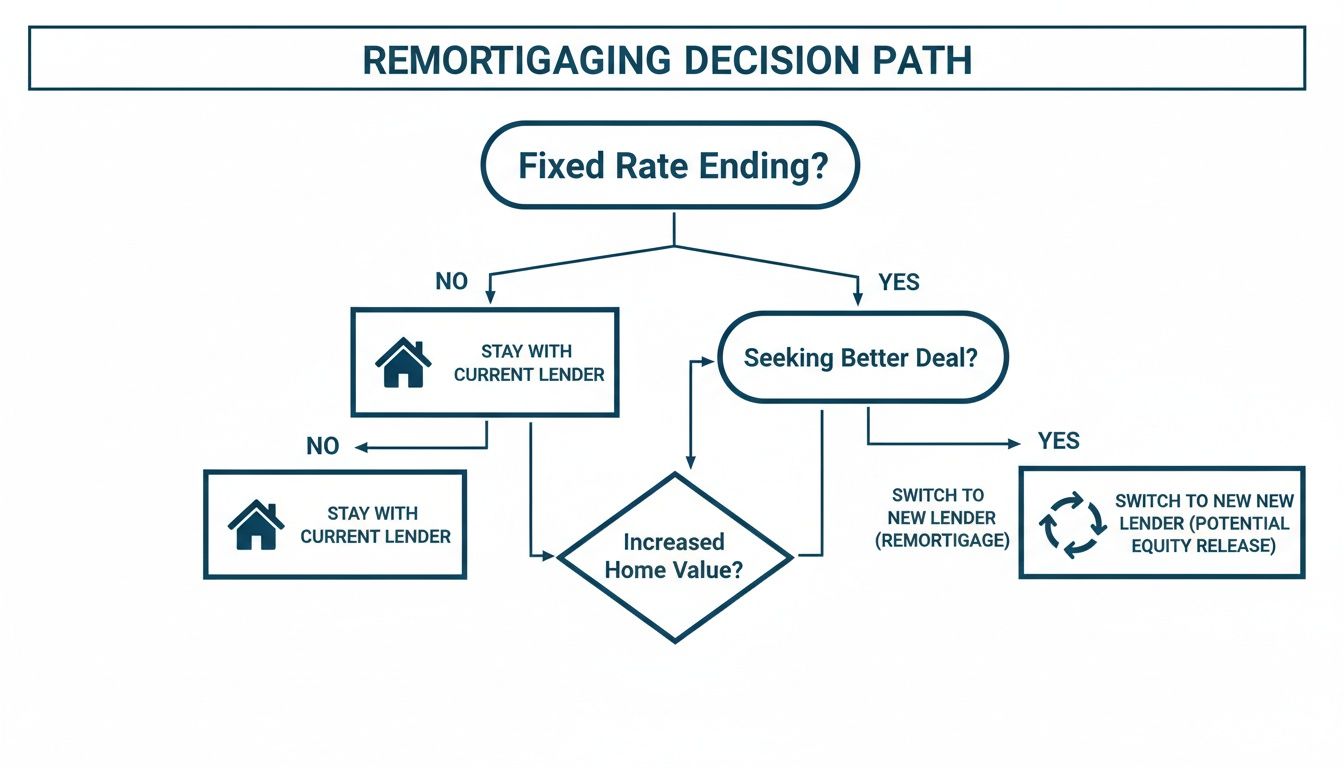
Ultimately, it highlights the fundamental question: Does staying put offer enough convenience to outweigh the potential savings from switching lenders?
Building Your Foundational Knowledge
Our goal is to give you a clear, foundational understanding of your options. We want to empower you to weigh the convenience of staying against the potential savings of switching providers.
For those just starting their homeownership journey or looking back on the initial steps, a detailed checklist for first-time homebuyers can illuminate the foundational process of securing financing. This foundational knowledge is crucial, and you can learn more about the specifics of the process in our guide to remortgaging a house.
Product Transfer vs Full Remortgage: What’s The Difference?
When your current mortgage deal comes to an end, you’ll find yourself at a crossroads with two main paths to choose from. Grasping the difference between a product transfer and a full remortgage is key to making the right decision. Think of it like your mobile phone contract: do you stick with your current provider and take one of their renewal deals, or do you shop around for a brand new plan?
A product transfer is the simple renewal option. You’re essentially just switching to a new rate offered by your existing lender. The process is usually quick, straightforward, and involves minimal fuss.
In contrast, a full remortgage means starting from scratch. It involves a complete application for a new mortgage – either with your current lender or a different one – which means going through thorough affordability checks and often getting a new property valuation. For homeowners everywhere, including those in Braintree, understanding this distinction is crucial to your financial future.
Understanding The Key Differences
These two options differ massively in terms of speed, cost, and the level of scrutiny you’ll face. A product transfer often lets you bypass new, in-depth affordability checks, which can be a huge plus if your income or employment situation has changed since you first took out your mortgage.
On the other hand, a full remortgage opens the door to the entire market. This means you could find a much more competitive interest rate, saving you a significant amount of money over the long run. This is a critical point, especially given the recent activity in the UK remortgage market. Last year, external remortgaging hit an estimated £71 billion a 17% increase driven by around 1.8 million fixed-rate deals expiring. You can dig into the numbers with these UK Finance mortgage market forecasts.
A Side-By-Side Comparison
To make the choice clearer, it’s useful to line up the features of each option side by side. This lets you properly weigh up what matters most to you, whether that’s avoiding paperwork or securing the lowest possible monthly payment.
Here’s a breakdown comparing a product transfer with a full remortgage.
| Feature | Product Transfer (Same Lender) | Full Remortgage (New Lender) |
|---|---|---|
| Speed | Typically very fast, often just a few clicks. | Slower process, can take several weeks. |
| Checks | Usually, no new affordability or credit checks. | Full affordability and credit checks required. |
| Costs | No legal or valuation fees are typically needed. | Often involves solicitor and valuation fees. |
| Rate Access | Limited to deals offered by your current lender. | Access to thousands of deals across the market. |
Ultimately, choosing between these two paths comes down to your personal circumstances. If speed is your main priority and your situation hasn’t changed much, a product transfer might seem like the obvious choice. However, if finding the very best deal is your goal, then exploring a full remortgage is the only way to be sure you’re not missing out.
The Pros and Cons of Staying with Your Lender
So, you’re weighing up whether to stick with your current lender or jump ship. It’s a big decision, and the main reason you’re staying put is almost always convenience. But as many homeowners in Chelmsford have discovered, simplicity can come with a pretty significant catch.
Let’s be honest, the process of a product transfer is often refreshingly simple. There’s usually very little paperwork, no need to go through the stress of new affordability checks, and no solicitor fees to find. It’s a tempting offer, especially if you’re short on time or if your circumstances have changed since you first took out your mortgage.

To help you decide, here’s a straightforward look at the pros and cons of sticking with your current provider.
| Aspect | Pros | Cons |
|---|---|---|
| Speed | Quick and efficient, often arranged with a simple call or online. | You might rush into a deal without seeing better offers elsewhere. |
| Simplicity | Minimal paperwork and no need for a solicitor. | The easiest option isn’t always the most financially savvy one. |
| Checks | Usually, no new affordability or credit checks are needed. | New lenders might offer better rates if your credit has improved. |
| Costs | No valuation or legal fees, saving you money upfront. | Potential long-term costs from a higher interest rate can be substantial. |
| Rates | Avoids the lender’s high Standard Variable Rate (SVR). | The new rate is unlikely to be the best deal on the open market. |
As you can see, it’s a real balancing act between short-term ease and long-term savings. Let’s dig into those points a bit more.
The Advantages of Simplicity
The biggest arguments for remortgaging with the same lender really boil down to speed and avoiding hassle. This path can be a real lifesaver in certain situations.
- Speed and Efficiency: A product transfer can sometimes be completed in just a few clicks or with a quick phone call. It’s worlds away from the time it takes for a full remortgage application.
- No New Affordability Checks: This is a huge one. If your income has dipped, or you’ve recently become self-employed, dodging a new affordability assessment can be a massive relief.
- Cost & Time Savings: You’ll almost certainly sidestep the time and cost of a new property valuation or any solicitor fees (although many remortgage products have free legals and valuations), which can take a bit of time.
For some people, these benefits make a product transfer the only sensible choice. If you’ve had a recent change in your job or a drop in income, it might be the only straightforward way to avoid ending up on your lender’s expensive Standard Variable Rate (SVR).
The Risk of the ‘Loyalty Tax’
Now for the flip side. The single biggest drawback of staying put is the very real risk of paying a ‘loyalty tax’. Think about it: your current lender only has to offer you a rate that’s better than their own eye-wateringly high SVR. They have zero obligation to compete with the best deals available across the entire market.
This lack of competition is where you can lose out. A slightly lower interest rate from a new lender might not sound like much, but it could translate into a lower monthly payment and add up to thousands in savings over the fixed term. The convenience of staying could end up being a very expensive shortcut.
Ultimately, the choice comes down to a trade-off. Is the ease of a product transfer worth the potential cost of not getting the best available rate? The only way to know for sure is to see what other lenders are willing to offer.
Navigating The Product Transfer Process Step by Step
So, you’ve weighed up the options and decided a product transfer is the right move for you. What happens next?
The whole process is designed to be pretty straightforward, mostly just a bit of admin. Knowing the timeline helps you feel in control, so let’s walk through it.
Your journey usually begins when your lender contacts you, typically around three to six months before your current mortgage deal ends. They’ll send you a letter or an email with a new set of offers, often directing you to an online portal to see the details.

Reviewing Your Lender’s Offer
Once that offer lands, the ball is firmly in your court. It’s absolutely vital to go through it with a fine-tooth comb – look at the interest rates, the length of the new deal, and any attached fees.
This is the perfect time to call a broker. We can quickly benchmark those offers against what’s happening in the wider market to see if you’re genuinely getting a competitive deal or just the easy option.
Remember, the mortgage market can change in the blink of an eye. Last year, for instance, remortgage business jumped from making up 21.3% of all mortgage lending in one quarter to 29.0% in the next – a huge leap of 7.7 percentage points. That shows just how quickly rates and deals can shift.
Finalising the Switch
If you’re happy to go ahead, finalising the switch is usually a piece of cake. Most of the time, you can do it online or by phone. You’ll need to formally accept one of the offers before the deadline your lender gives you.
Pay very close attention to that deadline. If you miss it and don’t do anything, your mortgage will automatically flip onto your lender’s Standard Variable Rate (SVR). Trust me, that’s almost always a much more expensive place to be.
For a deeper dive into timings, our guide on how long a mortgage application can take is a great read.
Once accepted, your new rate will take effect the day after your old one expires. There’s no break in your payments, and it’s all designed to keep you with your lender with minimal fuss. But making sure that the deal is truly right for you is where a bit of expert guidance for homeowners in areas like Colchester and across Essex can make all the difference.
Why a Broker Is Essential Even When Staying Put

It’s a common line of thinking: if you’re planning to remortgage with the same lender, why not go direct and cut out the middleman? A product transfer seems simple enough, but going it alone can be a costly mistake.
Even if you fully intend to stay put, using an independent, whole-of-market broker is vital. Why? Because without a professional to benchmark the deal, you have no way of knowing if your lender’s offer is genuinely competitive or just conveniently mediocre. We provide that crucial context.
Think of it as getting a second opinion before a major financial decision. A broker’s first job is to show you exactly how your lender’s renewal rate stacks up against the best deals available elsewhere. This knowledge isn’t just about switching; it’s about validation and peace of mind.
Gaining Leverage and Clarity
Knowing what’s happening across the market gives you power. If a broker finds several other lenders willing to offer you a significantly lower rate, they can look after that application process and check for further rate cuts over the coming months.
This need for an expert overview is a growing trend. Broker search activity for remortgaging products surged by 34% early last year, indicating that more people are seeking professional advice. The shift was even more dramatic among older borrowers, with a 76% jump in searches for those aged 65 and over.
Comparing rates is just one piece of the puzzle. For a full breakdown of how our role differs from going direct, you might find our guide comparing a mortgage broker vs going to a bank useful.
Navigating Complex Scenarios
For many homeowners, a broker’s support becomes non-negotiable when personal circumstances aren’t straightforward. A product transfer might seem like the easiest path, but an expert can often find far better solutions that you wouldn’t discover on your own.
Consider these common situations where a broker is indispensable:
- Self-Employed Borrowers: Lender criteria for self-employed income can be strict and may have tightened since your last application. A good broker knows which lenders are more flexible with company directors or sole traders.
- Adverse Credit: If you’ve had a few credit hiccups, your current lender might see a simple transfer as your only option. However, a specialist broker can connect you with lenders who view your case more sympathetically.
- Later-Life Lending: As you approach or enter retirement, your mortgage options change completely. A broker specialising in later-life lending can advise on products like Retirement Interest-Only (RIO) mortgages that a high-street lender may not offer.
- Changed Lender Criteria: Lenders update their rulebooks regularly. The criteria you met a few years ago might no longer apply, which could complicate even a simple renewal. We stay on top of these changes for you.
In every case, a broker provides a vital safety net. We navigate the complexities, ensuring that staying with your current lender is a conscious, informed choice—not just the default option because it seems easier. We’re your partner in making the right call.
Making Your Final Decision And Taking Action
So, your current mortgage deal is coming to an end. It’s time to weigh your options and figure out what’s next for your finances.
The choice really boils down to one thing: balancing the sheer convenience of a quick product transfer against the potential savings of shopping around. Your personal circumstances and plans – such as whether you need to borrow more money – will ultimately guide your decision.
But if there’s one thing to take away from all this, it’s that you can only be sure you’ve got the best possible deal by comparing your lender’s offer with the entire market. Taking the easy route of remortgaging with the same lender without properly looking around could mean you end up overpaying for years. A little proactivity now puts you back in the driver’s seat.
Whether you’re in Chelmsford, Braintree, or anywhere else in Essex, our job as independent brokers is to find the right fit for your unique situation. We bring the market insight and clarity you need to make an informed choice, ensuring you don’t get penalised for loyalty.
Your financial future is far too important to leave to chance. Let us help you review all the options on the table and lock in the best rate for you.
Your Questions Answered
We’ve covered many of the details when it comes to remortgaging with the same lender. To tie up any loose ends, here are the answers to a few common questions we get from homeowners across Essex.
Can My Lender Refuse a Product Transfer?
Yes, they can, although it’s quite rare. A lender would usually only refuse a product transfer if your financial situation has taken a significant turn for the worse since you first took out your mortgage.
The most common reasons for a rejection include:
- Falling into mortgage arrears: If you’ve missed payments, your lender will naturally be reluctant to offer you a new deal.
- A major negative change to your credit file: While most lenders don’t do a full credit check for a simple transfer, some might run a light check or review your payment history with them.
- Breaching your mortgage conditions: This could include renting out your property without getting their permission first. Breaking the original terms is a red flag for them.
If you find yourself in this situation, it’s a good idea to speak with a mortgage broker straight away to figure out your next steps.
Do I Need to Get a Solicitor Involved?
Thankfully, no. One of the biggest perks of a product transfer is that you don’t need to hire a solicitor. This is a key difference from a full remortgage with a new provider, where legal work is a must-have to switch the lender’s legal charge on the property.
Because you’re just moving to a new rate with your current lender and your name on the title deeds isn’t changing, there’s no legal paperwork required. This saves you a fair bit of time and money – solicitor fees on a standard remortgage can easily run into several hundred pounds if not paid for by the new lender.
Can I Borrow More Money with a Product Transfer?
As a rule, no. A standard product transfer is designed to change the interest rate on the amount you already owe. If you’re looking to raise extra cash – perhaps for some home improvements or to consolidate other debts – your lender will almost certainly ask you to apply for a full remortgage.
This means you’ll need to go through all the usual affordability and credit checks, even though you’re staying with them. The whole process becomes much more like starting a brand-new mortgage application from scratch.
Are you ready to find out if your lender’s renewal offer is truly the best deal for you? At EHF Mortgages, we provide a whole-of-market comparison to give you the clarity and confidence you need. Don’t leave money on the table – contact us today to secure your best rate and make a decision you won’t regret.