💡 Top Tip: Choosing a product transfer to remortgage with the same lender can save you a surprising amount of time, stress, and hundreds of pounds in legal and valuation fees. We’ll break down exactly how this works throughout this guide.
Table of Contents
Should You Remortgage With Your Same Lender in 2026?
When your fixed-rate mortgage deal is drawing to a close, you’re faced with a big decision: should you switch to a new lender or stick with your current one? The answer isn’t always as simple as it sounds.
This guide demystifies the process of staying with your existing provider, an option often called a product transfer. We’ll explore why so many homeowners across Essex, from Chelmsford to Colchester, are considering this path to avoid being shunted onto their lender’s expensive Standard Variable Rate (SVR).
Choosing whether to stay or switch is one of the most critical financial decisions you’ll make as a homeowner. It directly impacts your monthly payments, the total interest you’ll pay, and your financial freedom for years to come. Get it wrong, and you could end up paying thousands more than you need to.
Your Two Main Paths
At its core, you have two choices. You can either accept a new mortgage deal from your current lender or go through a full remortgage application with a new provider. Each option has its own set of pros and cons, which will vary depending on your personal circumstances – things like changes to your income, your credit score, or even your property’s value.
This flowchart gives you a simple way to visualise the decision between sticking with your lender and shopping around.
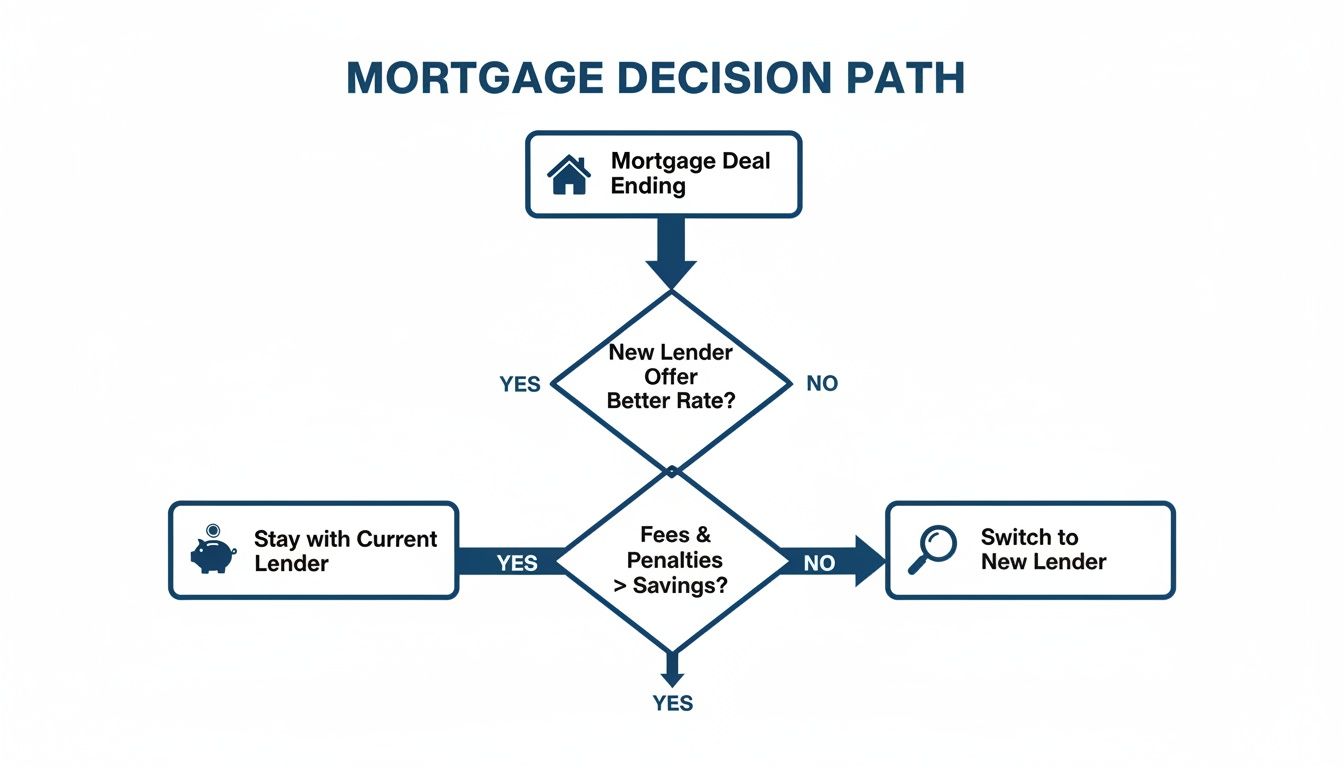
The key takeaway? While staying put is often simpler, switching lenders opens you up to the entire mortgage market, which could mean finding much better rates. It’s a classic trade-off: weigh the convenience of a product transfer against the potential savings of finding a more competitive deal elsewhere.
Why Acting Early Is Crucial
You can usually start looking at new deals three to six months before your current one expires. It’s absolutely vital to act early.
If you’re thinking about your next move, you might find our guide on remortgaging early useful, as it explains the timelines and potential fees. Taking action in good time means you can lock in a new rate and avoid the costly trap of falling onto your lender’s SVR.
Understanding a Product Transfer vs a Full Remortgage
When it’s time to find a new mortgage deal, you’ll hear two key terms: ‘product transfer’ and ‘full remortgage’. Knowing the difference is crucial, as the path you choose affects everything from the paperwork involved to the deals you can access.
Think of it like your mobile phone contract. A product transfer is like renewing with your current provider – you stick with them, pick one of their new offers, and the whole thing is usually quick and straightforward.
A full remortgage, on the other hand, is like switching to a completely new mobile network. This means a new application from scratch, fresh credit checks, a deep dive into your finances, and all the legal work needed to move your loan to a new lender.

What Is a Product Transfer?
A product transfer is simply an internal switch. You move from your current mortgage deal to a new one offered by your existing lender. It’s the simplest way to remortgage if you decide to stay put.
The biggest draws are speed and simplicity. Because your lender already knows you, they often skip the heavy-duty checks that come with a brand-new application.
This can be a huge relief, especially if your income or personal circumstances have changed since you first got your mortgage.
How Does a Full Remortgage Differ?
A full remortgage involves taking your entire mortgage from your current lender and moving it over to a new one. This process is much more involved, as the new lender will treat you as a completely new customer.
You’ll need to be prepared to supply:
- Detailed proof of your income and outgoings.
- Recent bank statements.
- Permission for a full credit check.
The new lender will also almost certainly require a fresh valuation of your property and will need a solicitor to handle the legal side. While a product transfer is a streamlined affair, a full remortgage can open up a wider world of possibilities, such as refinancing your mortgage to consolidate debt and bringing other financial commitments under one roof.
Making this choice has become a major focus for homeowners recently. In the first quarter of 2025, remortgage activity in the UK shot up by 34% compared to the previous quarter. This was largely driven by 1.8 million fixed-rate deals coming to an end, prompting people to lock in new terms as interest rates shifted.
Product Transfer vs Full Remortgage: A Quick Comparison
To help you see the differences at a glance, we’ve put together a simple comparison table. It clearly lays out what to expect, whether you stay with your current lender or move to a new one.
| Feature | Product Transfer (Same Lender) | Full Remortgage (New Lender) |
|---|---|---|
| Application Process | Simple and often online | Full application required |
| Affordability Checks | Usually not required | In-depth assessment needed |
| Credit Check | Typically, no new hard check | Always required |
| Legal Fees | None | Required (solicitor needed) |
| Valuation | Often automated or waived | A new valuation is usually needed |
Getting to grips with these distinctions is the first step. Our guide to remortgaging a house breaks down the full process in more detail if you’re looking to switch.
Ultimately, there’s no single ‘right’ answer. A product transfer is perfect for a fast, no-fuss switch. But a full remortgage gives you access to the entire market, which could save you a significant amount of money over the life of your deal.
The Pros and Cons of Staying with Your Lender
Deciding whether to stick with your current mortgage lender is a classic battle of convenience versus opportunity. A product transfer, where you take a new deal from your existing provider, is an appealingly simple path. But this ease comes with trade-offs you need to understand before you commit.
Weighing the advantages against the drawbacks is the only way to make a truly informed choice that benefits your finances, both now and in the years to come. Let’s break down exactly what you gain and what you might lose when you opt to stay put.

Advantages of a Same Lender Remortgage
The biggest pull of a product transfer is its simplicity and speed. For many homeowners, especially those with busy lives, avoiding a mountain of paperwork is a huge plus.
The main benefits typically include:
- No New Affordability Checks: This is probably the biggest advantage. If your income has dropped, you’ve become self-employed, or your spending habits have changed, you can lock in a new rate without going through a full financial MOT.
- Minimal Paperwork: The process is significantly lighter than a full remortgage application. You won’t need to dig out months of bank statements, payslips, and other documents.
- Reduced Costs: You almost always avoid the extra costs that come with switching. There are usually no legal fees or valuation fees, which can easily save you hundreds of pounds.
- Speed and Efficiency: A product transfer can often be wrapped up in a matter of days. A full remortgage with a new lender, on the other hand, can take several weeks or even months to complete.
This simplified route offers a crucial safety net. With 1.8 million fixed-rate mortgages set to mature in 2025, sticking with the same lender can be a lifeline for UK homeowners feeling the economic pressure. Recent figures show that remortgage advances now account for 29.0% of gross lending, while arrears have actually fallen. This suggests borrowers are navigating these transitions well, often through product switches that bypass new credit checks and speed things up. In areas like Colchester, this is a game-changer for those with complex cases or adverse credit. You can explore more UK mortgage statistics and learn about the latest trends.
Disadvantages of a Same Lender Remortgage
While the convenience is tempting, it can come at a real cost. The biggest drawback is the risk of missing out on a much better deal available on the open market.
Here are the key cons to think about:
- Limited Choice: You’re restricted to whatever deals your current lender offers. These are rarely the most competitive rates available across the whole market.
- Potential for Higher Rates: Lenders know many customers will stay put for an easy life. The rates offered in a product transfer are often slightly higher than those used to attract new customers.
- No Option to Borrow More: A standard product transfer is a like-for-like switch. If you want to raise extra cash for home improvements or debt consolidation, you’ll almost certainly need to do a full remortgage application.
- Inability to Change Mortgage Terms: Want to shorten or extend your mortgage term? Or maybe switch from a repayment to an interest-only mortgage? A product transfer just isn’t designed for that.
Ultimately, it’s a balancing act. The ease of a product transfer is a major draw, but you should never accept it without first seeing what other lenders can offer. A mortgage broker can run this comparison for you, making sure you don’t sacrifice a great rate just for a simple process.
When a Product Transfer Is Your Smartest Move
While a product transfer is often labelled the “easy option,” for many homeowners it’s actually the most strategic one. Choosing to stick with your current lender isn’t just about dodging paperwork; it’s a calculated decision that can protect your financial standing when switching might be tricky or expensive.
There are some very real-world scenarios where a remortgage with the same lender is the only sensible option. These situations usually pop up when your personal or financial circumstances have changed since you first got your mortgage, turning a new application elsewhere into a potential minefield.
Let’s walk through the key moments when a product transfer isn’t just convenient – it’s the smartest play you can make for your property in Chelmsford or wider Essex.
Your Financial Situation Has Changed
This is far and away the most common reason to go for a product transfer. A new lender will put your finances under a microscope, but your existing one usually won’t.
A product transfer is often your best bet if:
- Your Income Has Decreased: Maybe you’ve cut back your hours, taken a lower-paid job, or are on maternity leave. A new lender’s affordability maths might not work out for you, but a product transfer typically sails through with no new income checks.
- You’ve Become Self-Employed: Most new lenders want to see at least one to two years of accounts from self-employed applicants. If you’ve recently launched your own business, your current lender will probably let you switch to a new rate without demanding proof.
- Your Credit Score Has Dropped: A couple of missed payments or a new loan can put a dent in your credit score. A product transfer normally sidesteps any new hard credit checks, protecting you from a potential rejection.
Issues with Your Mortgage or Property
Sometimes, the roadblock isn’t your personal finances but something to do with the loan or the property itself. These are classic cases where staying put is the most sensible path. Of course, market conditions play a big part in any decision; for instance, understanding current mortgage rate changes can really shape your thinking.
You should definitely consider a product transfer if you have:
- A Small Mortgage Balance: If you only have, say, £50,000 left on your mortgage, the legal and valuation fees for switching could easily cancel out any savings from a slightly better interest rate. A product transfer has none of these costs.
- An Interest-Only Mortgage: New lenders have incredibly tight rules for interest-only mortgages. If your repayment plan or equity level doesn’t tick their boxes, your existing lender may be the only one prepared to offer you a fresh deal.
- A Unique or Non-Standard Property: Homes with unusual construction, a commercial element, or a short lease can be a real headache for mortgage lenders. A new lender might view it as too risky, whereas your current one already has it on their books and is usually happy to offer a new rate.
When you see it laid out like this, a remortgage with the same lender transforms from a simple choice into a genuinely savvy financial strategy. It’s the move that ensures you can swerve your lender’s expensive Standard Variable Rate and lock in a new deal, no matter what new complexities life has thrown your way.
Your Step-by-Step Guide to the Product Transfer Process 2026
Thinking about a product transfer? This is your roadmap for remortgaging with the same lender. It’s a much simpler route than a full remortgage, but knowing the key steps is vital to make sure you get the best deal and don’t end up paying over the odds.

Step 1: Receive Your Lender’s Initial Offer
Your journey usually kicks off around three to six months before your current mortgage deal is set to end. Expect a letter or email from your lender outlining their new product transfer offers.
Think of this letter as the starting pistol. It’s the official nudge to plan your next move and avoid being automatically shifted onto their expensive Standard Variable Rate (SVR).
Step 2: Do Not Accept the First Offer
It’s tempting, isn’t it? Just tick the box and accept the deal they’ve sent over. Easy. But this is rarely the best financial decision. Lenders know that many people will take the path of least resistance.
Instead, use this offer as your baseline. It’s the absolute minimum you should settle for, and it’s the perfect opportunity to see if you can do better. This is precisely where getting professional advice pays off.
Step 3: Engage a Whole-of-Market Mortgage Broker
Even if you’re pretty sure you want to stay put, speaking to an independent broker is crucial. A broker works for you, not the lender. Their only job is to find the best possible deal for your circumstances, no matter which lender provides it.
Here’s what a good broker will do:
- Market Comparison: They’ll stack your lender’s offer up against deals from dozens of other lenders across the market to see if switching could save you a significant amount of money.
- Exclusive Deals: Brokers often get access to exclusive ‘retention’ deals from your current lender – rates that you can’t get by going direct.
- Handle the Application: Whether you decide to stay or switch, your broker will handle all the paperwork and admin, making the process smooth and stress-free.
Step 4: Secure Your New Rate
Once you and your broker have figured out the best route forward, be it a product transfer or a full remortgage – they will get the application sorted. The real beauty of acting early is that you can lock in a new rate months in advance. If interest rates climb before your old deal expires, you’re protected.
The trend to remortgage with the same lender has definitely grown, especially as fixed-rate deals from the pandemic’s ‘race for space’ era come to an end. FCA data shows owner-occupier remortgages hit 29.0% of gross advances in Q2 2025, the highest since early 2024. Many are choosing simple product transfers to sidestep extra fees. For anyone with a more complex case in Essex, brokers are essential for navigating these deals properly. You can discover more insights about 2025 remortgaging trends and see how they’re impacting homeowners.
By following these simple steps, you put yourself in the driver’s seat. You ensure convenience without sacrificing a competitive mortgage rate.
How a Broker Ensures You Get the Best Possible Deal
Even if you’re leaning towards staying with your current lender, you should never go it alone. An independent mortgage broker is your most powerful ally when you want to remortgage with the same lender, making sure that convenience doesn’t come at the cost of a great deal.
A broker’s job is to work for you, not the lender. We bring an impartial, expert eye to the entire market, confirming whether your lender’s product transfer offer is genuinely competitive or if there’s a much better deal waiting for you somewhere else.
The Power of an Independent Comparison
It’s easy to assume your lender will reward your loyalty with their best rate, but that’s rarely how it works. Lenders often reserve their most attractive deals to win over new customers, not to keep existing ones. By bringing in a broker, you get a full, transparent comparison.
We’ll break down:
- The interest rate your current lender is offering.
- Deals from dozens of other lenders, from high-street banks to specialist providers.
- Any associated fees, like arrangement or booking fees.
- The true cost of the mortgage over the initial fixed term.
This comparison gives you the power to make a decision based on hard numbers, not just a sense of familiarity. We make sure you see the complete picture before you commit to anything.
Access to Exclusive Broker-Only Deals
Here’s one of the best-kept secrets in the mortgage world: lenders sometimes offer better “retention” deals to brokers than they do directly to their own customers. Why? Because they know we bring them well-packaged, high-quality applications, and they want to keep that business.
This means we can often secure a more favourable rate from your existing lender than you could get on your own. It’s the best of both worlds – the simplicity of a product transfer, but with a rate you might not otherwise get. For more tips, check out our article on how to choose a mortgage broker to find the right expert for your situation.
At EHF Mortgages, we specialise in navigating the Essex mortgage market. This includes complex cases for the self-employed, landlords in Braintree, or anyone with a less-than-perfect credit history. Let us do the legwork to guarantee you’re making the best financial decision for your future.
Your Product Transfer Questions Answered
Got questions about sticking with your lender? You’re not alone. Let’s clear up some of the most common queries homeowners have about product transfers.
Can I Borrow More Money with a Product Transfer?
In a word, no. A standard product transfer is simply a new rate on what you already owe. It’s a clean swap, designed for speed and simplicity, not for raising extra cash.
If you need to borrow more for home improvements, to pay off debts, or for any other reason, you’ll need a proper remortgage. This means a full application, even with your current lender, including fresh affordability and credit checks.
Will My Lender Run a Credit Check for a Product Transfer?
This is one of the biggest perks. For a straightforward, like-for-like product transfer, lenders usually don’t run a new hard credit check.
It’s a huge relief if your credit history has a few bumps or if you want to avoid another search on your credit file. It allows you to lock in a new rate without the stress of a full credit assessment.
How Long Does a Product Transfer Take?
It’s fast. Seriously fast. The speed is a massive plus for busy homeowners in places like Braintree and right across Essex.
While a full remortgage to a new lender can drag on for weeks or even months, a product transfer can be sorted in just a few days once you’ve given the green light and completed the simple paperwork.
What Happens If I Do Nothing When My Fixed Rate Ends?
This is the one thing you absolutely must avoid. If you let your current deal expire without arranging a new one, your lender will automatically shunt you onto their Standard Variable Rate (SVR).
Think of the SVR as a lender’s default setting, and it’s almost always far more expensive than any fixed or tracker deal on the market. Your monthly payments could rocket overnight, costing you a fortune until you get it sorted. Acting before your rate ends is the only way to avoid this costly trap.
At EHF Mortgages, we’ll put your lender’s offer under the microscope and compare it against the whole market. We give you the clarity to know whether a product transfer is your best move or if switching could save you thousands.