💡 Top Tip: Believe it or not, some lenders are now looking at your solid rental payment history as a key factor in approving a no-deposit mortgage.
We’ll dive deep into how this works later in the article.
Table of Contents
- Can You Really Buy a Home with No Deposit?
- What is a modern no-deposit mortgage?
- The Real Pros and Cons of a 100% Mortgage
- Who Qualifies for a No Deposit Mortgage?
- Realistic Alternatives to a Zero Deposit Mortgage
- How a Mortgage Advisor Can Secure Your Home
- Frequently Asked Questions
Can You Really Buy a Home with No Deposit?
Watching house prices in Essex climb while you’re trying to scrape together a deposit can feel like an impossible, uphill battle. If that sounds familiar, this guide is for you. We’re going to unpack the reality of a no-deposit mortgage and show you how they’re making a quiet comeback for determined first-time buyers.
While they are not a mainstream option you will see advertised everywhere, specific routes like guarantor support and innovative new ‘track record’ mortgages are starting to open doors again. We completely get the frustration of watching your hard-earned rent money vanish each month when it could be building equity in a place you actually own.

This article will give you a clear, step-by-step roadmap to understanding this complex but potentially life-changing path to owning your own home in areas like Chelmsford. For a broader look at the buying journey, our guide to first-time buyer mortgages provides more essential background.
What is a modern no-deposit mortgage?

Let’s clear up what a modern no-deposit mortgage actually means. In a nutshell, it’s a loan that covers 100% of a property’s value, which is why you will often hear it called a 100% Loan-to-Value (LTV) mortgage. You borrow the full purchase price, meaning you do not need to put down a hefty cash deposit upfront.
Think about a traditional deposit for a moment. It’s essentially a safety net for the lender. If you could not pay your mortgage and they had to repossess the property, that deposit helps cover their potential losses. With a no-deposit mortgage, that safety net is not there, so lenders need another form of security to feel comfortable.
It is important to know that today’s 100% mortgages are nothing like the risky products that were around before the 2008 financial crisis. Lenders are much more cautious now, and these mortgages have strict safeguards built in. They are not available everywhere, but they do exist if you know where to look.
The Two Main Paths to a 100% Mortgage
For aspiring homeowners in places like Colchester and across Essex, there are two main ways to get a no-deposit mortgage on the board. Each route replaces the traditional cash deposit with a different kind of security for the lender. Getting to grips with how they work is the first step to seeing if one could work for you.
- Guarantor (Joint Borrower Sole Owner) Mortgages: This is the classic approach. A close family member, usually a parent, agrees to be a ‘guarantor’ or additional applicant, by using their own property or savings as security for your loan, as well as any surplus income of the parent.
- Rental History Mortgages: This is a more recent innovation. It allows you to use your strong track record of paying rent on time as proof that you can handle mortgage repayments.
Let’s dig into how each of these options works in the real world.
How Do These Options Work in Practice?
The mechanics of each pathway are quite different. With a guarantor (joint borrower & sole owner) mortgage, your family member commits to covering your mortgage payments if you are unable to. They offer security by either allowing a legal charge to be placed on their home or by putting a lump sum of savings into a special account held by the lender. As they may also be on the mortgage account, they need to ensure the monthly payment is made.
The rental history route, on the other hand, is a real game-changer for renters. A standout example is the innovative Track Record Mortgage from Skipton Building Society. Launched in May 2023, it quickly became a vital option for UK renters, with rates recently dropping to as low as 5.09% on a five-year fixed deal. This product is aimed squarely at people with a solid 12-month rental payment history who are stuck behind the deposit barrier. You can read more about the recent rate changes on Mortgage Soup.
Here’s a quick comparison of the two main types of no-deposit mortgages.
| Feature | Guarantor / JBSP Mortgage | Rental History Mortgage |
|---|---|---|
| Main Requirement | Family member’s property or savings | 12+ months of proven rental history |
| Who It’s For | Buyers with family financial support | Renters with excellent payment records |
| Lender’s Security | Guarantor’s assets | Your track record of affordability |
| Key Benefit | Access to 100% borrowing | Turns rent payments into a positive |
Ultimately, both routes are designed for people with a good income and a clean credit file who just have not been able to save up the large sum needed for a deposit.
The Real Pros and Cons of a 100% Mortgage
A no-deposit mortgage can feel like finding a golden ticket, especially when you’re desperate to stop renting and start owning. But before you jump in, it’s absolutely vital to look at both sides of the coin. The upsides are tempting, but the downsides carry real weight, and you need to see how they stack up against your personal situation.
The biggest ‘pro’ is obvious: speed. A 100% mortgage can get you onto the property ladder years ahead of schedule. For young professionals in commuter towns like Braintree or Chelmsford with a solid income but who haven’t had time to build a large savings pot, this is a genuine game-changer.
Instead of watching house prices climb while you spend another few years saving, you could be in your own home, building your own equity. That head start is the main reason why these mortgages are so appealing.
The Advantages of a No Deposit Mortgage
Beyond just getting the keys faster, there’s another huge plus. A 100% mortgage means the deposit does not completely wipe out your savings. You can keep that cash for all the other costs that crop up when you buy a house.
People often forget about these, but they add up fast:
- Legal Fees: Paying your solicitor for all the conveyancing work.
- Valuation and Survey Fees: These are essential checks to make sure the property is worth what you’re paying and is not about to fall.
- Stamp Duty: A government tax on property purchases (though many first-time buyers get a discount or are exempt).
- Moving Costs and Furnishings: The actual cost of moving your life from one place to another, plus buying the basics for your new home.
Having that cash buffer for these expenses makes the whole process far less stressful. It’s a safety net for any surprises along the way.
The Significant Risks and Downsides
Now for the reality check. The ‘cons’ of a no-deposit mortgage are serious and can have long-term financial consequences. Lenders view these as higher-risk loans and price them accordingly. That means you will almost always face higher interest rates compared to a mortgage with even a small deposit.
That higher rate translates directly into more expensive monthly payments, eating into your budget for the entire initial fixed term. But the biggest risk of all? Negative equity.
This is the scenario every homeowner dreads. It’s when the market value of your home drops below the outstanding balance on your mortgage. Let’s say you buy a place in Colchester for £300,000 with a 100% mortgage. If the local market dips by just 5%, your home is now worth £285,000, but you still owe pretty much the full £300,000 to the bank.
If you’re in negative equity, it becomes incredibly difficult, often impossible, to sell or remortgage to a better deal. You’re effectively trapped until property prices recover or you’ve paid off a big chunk of your mortgage.
To help you weigh everything up, we’ve put together a simple table that lays out the key trade-offs.
Pros vs Cons of a No Deposit Mortgage
This table breaks down the main advantages and disadvantages you’ll face when considering a 100% LTV mortgage.
| Aspect | Advantages (Pros) | Disadvantages (Cons) |
|---|---|---|
| Market Entry | Get on the property ladder much faster. | Higher interest rates mean costlier monthly payments. |
| Savings | Frees up cash for fees, moving, and furniture. | No initial equity buffer in your property. |
| Equity | Start building equity from your first payment. | Major risk of falling into negative equity. |
| Flexibility | Avoids years spent saving while renting. | Difficult to sell or remortgage if in negative equity. |
Ultimately, a no-deposit mortgage is a straight trade-off: you get the immediate reward of owning a home, but you take on a much higher level of long-term financial risk to get there.
Who Qualifies for a No Deposit Mortgage?
When a lender is putting up 100% of the money, they’re shouldering all the risk. It’s no surprise, then, that their standards are incredibly high. Getting a no-deposit mortgage is not like applying for a standard loan; it’s more like trying to get into an exclusive club with a very strict membership policy. You need to be a textbook example of a perfect applicant.
The absolute first hurdle is an excellent credit score. Lenders will be looking for a long, clean track record of you managing your finances flawlessly. This means zero missed payments, no defaults, and definitely no County Court Judgements (CCJs).
After that, they will put your income under a microscope. You must have a stable and sufficient income to prove you can handle the monthly repayments without breaking a sweat. For most of these products, your total borrowing will be firmly capped at around 4.5 times your annual salary.
Proving Your Affordability
This is where the path splits, depending on the type of no-deposit mortgage you’re after. The evidence you need for a ‘rental history’ mortgage is completely different from what’s required for a guarantor loan.
If you’re going down the rental history route, you will need to prove you’ve consistently paid your rent on time and in full. We’re talking about a solid period, usually at least 12 consecutive months. The crucial detail? The rent you were paying has to be the same as, or greater than, your new mortgage payment. It’s the lender’s concrete proof that you can manage the commitment.
Guarantor and Documentation Requirements
Opting for a guarantor mortgage shifts the financial spotlight onto your family member. It’s not enough for them to say they will back you; they have to pass the lender’s own rigorous checks.
A guarantor will almost always need to have:
- Substantial equity in their own home, or a hefty amount in savings.
- A high, independent income of their own.
- A spotless credit history.
- They must also meet the lender’s age requirements, as their guarantee may be needed for many years.
These specialist products have seen a recent resurgence. In 2024, the UK market saw a remarkable 32% jump in zero-deposit mortgages, rising from 470 loans in 2023 to 622, worth a combined £197 million. To put that in perspective, loans with LTVs over 95% made up 6.1% of the market in 2007 but fell to just 0.35% in 2024, underscoring how niche these deals are today. You can learn more about the recent mortgage surge on if a magazine.com, where you can see the full figures.
This chart gives you a bird’s-eye view of the journey, from your initial thoughts right through to getting professional advice.
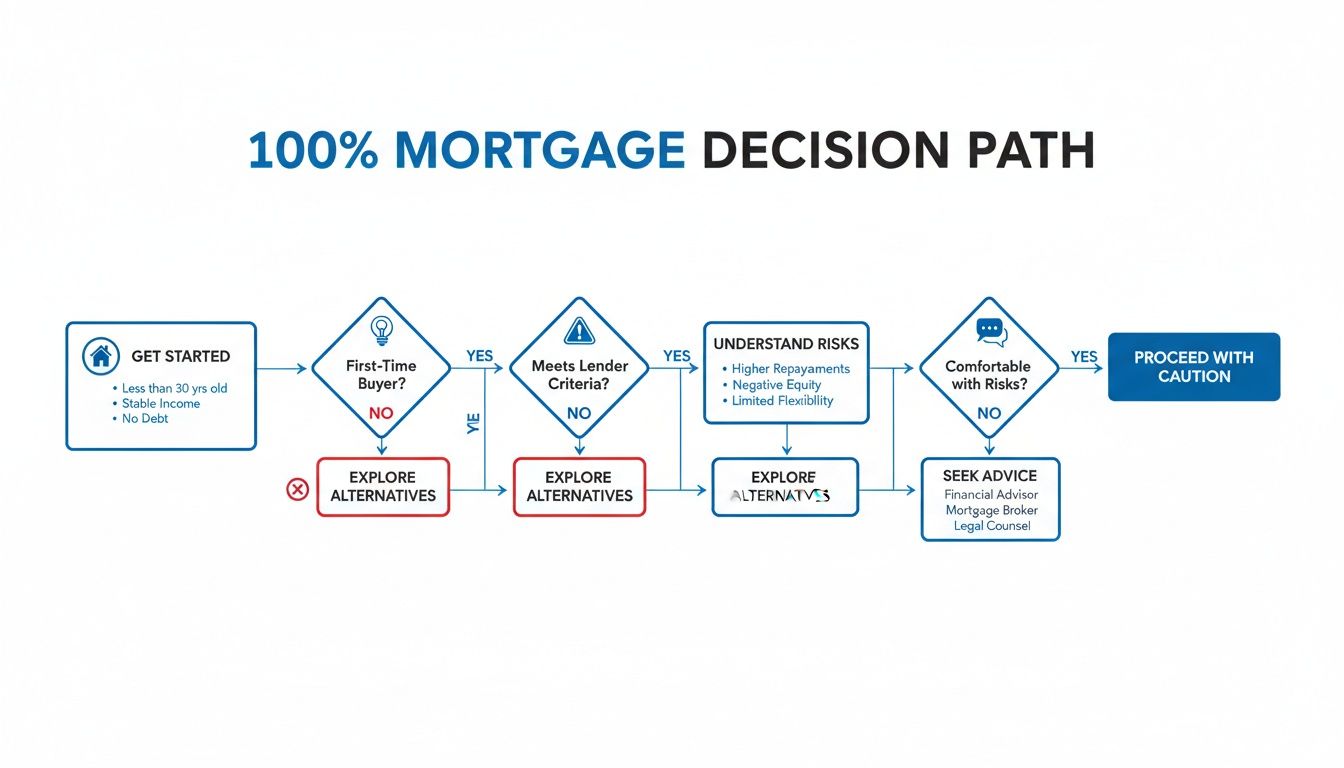
The big takeaway here is that fully understanding the risks and getting expert guidance are not just boxes to tick; they’re fundamental parts of the process. Whether you’re based in Braintree or elsewhere in Essex, having all your paperwork in order is vital. You’ll need to pull together a detailed file of payslips, bank statements, proof of rent, and your ID.
Realistic Alternatives to a Zero Deposit Mortgage in 2026
While the dream of a 100% mortgage is alive, the reality is that it’s a very niche product that will not be available or suitable for most people. But that’s far from a dead end.
Thankfully, there are several other well-trodden paths to getting the keys to your first home. For many buyers we work with in places like Chelmsford and Braintree, these alternatives are not just a backup plan; they are the most practical and successful routes to owning a property. Let’s break them down.
Gifted Deposits and Family Assistance
By far the most common alternative is a gifted deposit. This is where parents or other close relatives provide the funds for your deposit as an outright gift, with no strings attached and no expectation of repayment.
Lenders are perfectly comfortable with this, as long as it’s documented correctly. All they will need is a straightforward signed letter from the person giving you the money, stating clearly that it’s a true gift and not a loan in disguise. This simple act of family generosity is still the single biggest helping hand for first-time buyers across the country.
Shared Ownership Schemes in Essex
Another incredibly popular route, especially here in Essex, is Shared Ownership. This is a government-backed scheme that lets you buy a share of a property, usually between 25% and 75%, from a housing association. You then pay a more affordable, subsidised rent on the part you do not own.
The huge advantage here is that you only need to deposit the share you’re buying, not the whole property. So, for a 25% share of a £300,000 home in Colchester, you would only be buying £75,000 worth of it. A 5% deposit on that share would be just £3,750, a much more manageable figure than the £15,000 needed for a standard 5% deposit. You can find more information in our dedicated article about saving for a mortgage deposit.
High LTV Mortgages and Specialist Lenders
If a zero-deposit loan is not the right fit, exploring strategies for actively saving for a house can be a powerful alternative. Even saving a 5% deposit opens up a much wider world of 95% Loan-to-Value (LTV) mortgages.
This is where working with a whole-of-market broker like EHF Mortgages really makes a difference. We have access to specialist lenders who are often more flexible than the big high street names. These lender may have more accommodating criteria for people with complex incomes, such as freelancers, contractors, or small business owners.
Low-Deposit Homeownership Options Compared
To help you weigh up your options, this table breaks down the different routes to getting on the ladder with a smaller deposit.
| Option | Minimum Deposit Required | Key Feature | Best For | Key Consideration |
|---|---|---|---|---|
| Gifted Deposit | 5% of property price | Deposit funded by family as a gift. | Buyers with family who can help financially. | Requires a formal gift letter for the lender. |
| Shared Ownership | 5% of your share’s value | Buy a share, rent the rest from a housing association. | Buyers on a lower income or with a smaller deposit. | You pay rent on the share you do not own. |
| 95% Mortgage | 5% of property price | A standard mortgage with a small deposit. | Those who can save a small deposit on their own. | Interest rates can be higher than with a larger deposit. |
| Specialist Lender | 5% to 10% | More flexible income criteria for affordability. | Self-employed, contractors, or those with unique income. | May have slightly higher rates or fees than mainstream lenders. |
Looking into these realistic and often safer alternatives can dramatically improve your chances of getting a mortgage and finally owning your own home.
How a Mortgage Advisor Can Secure Your Home

Trying to make sense of the mortgage market, especially for lo-w and no-deposit products, can feel like navigating a maze. With specialist deals, very strict criteria, and real risks like negative equity, it’s easy to feel overwhelmed. This is where an expert mortgage broker not only helps, we can turn a daunting process into a clear, manageable journey.
Think of us as your personal project manager for buying a home. An experienced broker does far more than just find a product. We’re with you at every stage, from figuring out your options right up to the day you get your keys. For anyone even considering a no deposit mortgage, this level of support is absolutely vital.
The Power of Whole-of-Market Access
With over 35 years of experience helping clients across Chelmsford, Braintree, and the rest of Essex, we know the local property and mortgage landscape like the back of our hand. One of the biggest advantages we bring to the table is our whole-of-market access. This simply means we can look at every single option out there, from the big high-street banks to small, specialist lenders, not just the handful of deals you might find advertised online.
This is crucial because many of the best products for niche situations are only offered through brokers. In fact, speaking with experienced mortgage lending professionals is often the only way to discover the full range of options truly available to you.
Impartial Advice and Risk Assessment
Our first job is to sit down with you and assess your financial situation honestly. We need to work out if a 100% mortgage is genuinely the right path for you. We will stress-test your affordability, have a frank chat about the risks, and sometimes, the best advice we can give is to look at a safer, more affordable alternative that better protects you down the line.
As an independent, FCA-authorised firm, our advice is always impartial and focused entirely on your best interests, not the lender’s. This unbiased view is fundamental when you’re making one of the biggest financial decisions of your life. If you want to learn more about what to look for, you might find our guide on how to choose a mortgage broker useful. Your journey to homeownership deserves to be built on a solid foundation, and that starts with expert support.
Frequently Asked Questions
We get a lot of questions from clients across Chelmsford, Braintree, and Colchester about no-deposit mortgage. It’s a hot topic, so here are our thoughts on some of the most common queries we hear.
Are 100% Mortgages a Good Idea in 2026?
This is the million-dollar question, and the honest answer is: it completely depends. It’s a case of weighing up your personal finances, your appetite for risk, and the state oft the property market at the time.
For a diligent tenant with a perfect payment history and a steady income, a 100% mortgage can feel like a lifeline. It’s a way to finally break free from the rental cycle and get a foot on the property ladder. On the flip side, these deals always come with higher interest rates and the very real risk of negative equity if house prices take a dip. It’s absolutely vital to chat with a professional broker to properly understand the pros and cons of your specific situation before even considering applying.
Can I Get a No Deposit Mortgage with Bad Credit?
To be blunt, it is extremely unlikely. When a lender offers a 100% mortgage, they are shouldering every bit of the financial risk. It is only natural that they’re going to be incredibly selective. A key part of their checklist is an excellent credit history, which means no missed payments, no defaults, and certainly no County Court Judgements (CCJs).
If you have some blemishes on your credit file, the first job is to start the repair work. An experienced mortgage adviser can help you map out a clear plan to improve your score. We can also explore other routes, like saving a small deposit and working with specialist lenders who are more understanding of past credit issues.
What Happens If My Guarantor Wants to Be Removed?
This is a common concern for both the homeowner and the guarantor. Usually, a guarantor signs up for a fixed term or until the Loan-to-Value (LTV) ratio drops to a much safer level, typically around 75-80%. This happens naturally as you make your monthly repayments and, hopefully, as your property’s value increases over time.
To get the guarantor removed, you will need to formally apply to your lender. They will reassess your finances to see if you can comfortably afford the mortgage entirely on your own. If they’re happy with your income and the LTV is where it needs to be, they can release the guarantor from their legal commitment.
Is It Better to Use a Guarantor or Save for a 5% Deposit?
In most cases, saving for a 5% deposit is the safer and more straightforward option. Putting down your own money, even a small amount, opens the door to a much wider choice of lenders and more competitive interest rates. More importantly, you start day one with a bit of equity in your home, which acts as a crucial buffer against falling into negative equity.
A guarantor mortgage is a more niche product and a huge commitment for the family member who is financially tying themselves to your loan. That said, if saving a 5% deposit would take you years, while house prices might be climbing, a guarantor could be your fastest route to homeownership. There is no single ‘better’ option here; it’s a deeply personal choice that needs a serious chat with your family and a mortgage adviser.
At EHF Mortgages, our job is to give you clear, expert advice so you can weigh up every option with confidence. Ready to take the next step towards owning your own home?