Did you know that combining certain long-term benefits with even a small part-time income could be the key to unlocking a mortgage? It’s an opportunity many people overlook, and we’ll explain exactly how it works later in this guide.
It’s one of the biggest myths we hear: that receiving state benefits automatically puts homeownership out of reach. The reality is actually much more hopeful.
Your Guide to Mortgages on Benefits in 2026
Thinking about buying a home while receiving benefits can feel like a huge challenge, but it doesn’t have to be.
When it comes down to it, lenders are really only concerned with one thing: affordability. Can you comfortably and consistently meet your monthly mortgage payments over the entire life of the loan? For them, where the money comes from is far less critical than its stability.
This is excellent news because it means many long-term state benefits are treated the same as a salary from a job.
What This Guide Covers
We’ve put this guide together to give you a clear roadmap. Whether you’re in Chelmsford, Braintree, Colchester, or anywhere else in Essex, we want to show you what’s achievable. We’ll explain how lenders assess benefit income, what you’ll need for your application, and how a specialist mortgage broker can make all the difference.
- Understanding Which Benefits Lenders Accept
- How Lenders Calculate Your Affordability
- Using Government Schemes for Homeowners
- How to Strengthen Your Mortgage Application
- Navigating the Market with an Expert Broker
- Frequently Asked Questions About Benefit Mortgages
The journey to securing a mortgage on benefits is all about building a strong, clear case for your financial stability. It involves gathering the correct documents, understanding the lender’s perspective, and presenting your application in the best possible light. Great resources like the government’s MoneyHelper service can provide a solid foundation for your planning.
“Getting a mortgage is one of the biggest financial decisions you can make. With the right resources and support, the dream of homeownership can become a reality.”
Throughout this article, we’ll break down each step so you feel confident and prepared for the process ahead.
Ready to explore your options? Getting the right advice is the first step towards getting the keys to your new home. Contact our expert team at EHF Mortgages to find out how we can help.
Understanding Which Benefits Lenders Accept
When it comes to getting a mortgage on benefits, there’s one word lenders look for above all else: stability. They need to feel confident that your income is reliable over the long term so that you can meet your monthly payments without any trouble. This is precisely why they don’t see all benefits in the same light.
A good way to think about it is to imagine it as a river. A consistent long-term benefit like Personal Independence Payment (PIP) is a deep, dependable river that flows steadily year-round. On the other hand, a short-term benefit like Jobseeker’s Allowance is more like a seasonal stream that might dry up. Lenders will always feel safer building on the river’s foundation.
The journey to securing a mortgage might seem complicated, but it breaks down into a few simple stages.
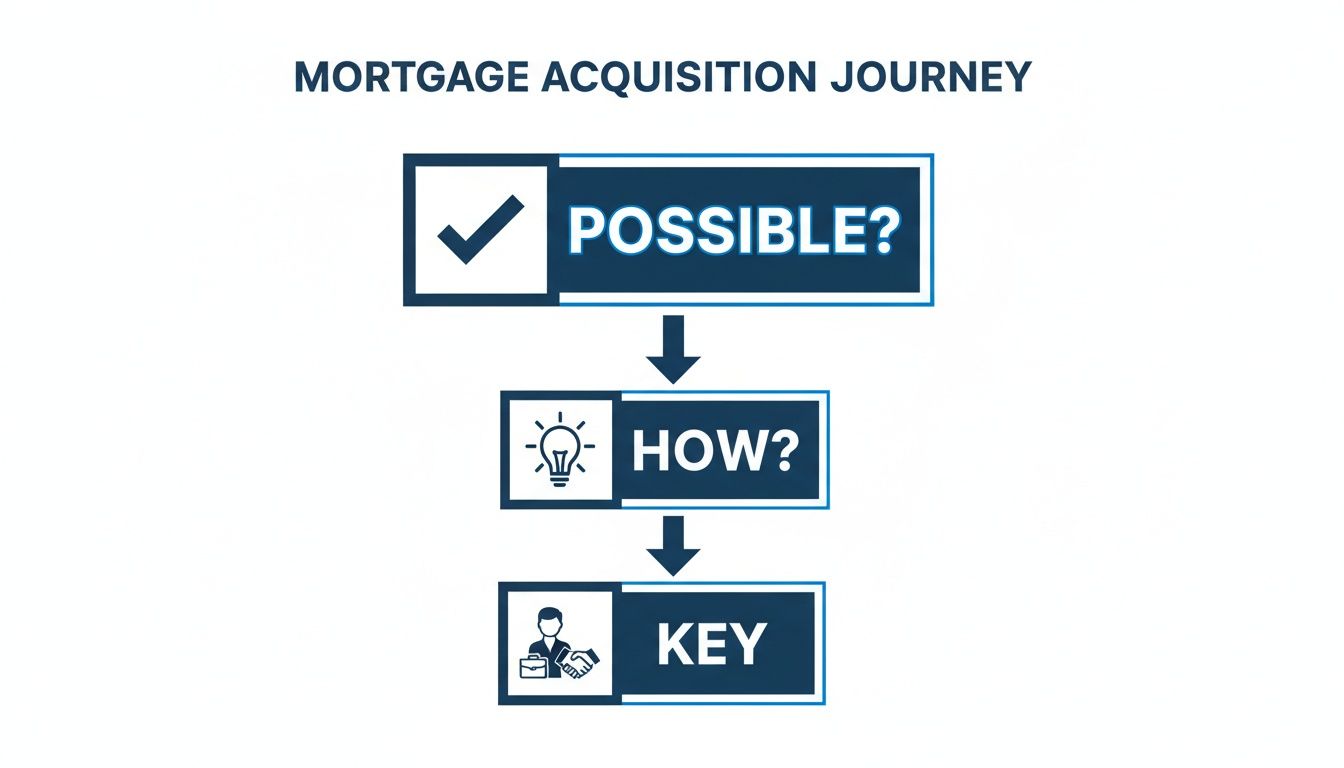
As you can see, getting a mortgage is definitely possible. The real challenge lies in the “how”, and that’s where a broker’s specialist knowledge becomes essential.
Long-Term vs Short-Term Benefits
Lenders draw an obvious line in the sand between benefits designed for long-term support and those meant to be a temporary stopgap. Getting your head around this distinction is the first step in building a strong application, as it helps you see your finances from their perspective.
Benefits that many lenders are happy to consider often include:
- Disability Living Allowance (DLA) or Personal Independence Payment (PIP) are usually awarded on a long-term or even indefinite basis.
- Carer’s Allowance, which is paid to someone providing ongoing care for another person.
- Child Benefit, although some lenders are cautious here. They might only count it if your children are young, since the payments will eventually stop.
- Specific Industrial Injuries Benefits are linked to long-term health conditions.
This table provides a quick overview of how lenders typically view different UK benefits, helping explain why some are more mortgage-friendly than others.
How Lenders View Different Types of UK Benefits
| Benefit Type | Common Examples | Typical Lender View | Reasoning |
|---|---|---|---|
| Long-Term Disability | PIP DLA Attendance Allowance | Often Accepted | Payments are stable and predictable, and are usually awarded for many years, giving lenders confidence. |
| Long-Term Care | Carer’s Allowance | Often Accepted | This reflects a stable long-term care arrangement that is recognised as a reliable income source. |
| Child Related | Child Benefit Child Tax Credit | Sometimes Accepted | Acceptance depends on the children’s age. Since payments aren’t lifelong, some lenders are wary. |
| Short-Term Support | Jobseeker’s Allowance Universal Credit (Standard) | Rarely Accepted | These are viewed as temporary support to bridge gaps in employment, but they lack the required stability. |
| Bereavement | Bereavement Support Payment Widowed Parents | Varies by Lender | Some lenders view this as stable income, while others treat it as temporary financial assistance. |
As you can see, the theme of long-term stability is what really matters.
Building Your Income Profile
Your main goal is to paint a complete and reliable picture of your income. For our local clients in Chelmsford, Braintree, or Colchester, this often means combining any eligible benefits with other sources of income you may have. This could be anything from part-time work or self-employment earnings to a private pension.
The more diverse and stable your income streams are, the stronger your application will be. A specialist broker knows precisely how to package this information correctly, making sure lenders see the full dependable value of your household income. As the Financial Conduct Authority (FCA) states, lenders have a duty to assess affordability responsibly, and this is where clear, well-documented evidence of your long-term income becomes absolutely critical.
How Lenders Calculate Your Affordability
When you apply for a mortgage while on benefits, lenders aren’t using some secret set of rules. They run the same affordability checks as they would for anyone else, but they put a much sharper focus on the long-term reliability of your income. It’s less about *where* the money comes from and much more about proving it will keep coming in month after month.
This whole process boils down to documentation. To put a lender at ease, you need to provide official proof that clearly demonstrates your financial stability. It’s on you to give them the evidence they need to say yes confidently.

Providing the Right Paperwork
To have your benefit income verified, you’ll need to provide specific documents. These are non-negotiable and form the absolute foundation of your application.
Official DWP Award Letters: These need to be recent and clearly show the benefit amount and how long you’ll receive it. An indefinite or long-term award will always look much stronger to a lender.
Bank Statements: You’ll typically need to provide three to six months of statements. These must show that benefit payments land in your account regularly and on time, confirming the figures on your award letter.
Lenders use this paperwork not just to determine how much you get but also to ensure its longevity. This evidence is crucial for them to lend responsibly and meet their strict regulatory obligations, as explained by the Financial Conduct Authority.
“Proving affordability is about building a story of financial stability. We help clients in Chelmsford and across Essex present their case clearly, ensuring lenders see the full picture of their reliable income, including long-term benefits.”
Understanding Income Multiples
Once your income is fully verified, lenders apply what’s called an income multiple to determine the maximum amount they’re prepared to lend you. This is standard practice right across the industry.
As a general rule, most lenders will offer to lend somewhere between 4 and 4.5 times your total annual income. But it is important to note that lenders need to assess your overall affordability, including your commitments and monthly deductions. High commitments will reduce your borrowing power.
So, for example, if your accepted benefits combined with a part-time job add up to £20,000 a year, a lender might offer you a mortgage between £80,000 and £90,000. Just remember this isn’t the final figure, they’ll also factor in your regular outgoings and any existing debts. You can dig deeper into this in our complete guide to understanding your borrowing potential.
Here at EHF Mortgages, we work with clients across Chelmsford, Braintree, and Colchester to package their financial information effectively. Our job is to present your situation in the strongest possible light, highlighting the stability and reliability of your entire income. This straightforward professional approach helps lenders see you as a dependable borrower, massively boosting your chances of getting your application approved.
Using Government Schemes for Homeowners
Beyond the benefits you receive, there are other government schemes designed to act as a safety net if you hit a rough patch after taking out your mortgage. The main one you need to know about is Support for Mortgage Interest (SMI), but there’s a massive distinction to make right from the start.
SMI is not a benefit payment in the traditional sense. It’s actually a government loan that’s secured against your property. Its purpose is to help you cover the interest portion of your mortgage payments if you’re on certain qualifying benefits, such as Universal Credit.
This means you will have to pay it back, with interest, when you eventually sell your home or transfer ownership. It’s a genuine lifeline for homeowners facing tough times, but it’s also a serious financial commitment that needs careful consideration. If you’re looking for other ways to get onto the property ladder with government help, you might find our guide on Shared Ownership schemes applicable.
How Does Support for Mortgage Interest Actually Work?
Getting your head around how SMI works is crucial. The scheme is designed to step in when things get difficult, but it has its own rules and timelines you need to be aware of.
The process usually breaks down into these key stages:
- Eligibility Check: First, you must be receiving a qualifying benefit. This list includes Universal Credit, Pension Credit, and income-based Jobseeker’s Allowance, among others.
- Waiting Period: Don’t expect the money to arrive overnight. There’s a waiting period before you can get your first payment. For most people on Universal Credit, this is a nine-month wait from when you first start your claim.
- Payment Structure: The payments aren’t sent to you. They go directly to your mortgage lender and only cover the interest on your loan, not the capital part you’re paying off.
This setup prevents your mortgage balance from increasing due to missed interest payments, but it’s important to remember you’re still responsible for repaying the original capital you borrowed.
What’s the True Cost of an SMI Loan?
Because SMI is a loan, it accrues interest over time, which is added to the total amount you’ll eventually repay. The interest rate is variable, meaning it can and does change, which will affect the final bill.
To give you an idea, the rate used for SMI payments has moved around quite a bit. As of September 2025, the rate was 3.66%, up from 3.16% between December 2023 and September 2024. This shows how the cost can creep up. You can read more about the methodology used to set SMI interest rates on the official government website.
Repaying the loan is deferred until your property is sold or ownership is transferred. When that happens, the total loan amount, plus all interest accrued, must be repaid from the sale proceeds. For homeowners across Chelmsford, Braintree, and Colchester, understanding how SMI works is a key part of long-term financial planning.
How to Strengthen Your Mortgage Application
Getting a mortgage while receiving benefits means it’s absolutely vital to present the strongest possible case to lenders. By taking a few proactive steps to tidy up your financial profile, you can genuinely boost your chances of getting that “yes.” It all comes down to focusing on the core areas every lender scrutinises.
Saving for a larger deposit is probably the single most effective thing you can do. A bigger deposit reduces your Loan-to-Value (LTV) ratio, that’s the percentage of the property’s price you actually need to borrow. For a lender, a lower LTV means less risk, which instantly makes you a more attractive applicant.
Another key area to focus on is managing any existing debts. Lenders will take a close look at your debt-to-income ratio. If you can pay down credit cards, clear an overdraft, or chip away at a personal loan before you apply, it shows you’re a responsible borrower. Plus, it frees up more of your monthly income for mortgage payments.

Improve Your Credit Score
Your credit history is a massive piece of the puzzle. A higher score tells lenders that you have a proven track record of borrowing responsibly and paying it back on time.
You can take several simple actions to give your score a lift:
Check Your Report: First, get copies of your credit report from agencies like Experian and Equifax. Check for any errors or out-of-date information that could be dragging your score down.
Register to Vote: This is a quick and easy win. Being on the electoral roll helps lenders confirm your identity and address, often giving your score an almost immediate boost.
Pay Bills on Time: This is the big one. Consistently meeting all your payment deadlines for bills, credit cards, and other commitments is the most critical factor in building a healthy credit score.
While understanding how your benefits contribute to your income is crucial, actively managing your household finances can make a huge difference. For some practical advice on reducing your outgoings, check out these tips to assist with the rising cost of living.
Alternative Mortgage Pathways
If your individual circumstances feel a bit complex, don’t worry. Exploring alternative application routes can open up more possibilities. Options like “joint borrower sole owner” mortgages are specifically designed to provide that extra layer of security that lenders are looking for.
A joint mortgage is when you apply with a partner, friend, or family member and combine your incomes. If the other applicant has a traditional employment income to add to your benefit income, it creates a much stronger affordability profile in the eyes of a lender.
A guarantor mortgage is another excellent option. This involves a family member (usually a parent) legally agreeing to cover your mortgage payments if you are ever unable to do so. For the lender, this acts as a robust safety net.
Here at EHF Mortgages, we have years of experience helping clients across Chelmsford, Braintree, and Colchester find the right path forward. Our access to the whole market means we can pinpoint specialist lenders with more flexible criteria, ideally suited to your unique financial situation.
Let an Expert Broker Navigate the Market for You
Getting a mortgage while receiving benefits can feel like a maze, but it’s much easier to navigate with the right guide. The key is to partner with an expert who knows the specialist lending market inside and out. This is where an FCA-authorised broker really proves their worth.
With over 35 years of experience under our belts, we’ve built solid relationships with lenders who are prepared to look beyond the usual high-street checklists. We know exactly which ones are open to more complex income streams and, crucially, how to package your application to give it the best possible chance of success. The principles of choosing an insurance broker are similar here; you need a professional you can trust.
Your Local Essex Mortgage Specialist
For our clients in Chelmsford, Braintree, and Colchester, our local knowledge is a real game-changer. We have our finger on the pulse of the local property market and understand the unique hurdles that first-time buyers and those seeking later-life lending face right here in our community.
Think of us as translators. Our job is to present your financial situation in a way lenders will understand and accept. We’ll carefully piece together your benefit income, any employment earnings, and your overall financial picture to build a strong, compelling case for your mortgage.
“For many people, getting a mortgage on benefits feels impossible after a rejection from a mainstream bank. Our job is to show them what is possible by connecting them with the right specialist lenders.”
If you feel like you’ve hit a wall or have already been turned down by your bank, please don’t lose hope. The high street isn’t the whole story. Many specialist lenders out there are ready and willing to help and we know exactly where to find them.
Ready to see what you could achieve with some expert guidance on your side? Book a free no-obligation appointment with our team today.
Let our experience open the door to your new home. Contact Us at EHF Mortgages to find out what’s possible for you.
Frequently Asked Questions About Benefit Mortgages
Navigating the world of mortgages on benefits naturally raises many questions. We get calls every day from clients in Chelmsford, Braintree, and Colchester, so we’ve put together some answers to the most common queries to give you a bit more clarity.
Can I Get a Buy-to-Let Mortgage on Benefits?
Honestly, securing a buy-to-let (BTL) mortgage while receiving benefits is incredibly tough. BTL lenders have one primary focus: will the rent cover the mortgage payments? They typically look for the rental income to be 125% to 145% of the monthly mortgage cost.
On top of that, most BTL lenders require a minimum personal income from a job, often around £25,000, and benefits usually don’t count towards this. While there might be a handful of niche lenders who could consider a complex case, it’s far from a standard product. You’d absolutely need to speak with a specialist broker.
Does the Universal Credit Housing Element Count as Income?
Almost every lender will give you a firm “no” on this one. The housing element of Universal Credit is there to help you pay your rent, so it’s seen as temporary support that stops the moment you own a home. Because of this, lenders won’t factor it into their affordability calculations.
Instead, their attention is squarely on long-term stable income. This includes permanent disability benefits, child benefits, and any salary you earn from employment.
“Understanding the nuances of what lenders will and won’t accept is where a broker’s expertise becomes invaluable, saving you time and preventing unnecessary application rejections.”
What Happens If My Benefits Stop After I Get a Mortgage?
This is a significant point. You remain 100% responsible for the full monthly mortgage payment, no matter what happens to your income or benefits. This is precisely why lenders are so cautious during the application process and prioritise those long-term stable income sources, it’s a risk they have to assess very carefully.
At EHF Mortgages, we always have a conversation with our clients about protection policies, such as income protection or critical illness cover. These policies can create a vital financial safety net, helping you meet your mortgage obligations and protect your home if your circumstances suddenly change.
Your journey to owning a home while on benefits is definitely possible, but it requires the right advice. The team at EHF Mortgages has the specialist knowledge to guide you through the process and connect you with lenders who actually understand your situation.
To explore your options with a free no-obligation chat, get in touch with our friendly experts today. Visit our Contact Us page to get started.