💡 Top Tip: Working with a specialist mortgage broker can unlock lenders who are willing to assess your income based on your latest year’s figures or even include retained company profits.
This could dramatically increase how much you can borrow. We’ll explain more later in this article.
This guide will clear up the confusion for entrepreneurs in Chelmsford, Braintree, and Colchester. We will give you a clear look from a lender’s perspective and provide practical, actionable advice from us here at EHF Mortgages, helping you get mortgage-ready with confidence.
Table of Contents
- Gathering Your Proof of Income Documents
- How Lenders Calculate Your Borrowing Power
- Proven Strategies to Strengthen Your Application
- Why a Specialist Broker Is Your Greatest Asset
- Protecting Your Mortgage and Family
- Common Questions About Self-Employed Mortgages

“Navigating the mortgage market as a self-employed individual requires a different strategy. It’s not just about having a good income; it’s about proving it in the right format for lenders.”
Why Is It Different for the Self-Employed?
From a lender’s point of view, self-employed applicants come with a higher chance of income fluctuations compared to someone with a PAYE salary. This perceived risk means they need more detailed proof that your earnings are consistent and crucially sustainable.
The UK’s self-employed workforce is a huge part of our economy. But despite making up a significant chunk of the workforce, self-employed people often face bigger hurdles when applying for mortgages simply because of these income verification challenges. You can read more about the latest UK mortgage statistics to get a better sense of the market. To learn more about this, you can also visit GOV.UK.
Feeling ready to take the next step? Our expert team at EHF Mortgages is here to help. Contact us today for a free, no-obligation chat.
Gathering Your Proof of Income Documents
A strong mortgage application is built on a foundation of clear, organised paperwork. For the self-employed, this is probably the most crucial step of the entire process as it translates all your hard work into a language lenders can actually understand.
It’s all about painting a credible picture of your financial stability and proving your income is reliable enough to handle a mortgage.
Getting your documents in order before you approach a lender will save you a world of time and stress. Lenders need to see a consistent history of earnings, and the only way to show this is through official documentation. Think of it as building a solid business case for yourself. A tidy file shows you’re a serious, organised applicant, which can make a real difference.
The Core Documents Every Self Employed Applicant Needs
Regardless of how your business is set up, there are a few core documents every self-employed applicant will need to get their hands on. These forms from HMRC are the bedrock of your income verification, offering an official record of the income you’ve declared and the tax you’ve paid on it.
Typically, lenders want to see evidence from the last two to three tax years to get a feel for your income’s consistency. Accurate tax returns are the absolute backbone of your application; using efficient tax preparation tools like TurboTax can help ensure everything is precise and ready for scrutiny.
The two key documents you’ll need from HMRC are:
- SA302 Forms (Tax Calculation): This is a summary of the income you reported to HMRC for a specific tax year. It breaks down your earnings from different sources and shows the final tax calculation.
- Tax Year Overviews: This document simply confirms that the tax bill shown on your SA302 has actually been paid. It’s like a receipt from HMRC proving your tax affairs are squared away.
You can download these directly from your HMRC online account or just ask your accountant to provide them for you.
“For limited company directors in Chelmsford, proving salary and dividends is the standard. However, the game-changer is finding a lender who will consider your retained company profits. This single factor can dramatically increase your borrowing potential.”
Specific Documents for Your Business Type
Beyond the standard HMRC forms, the exact documents you need will depend on how your business is structured. Lenders look for different evidence from a sole trader compared to a limited company director, so it pays to know what they’ll ask for.
If you’re a sole trader in Braintree, for instance, your personal and business finances are legally one and the same. Lenders will focus heavily on your SA302s and business bank statements to get a clear picture of your cash flow and net profit.
But if you run a limited company in Colchester, things get a bit more complex. Lenders will want to see certified or audited company accounts alongside your personal tax returns. These accounts reveal the company’s overall financial health, showing turnover, net profit, and any retained profits you’ve left in the business. Our guide provides more detail on how mortgages work for limited companies.
To make it easier here’s a quick checklist of the essential documents you’ll need to pull together based on your business setup.
Essential Documents for Your Self-Employed Mortgage
Use this checklist to gather the right documents based on your business structure, understand what they prove, and find out where to get them.
| Document Type | What It Proves | Where to Get It | Typical Requirement |
|---|---|---|---|
| SA302 & Tax Overview | Your declared income and paid tax | HMRC online account | 2-3 years |
| Certified Accounts | Company turnover profit and health | Your accountant | 2-3 years (Ltd Co.) |
| Business Bank Statements | Cash flow and business activity | Your business bank | 3-6 months |
| Personal Bank Statements | Personal spending and affordability | Your personal bank | 3-6 months |
Having these documents ready to go from the outset demonstrates real professionalism and makes the entire process smoother for you, your broker, and the lender.
How Lenders Calculate Your Borrowing Power
One of the biggest mysteries for self-employed applicants is figuring out how lenders arrive at that magic number: the maximum amount they’re willing to lend you. It’s not as simple as showing them your turnover; lenders have specific methods for assessing your income to work out your borrowing potential.
Unlike a PAYE employee with a consistent annual salary, lenders view self-employed income as more variable. To manage this perceived risk, they typically average your declared profits over the last two or three years. This gives them a figure they feel is a sustainable and reliable reflection of your long-term earnings.
This is where your tax returns become the absolute foundation of your application. It’s vital to understand how allowable expenses impact your declared profit as this is the primary figure lenders will use. A common pitfall is minimising profits to reduce a tax bill, which unfortunately has the knock-on effect of reducing your mortgage potential.
The Income Averaging Method Explained
The most common approach for lenders is to take your net profit (for sole traders) or salary and dividends (for limited company directors) from the past two or three years and calculate an average. For example if your net profits were £40,000 and £50,000 over two years a lender would likely use £45,000 as your annual income for their mortgage calculation.
However, not all lenders are so rigid. Some will take a more nuanced view, especially if your income shows a clear upward trend.
“Imagine a sole trader in Braintree whose income jumped from £35,000 to £55,000 in two years. A high-street bank might average this to £45,000. A specialist lender, however, could be willing to use the most recent year’s higher figure, giving them significantly more borrowing power.”
This flexibility is a key reason why working with a broker is so beneficial. We know which lenders are more likely to look favourably on growing businesses and can connect you with those who use the latest year’s figures potentially increasing your loan amount substantially. This is just one of many factors that influence how much you could potentially borrow for a mortgage.
This decision tree shows how your business structure sets the initial documentation path for a mortgage application.
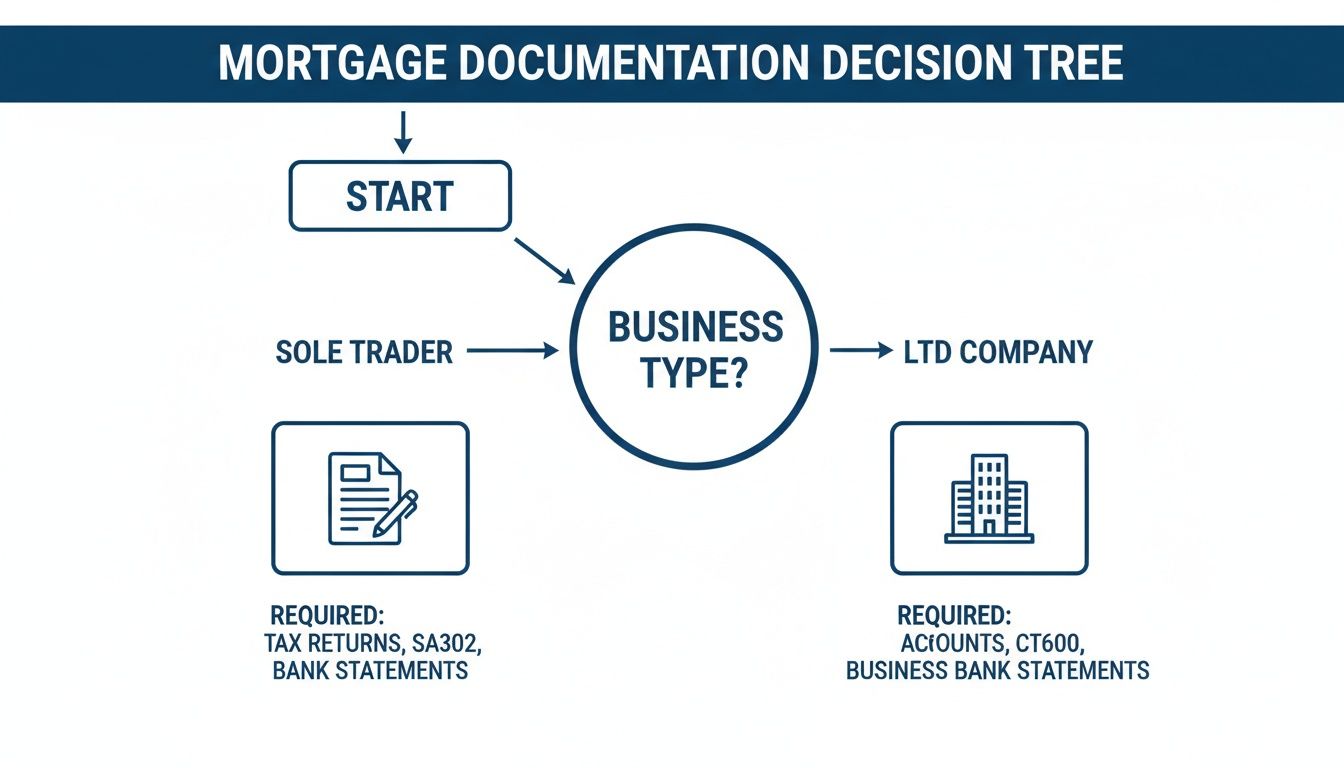
The key takeaway here is that while both sole traders and limited companies need to prove their income the specific evidence they need to provide differs right from the start.
Limited Company Directors: Salary, Dividends, and Retained Profit
For directors of limited companies, the calculation can get even more varied. The standard approach for most high-street lenders is to base affordability solely on the salary and dividends you’ve officially drawn from the business. This can feel incredibly restrictive if you strategically leave profits in the company for future growth.
This is where specialist lenders truly shine. Many will consider your share of the company’s net profit after corporation tax often in addition to your director’s salary. This simple shift in perspective can make a monumental difference to your application’s outcome.
For EHF Mortgages’ clients in Essex, from first-time buyers in Chelmsford to those remortgaging in Colchester, this means getting specialist advice is essential. With access to over 50 specialist lenders, a good broker can match you with those who will average your income favourably or include retained profits. This alone could increase your borrowing potential by as much as £42,000.
Let’s break down the two common approaches for a limited company director.
Comparing Lender Calculation Methods
| Calculation Method | What Lenders Consider | Best For | Potential Limitation |
|---|---|---|---|
| Salary & Dividends | The personal income you officially draw. | Directors who pay themselves the most profits. | Undervalues affordability if you retain profit. |
| Salary & Net Profit | Your salary plus your share of net profit. | Directors who reinvest profits in the business. | Offered by specialist lenders. |
By understanding these different calculation methods you can see why simply walking into your local bank might not get you the best result. Your income story is unique, and finding a lender whose assessment criteria align with your financial reality is crucial for success.
Proven Strategies to Strengthen Your Application
Getting your documents in order and understanding how lenders see your income are huge first steps. Now let’s get into the proactive things you can do to really strengthen your application and boost your chances of getting that “yes”. These aren’t just minor tweaks; they’re foundational moves that prove you’re financially stable and ready for a mortgage.
Think of it like this: your mortgage application is a business proposal to the lender. Your job is to present yourself as a low-risk reliable investment. That means looking beyond just your income figures to make sure the rest of your financial picture is just as solid.

Optimise Your Credit Score and Debt Profile
For any borrower a credit score is a lender’s go-to snapshot of reliability. But for the self-employed a strong score is non-negotiable. It helps to balance out the perceived risk that comes with a variable income. Lenders will pull your history from credit reference agencies like Experian and Equifax so it’s vital you know exactly what they’re going to find.
Before you even think about applying, get copies of your reports. Check them for any errors that could be dragging your score down. You’d be surprised how often mistakes happen. Beyond that, a few simple actions can make a massive difference:
- Get on the electoral roll: a quick win. It confirms your address and identity, which lenders love to see.
- Pay every bill on time: Consistency is everything here. Even a single late payment can hang around on your report for years.
- Keep credit utilisation low: This is a big one. Try to use less than 30% of your available credit on cards and overdrafts. High balances can look like a red flag.
NB – if you want to obtain a credit report we would suggest CheckMyFile, as this provides you with a comprehensive view of credit information from all major agencies – try a free 14-day trial at CheckMyFile
Just as important is your debt-to-income (DTI) ratio. This is simply the percentage of your monthly income already committed to existing debts. Lenders have strict limits here so paying down balances on loans and credit cards in the months before you apply can seriously improve how much they think you can afford.
If you’re worried about past credit issues, don’t panic. Our guide on securing home loans for the self-employed with bad credit offers more specific advice.
Strategic Financial Planning Before You Apply
When you’re self-employed, timing is everything. The perfect time to apply is right after a strong year of trading where your profits are stable or even better trending upwards. A rising profit line is a powerful signal to lenders that your business is healthy and growing.
This often means you have to play the long game. One of the most common pitfalls we see is business owners aggressively minimising their taxable income. While that’s fantastic for your tax bill, it’s a disaster for your mortgage application. Why? Because it directly slashes the very income figure lenders use to calculate how much you can borrow.
For the one or two years leading up to your application, you might need to strike a new balance. That means being a bit less aggressive with expenses to show a healthier profit on paper.
“We recently worked with a client from Chelmsford who runs a successful delivery business. He was planning to buy a new van, but delayed the purchase for six months. This decision kept his declared profit higher for the tax year, which ultimately helped him secure the mortgage he needed for his family home.”
Building a healthy deposit also puts you in a much stronger position. While 5% deposits are out there, aiming for 10% to 15% or more makes you a far more attractive applicant. A larger deposit lowers the lender’s loan-to-value (LTV) ratio which reduces their risk, and often unlocks better interest rates for you.
Of course saving this deposit while juggling business costs and the rising cost of living is a huge challenge. Research shows that for self-employed first-time buyers, the biggest hurdles are high house prices (50%) and saving a deposit (38%). Many have to delay business growth, or put life goals on hold, to get on the property ladder. Taking these proactive steps demonstrates to a lender that you are financially disciplined and ready for the commitment of homeownership.
Why a Specialist Broker Is Your Greatest Asset
Trying to get a mortgage on your own when you’re self-employed can feel like navigating a maze blindfolded. This is where a specialist mortgage broker isn’t just helpful they become your most valuable asset turning a complicated and often stressful process into a clear manageable path forward.
Think of it this way: walking into your high-street bank is like visiting a single shop with a very limited stock room. They have their own rigid lending criteria and their staff often aren’t equipped to understand the nuances of a self-employed income. If your accounts don’t fit neatly into their pre-defined box, you’re likely walking out with a rejection.
A specialist broker on the other hand is like a personal shopper who has keys to every store in town. At EHF Mortgages, we work with dozens of lenders including many specialist providers you can’t access directly. These are the lenders who truly understand complex incomes and are willing to look at the bigger picture like your latest year’s soaring profits or the cash you’ve retained in the business.
Protecting Your Credit Score Is a Top Priority
One of the biggest risks of going it alone is the damage you can accidentally inflict on your credit score. Every time you submit a full mortgage application it leaves a ‘hard search’ on your credit file. Too many of these in a short space of time especially if they result in rejections can look like a red flag to lenders making it even harder to get approved.
A good broker completely sidesteps this risk. We carry out an initial assessment and use our deep knowledge of lender criteria to pinpoint who is most likely to say yes before any formal application is made. This targeted approach avoids that scattergun effect of applying everywhere and hoping for the best protecting your credit history from unnecessary hits. It’s a critical part of learning how to get a mortgage when self-employed.
This table breaks down the key differences between going direct and using a specialist broker.
| Feature | Direct to High-Street Bank | Specialist Mortgage Broker |
|---|---|---|
| Lender Access | Limited to one bank’s products | Whole-of-market specialists |
| Income Assessment | Rigid often averaging 2-3 years | Flexible can use the latest year |
| Credit Score Impact | High risk of multiple hard searches | A single search with the right lender |
| Time and Effort | You do all the research and paperwork | We handle research and application |
Expertise That Saves Time, Stress, and Money
With over 35 years of experience helping clients across Chelmsford Braintree and Colchester we’ve seen it all. We know the local market inside out and understand the specific hurdles that freelancers contractors and limited company directors face. More importantly we know which lenders are keen to work with people just like you.
Our job is to package and present your application in the best possible light. We anticipate the questions lenders will ask and make sure every piece of documentation is perfectly organised giving them the confidence they need to approve your case.
“A broker acts as your translator and your advocate. We take your unique financial story and present it in a way that aligns perfectly with a lender’s criteria, giving you the best possible chance of success from the very first attempt.”
Ultimately this saves you countless hours of frustrating research and stressful phone calls. It also significantly boosts your chances of securing a mortgage offer often at a more competitive rate than you could find by yourself. By matching you with the right lender from the start we position your application for success.
Protecting Your Mortgage and Family
Getting the keys to your new place is a massive milestone but the work doesn’t stop there. The next absolutely essential step is protecting it. If you’re self-employed building a financial safety net is even more critical because you don’t have the cushion of company sick pay or death-in-service benefits. This leaves your family and your new home exposed if the unexpected happens.
Here at EHF Mortgages we see planning for your future security as a fundamental part of the home-buying journey. It’s about giving you peace of mind knowing your loved ones and your property are secure whatever lies ahead. It means a sudden illness or accident won’t threaten the home you’ve worked so hard to buy.
Key Protection Policies to Consider
Trying to understand the different types of protection can feel a bit overwhelming but each policy serves a distinct and vital purpose. For homeowners in Chelmsford Braintree or Colchester these policies are the bedrock of your financial resilience.
Here are the main types of cover we typically advise our clients on:
- Life Insurance: This pays out a lump sum if you pass away during the policy term. It’s primarily designed to clear the outstanding mortgage so your family isn’t left worrying about how to meet the repayments.
- Critical Illness Cover: This provides a tax-free lump sum if you’re diagnosed with a serious illness specified in the policy. People often use these funds to pay off the mortgage cover private medical costs or adapt their home.
- Income Protection: If you’re unable to work due to illness or injury this policy pays out a regular monthly income. For the self-employed this is a lifeline. It replaces those lost earnings so you can keep up with your mortgage payments and other bills.
“Your mortgage is likely your biggest financial commitment. Protecting it isn’t an optional extra—it’s an integral part of responsible homeownership, especially when you’re self-employed.”
On top of these it’s also a mandatory requirement from any mortgage lender to have the right buildings and contents insurance in place from the day of completion. This protects the physical structure of your home and everything inside it. We can walk you through all of these options to build a protection plan that fits your specific needs and budget.
Your Self-Employed Mortgage Questions Answered
As brokers working with self-employed people across Essex every day, we hear a lot of the same questions. Getting clear answers is the first step towards feeling confident about your application, so let’s tackle some of the most common queries we get.
Can I Get a Mortgage with Only One Year of Accounts?
It’s a common myth that you absolutely need two or three years of accounts. While most high-street lenders do prefer a longer track record, it’s certainly not a dealbreaker.
Plenty of specialist lenders the kind a good broker has on speed dial will happily consider applications with just one solid year of accounts. Your application becomes much stronger if you can bring a healthy deposit to the table or show you’ve got a long history of experience in your particular industry. This gives lenders confidence that your business, even if it’s new is built on a solid foundation.
Do My Company’s Retained Profits Count Towards My Income?
This is a fantastic question, and the answer really highlights the difference between mainstream and specialist lenders. For the most part high-street banks will only look at the director’s salary and any dividends you’ve officially paid yourself. That’s it.
Specialist lenders however tend to take a more realistic holistic view. They understand that savvy business owners in places like Chelmsford or Braintree often leave profits in the company to fuel growth. Many of these lenders are willing to include your share of the retained net profit in their affordability calculations, which can dramatically increase how much you’re able to borrow.
“Whether retained profits are included is one of the most important questions for a limited company director. Getting this right can be the difference between securing the home you want and falling short on borrowing power.”
How Much Deposit Will I Need for a Self-Employed Mortgage?
While getting a mortgage with a 5% deposit isn’t impossible putting down a larger deposit will always make your application look much stronger and more appealing to a lender. If you can aim for 10-15% or more you’re putting yourself in a great position.
Think of it from the lender’s perspective: a larger deposit lowers their risk because you have more of your own money invested in the property. This simple act often makes you a far more attractive borrower, and can even unlock more competitive interest rates saving you a significant amount of money over the life of the loan. It’s a clear signal of your financial stability and discipline.
Navigating the self-employed mortgage market can feel complicated but you absolutely don’t have to figure it all out on your own. The expert team at EHF Mortgages has the real-world experience to guide you through every single step.
Ready to take the next step towards your new home? For a free no-obligation chat about your situation and to find the right mortgage for you head over to our Contact Us page and get in touch with our expert team today.