💡 Top Tip: Using a Lifetime ISA can boost your savings with a 25% government bonus. We’ll explain exactly how this powerful tool works later in this guide.
Table of Contents
- Why Your Deposit Size Matters
- How a Larger Deposit Unlocks Better Mortgage Deals
- Acceptable Sources for Your Mortgage Deposit
- Deposit Requirements for Different Types of Borrowers
- Actionable Strategies to Save Your Deposit Faster
- Preparing Your Proof of Deposit for Lenders
- Your Mortgage Deposit Questions Answered
Your Guide to a Mortgage Deposit
Welcome to arguably the most crucial first step on the property ladder: getting your head around the mortgage deposit. Think of it as the down payment on your future home. It is the chunk of the property’s price you pay upfront, with the mortgage loan covering the rest.
This initial investment does more than get your foot in the door. It signals to lenders that you are a serious, committed borrower, which immediately reduces their risk and opens you up to much better deals. The size of your mortgage deposit is directly tied to your Loan-to-Value (LTV) ratio, a key figure that unlocks more attractive interest rates.
Before we get into the nitty-gritty of deposits, it is a good idea to zoom out and get a feel for understanding your mortgage as a whole. Having that foundational knowledge helps all the other pieces of the puzzle fall into place.
Why Your Deposit Size Matters
The link between your deposit and your mortgage deal is beautifully simple: a bigger deposit means you are borrowing less, which reduces the lender’s risk. In return for taking on that smaller risk, they reward you with lower interest rates. It is a win-win.
We’ll explore just how much of a difference saving for a 5% deposit versus a more robust 15% or 20% can make. It can genuinely change the entire landscape of your mortgage options and potentially save you thousands of pounds over the life of the loan. This is especially true in competitive Essex markets like Chelmsford or Braintree, where even a tiny reduction in your interest rate can make a massive difference to your monthly budget.
How LTV Affects Your Mortgage
Lenders organise their mortgage products into different Loan-to-Value (LTV) bands. Putting down a higher deposit lowers your LTV, which gives you access to better, cheaper bands.
Here is a quick look at how it works:
- A 5% deposit (or less) means you have a 95-100% LTV. Lenders view this as high risk, so rates are typically higher.
- A 10% deposit gets you into the 90% LTV bracket, opening up more products and slightly better rates.
- A 25% deposit brings you down to a 75% LTV, which is where you will often find the most competitive deals on the market.
Getting to grips with this relationship is vital for anyone starting their home-buying journey. It empowers you to set a realistic savings goal that actually aligns with the kind of property you want to buy, whether you’re looking in bustling Colchester or a quieter village somewhere in Essex.
How a Larger Deposit Unlocks Better Mortgage Deals
The size of your deposit is single-handedly the most powerful tool you have for securing a great mortgage deal. Think of it like this: the more of your own money you put down upfront, the less risk the lender is taking on.
In return for you shouldering more of that risk, lenders will reward you with better interest rates. Over the life of your loan, that can save you an enormous amount of money.
This whole relationship is measured by one crucial term: Loan-to-Value (LTV). It is simply the percentage of the property’s price that you are borrowing. A larger deposit means a smaller LTV, and that makes you a much more attractive applicant in any lender’s eyes.
Understanding LTV Bands
Lenders do not just offer a smoothly sliding rate scale. Instead, they group their mortgage products into specific LTV “bands”. You will typically see these set at 95%, 90%, 85%, 75%, and even 60% LTV.
The magic happens when you cross the threshold into a lower LTV band. Doing so can unlock a completely new tier of more competitive products.
For example, stretching your deposit from 10% (a 90% LTV) to 11% might not move the needle much on your interest rate. But pushing just a bit further to save a 15% deposit (an 85% LTV) could open the door to substantially cheaper deals. You’ve officially moved into a more desirable bracket for lenders.
This visual shows how even a modest increase in your savings can significantly lower your LTV, making you a less risky borrower.
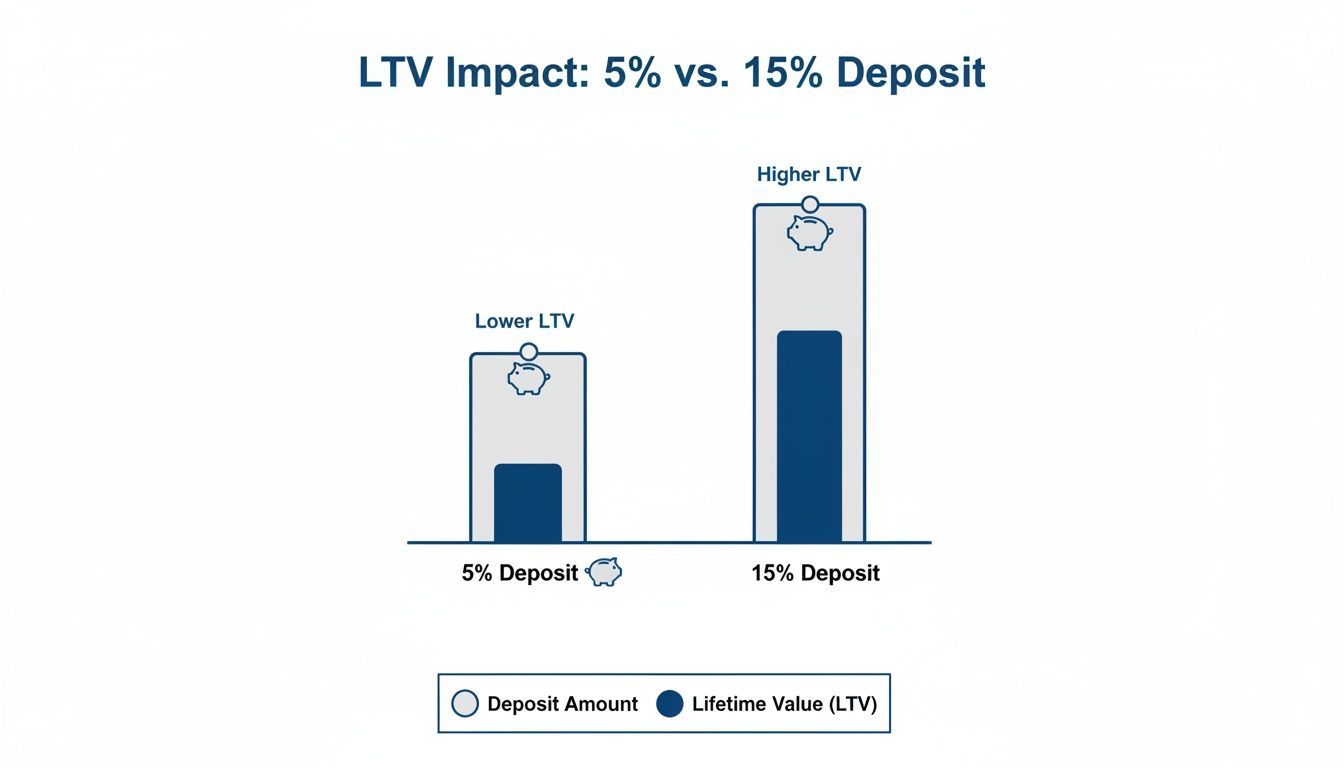
The key takeaway is simple: a larger deposit reduces the lender’s exposure, which directly translates into better mortgage terms for you.
The Financial Impact in Practice
To make this feel a bit more real, let’s look at how the numbers stack up. Imagine you’re buying a property in Braintree for £250,000. The table below shows just how much your monthly payments can change when you hit those different LTV bands.
Impact of Deposit Size on Monthly Mortgage Repayments
| Deposit % | Deposit Amount | Loan Amount (LTV) | Example Rate | Monthly Repayment |
|---|---|---|---|---|
| 10% | £25,000 | £225,000 (90%) | 5.25% | £1,245 |
| 15% | £37,500 | £212,500 (85%) | 4.75% | £1,123 |
| 20% | £50,000 | £200,000 (80%) | 4.50% | £1,013 |
| 25% | £62,500 | £187,500 (75%) | 4.25% | £912 |
Please note: Rates are for illustrative purposes and based on a 30-year term. Actual rates will vary.
As you can see, saving that extra £12,500 to get from a 10% to a 15% deposit could reduce your monthly payment by £122. Over a five-year fixed term, that is a saving of over £7,300. It’s a crystal-clear financial incentive for putting down as much as you can.
A Bigger Deposit Signals Stability
Beyond just the numbers, a larger deposit sends a powerful signal to lenders. It demonstrates financial discipline and proves you are a responsible saver, in other words, a lower-risk investment.
This isn’t a new trend; it is a cornerstone of the UK mortgage market. In fact, official data shows that the most common mortgage type has a loan-to-value (LTV) ratio of 75% or less, meaning a deposit of at least 25%.
Homeowners often save diligently for years to reach these lower LTVs, especially the coveted 60% LTV bracket, to secure the very best interest rates. This is why so many buyers in areas like Essex prioritise building their deposit to avoid the higher rates that come with 90-95% LTV deals. You can explore more about these UK mortgage trends and see the data for yourself.
“Every extra pound you add to your mortgage deposit works twice as hard. It reduces the amount you need to borrow and simultaneously unlocks a lower interest rate on the remaining balance.”
Ultimately, a larger deposit gives you more control, better options, and a much healthier financial start to homeownership.
Acceptable Sources for Your Mortgage Deposit

When you apply for a mortgage, lenders need to see a clear and legitimate trail for the money you’re using as your deposit. This isn’t just a box-ticking exercise; it is a non-negotiable step tied to strict UK anti-money laundering regulations.
The good news is that they accept funds from various sources, giving you multiple routes to building your deposit. Understanding these options can significantly speed up your journey to homeownership, whether you’re a diligent saver or fortunate enough to receive family help.
Your Own Savings
The most straightforward source for a mortgage deposit is, of course, your own personal savings. More than just the money itself, this demonstrates to lenders your ability to manage your finances responsibly over time.
To prove the funds are yours, you will need to provide several months of bank statements, typically between three and six. These statements should show the money building up steadily or sitting in your account for a while. Lenders look for a clear savings pattern, so it’s wise to avoid any large, unexplained cash deposits in the run-up to your application, as this can raise red flags.
Gifted Deposits From Family
A “gifted deposit” is an increasingly common way for buyers, especially first-timers, to get onto the property ladder. This is when a close relative, usually a parent or grandparent, provides some or all of the deposit money.
However, lenders are very strict about this arrangement. The money must be a true gift, with no expectation of repayment and no financial interest for the giver in the property.
To satisfy the lender, you’ll need a formal gifted deposit letter. This signed document is non-negotiable and must clearly state:
- The name of the person giving the gift (the donor).
- Your name (the recipient).
- The total amount of the gift.
- A clear declaration that the funds are a non-repayable gift.
- Confirmation that the donor will have no legal interest in the property.
The donor will also need to provide their own ID and proof of funds to demonstrate the source of the funds. Getting this paperwork right from the start is essential for avoiding frustrating delays.
Other Common Deposit Sources
Beyond personal savings and gifts, lenders accept several other sources for your mortgage deposit. Just remember, each one comes with its own documentation requirements.
- Inheritance: If you have received an inheritance, you can absolutely use this for your deposit. You will need to provide a letter from the will’s executor confirming the amount and the date you received it.
- Sale of a Property: Using the equity from selling a previous home is the standard route for home movers. You will need to show the memorandum of sale and your solicitor’s completion statement to prove the funds.
- Government Schemes: Savings from a Lifetime ISA (LISA) are a popular source of funding, especially for first-time buyers. The government bonus portion is accepted in full by lenders as part of your deposit, but you’ll need the closing statements from your LISA provider. We offer a wealth of information for first-time homebuyers in our dedicated guide to first-time buyer mortgages.
Finalising Your Deposit
Whatever the source, the key is to have a clean, transparent paper trail. A great tip is to consolidate all your deposit funds into one dedicated savings account at least three months before you apply. This gives the lender a simple, consolidated statement to review, making the process much smoother.
By understanding what lenders look for, you can prepare your documentation in advance and present a strong, well-supported application that meets all requirements.
Deposit Requirements for Different Types of Borrowers
The journey to securing a mortgage is rarely one-size-fits-all. The deposit you’ll need often depends on your personal circumstances, as lenders assess risk differently for different types of buyers. This means the goalposts for a mortgage deposit can shift quite a bit.
Whether you’re stepping onto the property ladder for the first time, investing in a rental property, or working for yourself, understanding these specific requirements is key. Each situation presents its own unique challenges and opportunities.
First-Time Buyers
For most first-time buyers, saving up the deposit is the biggest hurdle to homeownership. While 0%-5% deposit mortgages are out there, it is often wise to aim for 10% or more if you can. A larger deposit nearly always unlocks better interest rates and brings down your monthly payments. Many buyers in areas like Colchester find that government schemes are a great help in reaching this goal.
It is no secret that first-time buyers in the UK face a tough market. The average deposit hit a staggering £53,414 in 2023, which works out to about 19% of the property’s price. In competitive areas, that figure can climb even higher. This is a direct result of house prices soaring since 2000, making it harder for many to save. In Essex locations such as Chelmsford, this trend means buyers have to be strategic and dedicated with their savings to keep up. You can explore more regional data on first-time buyer deposits to get a better feel for the landscape.
Buy-to-Let Investors
If you’re looking to become a landlord, be prepared for a higher barrier to entry. Lenders view buy-to-let (BTL) mortgages as riskier than standard residential loans, so they naturally demand a larger deposit.
Typically, you’ll need to put down at least 25% of the property’s value. In some situations, especially for new landlords or if the projected rental income is a bit tight, lenders might ask for as much as 40%. They’ll also run an affordability assessment based on the property’s expected rental income, which usually needs to cover at least 125% of the monthly mortgage payment. You can find more details in our guide on the minimum deposit for a house.
Self-Employed Applicants
When you’re self-employed, the main challenge isn’t necessarily the deposit, but proving a stable and consistent income. While the deposit requirements aren’t automatically higher, having a larger one can make a huge difference to your application.
Lenders will typically want to see at least two to three years of certified accounts or tax returns (your SA302s) to get a clear picture of your earnings. A bigger deposit, ideally 15% or more, helps to offset any perceived risk from fluctuating income. It demonstrates financial stability and shows lenders you have the discipline to manage your finances effectively, which can strengthen your case considerably.
Borrowers With Adverse Credit
Having a history of credit issues, like missed payments, defaults, or a County Court Judgement (CCJ), does not automatically rule you out for a mortgage. However, you should expect to need a larger deposit to secure a loan.
Lenders use a higher deposit to mitigate the increased risk they associate with your credit history. The exact amount will depend on a few key factors:
- The severity of the credit issue: A single late payment is viewed very differently from a bankruptcy.
- How long ago it occurred: More recent problems tend to carry more weight.
- The size of the deposit: A deposit of 15-25% is often the minimum required by specialist lenders who cater to borrowers with adverse credit.
A larger deposit shows lenders that you’re in a much stronger financial position now and have become a more reliable borrower. This can be the key to turning a ‘no’ into a ‘yes’.
Navigating these different requirements can feel complex. Expert advice is vital to understanding what you need for your specific circumstances and finding a lender who fits your profile.
Actionable Strategies to Save Your Deposit Faster
Knowing you need a deposit is one thing; actually building it up is a whole different ball game. This is where we move beyond vague advice and give you some concrete, practical strategies to speed up your savings and get you closer to your new front door.
Create a Realistic Budget
The fastest way to accelerate your savings is to know exactly where your money is going. A budget is not about being restrictive; it is about finding opportunities.
Start by tracking your income and expenses for a full month. Break it all down, from essentials like rent and bills to the ‘nice-to-haves’ like takeaways and subscriptions. Once you have a clear picture, you can spot areas to trim. Maybe it’s a cheaper phone plan or a streaming service you barely watch? Every little bit counts.
Then, set up an automated transfer. Decide on a realistic amount you can put away each month, and schedule it to transfer from your current account to a high-interest savings account on the day you get paid. It’s the old “pay yourself first” trick, and it works because it prioritises your deposit before you even have a chance to spend that money elsewhere.
Supercharge Your Savings with a Lifetime ISA
For first-time buyers, the Lifetime ISA (LISA) is a game-changer. It is a government-backed savings account that gives you a massive 25% bonus on your contributions, up to £1,000 every single year.
Put simply, it is free money toward your mortgage deposit. If you manage to save the maximum of £4,000 in a year, the government will chip in an extra £1,000. You can open a LISA if you are aged between 18 and 39, and you can use it for your first home once the account has been open for at least 12 months.
To help you see how a LISA fits into the bigger picture, we have put together a table summarising the main schemes and savings options out there.
Government Schemes and Savings Accounts for Your Deposit
This table provides a quick look at the key savings vehicles and government schemes designed to help you build that all-important mortgage deposit.
| Scheme / Account | Who It’s For | Key Benefit | Annual Limit | Things to Note |
|---|---|---|---|---|
| Lifetime ISA (LISA) | UK residents 18-39 | 25% gov bonus | £4,000 | Open 12 months before use |
| Help to Buy ISA | Existing holders | 25% gov bonus | Closed to new applicants | Bonus claimed on completion |
| High-Interest Savings | All savers | Earns interest | Varies by provider | Rates can be variable |
| Shared Ownership | Income < £80k | Buy a share | N/A | Pay rent on the rest |
| Guarantor Mortgage | Family support | Borrow with a small deposit | N/A | The guarantor is liable for the debt |
As you can see, each option has its own rules and benefits, catering to different financial situations and goals on your journey to homeownership.
Explore Alternative Homeownership Schemes
If saving for a traditional deposit feels like an uphill battle, do not lose heart. Several other routes onto the property ladder could get you there much sooner, especially for buyers in areas like Essex.
One of the most popular is Shared Ownership. This is a government-backed scheme that lets you buy a share of a home (typically between 10% and 75%) while paying rent on the rest. Because you only need a mortgage for the share you are buying, the deposit you need to save is dramatically smaller.
Another avenue to explore is a Guarantor Mortgage (also known as a Joint Borrower Sole Proprietor Mortgage). This is where a close family member (usually a parent) agrees to use their own property or savings as security against your loan. Alternatively, their income is used within the application. This gives the lender extra confidence, often allowing you to borrow with a much smaller deposit, in some cases, even 100% of the property’s value. It is a huge commitment for the guarantor, of course, but it can be a fantastic leg-up for those with strong family support.
Preparing Your Proof of Deposit for Lenders
Once you’ve saved up your deposit, the next step is proving its source. This isn’t just a box-ticking exercise for the lender; it is a strict legal requirement under UK anti-money laundering rules. Getting your paperwork in order from the start is one of the best ways to ensure a smooth, stress-free mortgage application.
Lenders need to see a clear, straightforward history of your funds. Any large, last-minute cash deposits or unexplained transfers can raise immediate red flags with underwriters, potentially causing serious delays. Your goal is to present them with a clean file that answers all their questions before they even have to ask.

Your Essential Document Checklist
To get your application moving without a hitch, you’ll need to gather a few key documents that prove the source of your deposit for a mortgage. Think of this as your practical checklist:
- Bank Statements: You’ll typically need to provide the last three to six months of statements for the account holding your deposit. These should clearly show the money building up over time or sitting in the account for a consistent period.
- Gifted Deposit Letter: If a family member is helping you out, you must have a signed letter from them. This is non-negotiable. It needs to state the amount, confirm it’s a gift with no expectation of repayment, and declare the giver has no financial interest in the property.
- Evidence of Sale: If the funds are coming from the sale of another property, you will need to provide the memorandum of sale and the completion statement from your solicitor.
Avoiding Common Deposit Red Flags
Presenting your proof of deposit correctly can make all the difference. Underwriters are trained to spot anything unusual, so it is vital to avoid common mistakes that could put your application on hold.
A major red flag is a large chunk of money suddenly appearing in your account without a clear paper trail. This is particularly crucial for self-employed applicants, who must keep meticulous financial records. You can learn more about what’s needed in our guide to self-employed mortgage requirements.
By getting these documents ready in advance, you not only speed up the process but also show the lender that you are a responsible and organised borrower.
Your Mortgage Deposit Questions Answered
When it comes to getting a mortgage, the deposit is often where the most questions pop up. To help you get prepared, we have compiled answers to some of the most common questions we hear from homebuyers in Chelmsford, Braintree, and across Essex.
Can I Use a Loan for a Mortgage Deposit?
In a word, no. Lenders will not accept money from a personal loan or credit card as your deposit. The reason is simple: a mortgage is already a huge financial commitment, and taking on more debt to get it started rings major alarm bells for them.
Your deposit must come from non-repayable sources, such as your own savings, an inheritance, or a genuine gift. Taking out a loan to cover it skews the lender’s affordability calculations and makes you look like a much riskier bet.
How Long Does My Deposit Need to Be in My Bank Account?
Lenders need to see a clear trail of where your money came from, which is why they will ask for your bank statements for the last 3 to 6 months. They’re looking for a consistent savings pattern.
If a large lump sum suddenly appears out of nowhere right before you apply, they’re going to have questions. To keep things simple and avoid delays, it’s best to have the full deposit saved and sitting in a single account for at least 3 months before you kick off your application.
Does a Gifted Deposit Affect My Mortgage Application?
Not at all. A gifted deposit is a perfectly normal and acceptable source of funds, and it will not hurt your application. It does, however, come with a bit of extra paperwork.
The person gifting you the money will need to sign a letter confirming it is a true gift with absolutely no strings attached, meaning they do not expect it back. They will also need to provide their own ID and evidence of the source of their funds. It’s all part of the standard anti-money laundering checks.
Figuring out the details of a mortgage deposit can feel like a minefield, but you do not have to go it alone. Ready to take the next step towards your new home? Our team of expert mortgage advisors is here to provide clear, straightforward guidance tailored to your situation.