Buying A House And Renting It Out: A Complete 2026 Guide
💡 Top Tip: Before you even start looking at properties, get your finances pre-assessed by a mortgage broker. Knowing exactly what you can borrow puts you in a powerful position to make confident offers in a fast-moving market, a crucial advantage we’ll explain more about later in this article.
Table of Contents
- Your Essential First Steps To Renting Out A House In 2026
- Securing The Right Buy-To-Let Mortgage
- How To Calculate Your Rental Profitability
- Understanding Your Landlord’s Legal Obligations
- Managing Your Rental Property And Tenants
- Planning Your Long-Term Investment Strategy
- Frequently Asked Questions
Your Essential First Steps To Renting Out A House In 2026
So, you’re thinking of becoming a landlord? This guide is your roadmap. We’ll walk you through the entire journey, from securing the right mortgage to welcoming your first tenants. You’ll learn how to crunch the numbers on profitability, get to grips with your legal duties, and navigate the local property scene in places like Chelmsford and Colchester.
Our goal is simple: to give you the practical knowledge and confidence to start your buy-to-let journey, backed by experts who live and breathe the Essex market.
Getting Your Ducks in a Row: Pre-Purchase Prep
The journey to a successful rental property begins long before you set foot inside a potential investment. It’s all about solid preparation. This initial phase involves meticulous financial planning to make sure your investment is viable from day one.
Before you commit, it’s vital to do your homework. A good starting point is a comprehensive due diligence checklist for real estate, which can help you spot potential red flags and hidden opportunities.
The process can feel overwhelming, but it boils down to three core stages, as this graphic shows.
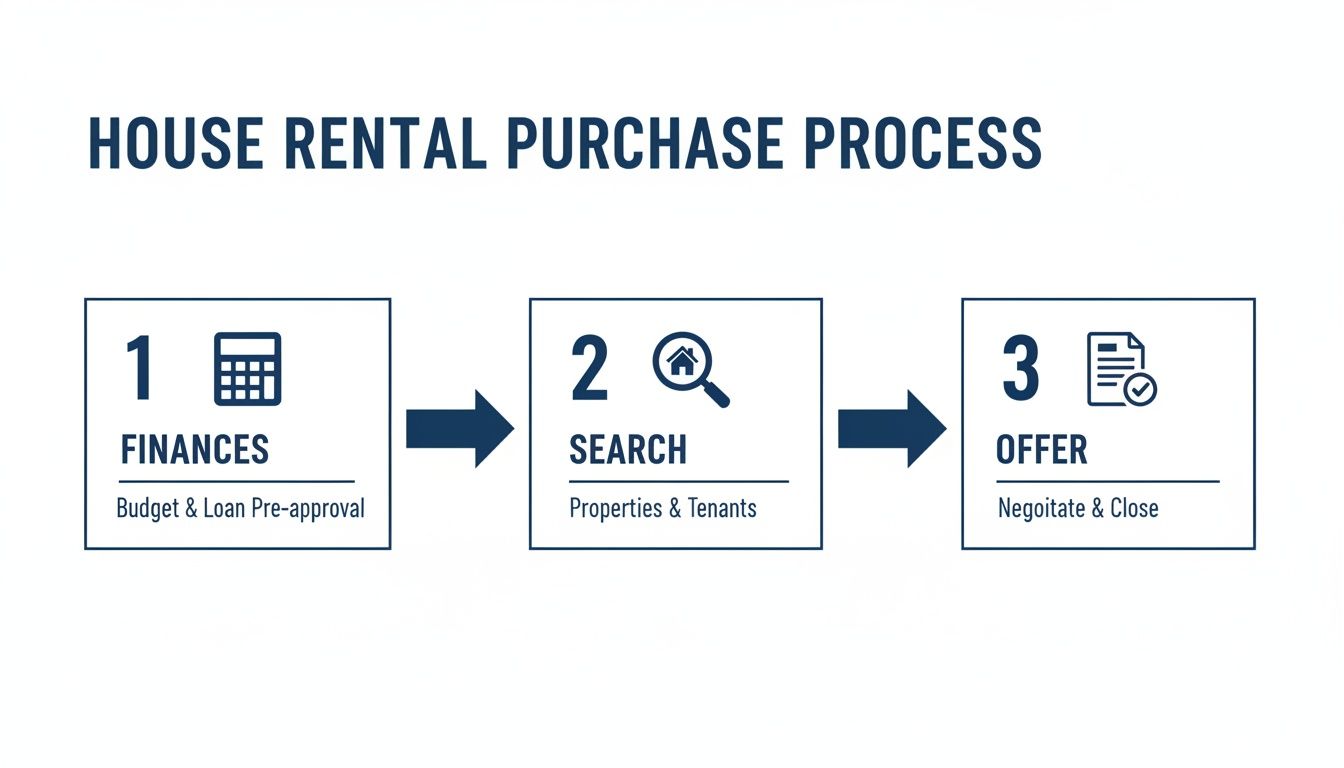
This highlights how getting your finances sorted first leads to a much more focused property search and, ultimately, a stronger offer.
Securing The Right Buy-To-Let Mortgage
Getting the right financing is the absolute cornerstone of a successful rental investment. You cannot just use a standard residential mortgage when you’re buying a house to rent out; you’ll need a specialist Buy-to-Let (BTL) mortgage, which lenders assess in a completely different way.
Instead of focusing on your personal salary, lenders are far more interested in the property’s potential rental income. This is what drives all their calculations and criteria.
The market for these mortgages is robust. Even with economic shifts, investor confidence remains high. Recent data shows just how active this space is, with new BTL loans in Q3 2025 alone totalling a staggering £10.9 billion.

Understanding Lender Criteria
When you apply for a BTL mortgage, lenders use two main yardsticks to measure the risk and viability of your investment.
First up is the deposit. Unlike a residential mortgage, where you might get away with 5% or 10%, BTL lenders almost always demand more skin in the game. You should be prepared to put down at least 25% of the property’s value. For a £300,000 property in Chelmsford, that’s a hefty £75,000 deposit right from the start.
The second key metric is the Interest Coverage Ratio (ICR). This is a crucial calculation lenders use to ensure the expected rent comfortably covers the mortgage payments. They typically want to see the rent covering the mortgage by 125% to 145% at a “stressed” interest rate, which is higher than the actual rate you will pay. It gives them a safety buffer against periods of inactivity or future rate rises.
Individual Name or Limited Company?
One of the biggest decisions you will face is whether to buy the property in your personal name or through a limited company, often called a Special Purpose Vehicle (SPV). This choice has massive tax and mortgage implications, so it is not one to take lightly.
A few years ago, buying as an individual was the standard route. However, changes to mortgage interest tax relief (known as Section 24) have made limited company ownership much more popular for its tax efficiency. To figure out which structure truly fits your circumstances, it’s worth getting some expert BTL mortgage advice.
Here’s a quick breakdown of the key differences:
| Feature | Individual Ownership | Limited Company |
|---|---|---|
| Tax on Profits | Income Tax (20-45%) | Corporation Tax (19-25%) |
| Mortgage Interest | Tax credit at 20% | Fully tax-deductible expense |
| Mortgage Rates | Generally lower | Slightly higher rates and fees |
| Legal Complexity | Simpler, less admin | More complex, requires accounts |
Navigating Complex Scenarios
What if you’re self-employed, planning to build a portfolio, or eyeing an unconventional property? This is where a whole-of-market broker really proves their worth. High street banks often have rigid, ‘computer-says-no’ criteria that automatically reject anything outside the norm.
Specialist lenders, on the other hand, are set up to handle these situations. They have specific criteria for:
- Portfolio Landlords: Anyone with four or more mortgaged rental properties will face tougher stress tests and need to present a more detailed business plan.
- Self-Employed Applicants: Lenders assess income differently here, often looking at one to two years of accounts or your SA302s.
- Non-Standard Properties: Finding a mortgage for a high-rise flat in Braintree or a property with unusual construction can be a real headache without access to the right lenders.
Working with a broker opens the door to these specialist lenders and exclusive deals you will not find on the open market. We can help find a solution that lines up perfectly with your investment goals, ensuring you get the right finance to make your BTL venture a success from day one.
How To Calculate Your Rental Profitability
An investment property lives and dies by its numbers. When you’re buying a house to rent out, you have to move beyond optimistic guesses and get into solid, evidence-based calculations. It is the only way to know if your venture will actually be profitable.
This really boils down to two key metrics: rental yield and monthly cash flow. They each tell you a different story about your investment’s health. Yield gives you a high-level view of its efficiency, while cash flow tells you whether you will have money left in your pocket each month. Getting a firm grip on both is essential.

Calculating Gross And Net Rental Yield
Rental yield is a simple percentage that shows the annual return you’re making on a property’s value. It’s a brilliant way to compare different investment opportunities side-by-side quickly.
There are two flavours of yield you need to know:
- Gross Yield: This is the back-of-the-envelope calculation. You divide the total annual rent by the property’s purchase price, then multiply by 100. It’s a quick-and-dirty measure, but it completely ignores all your running costs.
- Net Yield: This is the figure that actually matters. Here, you subtract all your annual running costs, like mortgage interest, insurance, repairs, and agent fees, from your annual rent before dividing by the purchase price.
The net yield is what reveals the true performance of your investment. It’s the number that tells you how hard your money is really working for you after every bill is paid.
Modelling Your Monthly Cash Flow
While yield is great for comparing properties, monthly cash flow is your day-to-day reality. This is the actual money left over each month after you’ve collected the rent and paid all the associated expenses. If it’s a positive number, you’re making a profit.
To model this properly, you need to create a detailed budget. It’s easy to remember the big mortgage payment, but forgetting smaller, recurring costs can quickly turn a property that looks profitable on paper into a real financial drain.
When you’re assessing a potential property in Braintree or anywhere in Essex, you have to factor in every single Cost. A great place to start is with our handy mortgage calculators to estimate your main outgoing. From there, it is all about building a comprehensive list of all expenses to get a true picture of your monthly financial commitment.
Here’s a simplified example of what that might look like for a typical property in our area.
Sample Rental Profitability Calculation (Property in Essex)
| Item | Monthly Cost (£) | Annual Cost (£) |
|---|---|---|
| Monthly Rent Received | +1,400 | +16,800 |
| Mortgage Payment (Interest-Only) | -650 | -7,800 |
| Letting Agent Fee (10%) | -140 | -1,680 |
| Insurance & Service Charges | -75 | -900 |
| Net Monthly Cash Flow | +535 | +6,420 |
This table gives you a basic idea of how to organise your income and expenses to find your true profit.
Building A Contingency Fund
One crucial expense to budget for is a contingency fund for maintenance and void periods. A void period is when the property is empty between tenants, and a contingency fund is what lets you cover the mortgage and other bills without any rent coming in.
This fund also covers nasty surprises, like a broken boiler in the middle of winter or a leaking roof. A good rule of thumb is to set aside 5-10% of your monthly rent to build this safety net. Do not skip this.
By meticulously calculating your yield and modelling your cash flow, you stop hoping for a profit and start planning for one. It is the difference between being an amateur landlord and a professional investor.
Understanding Your Landlord’s Legal Obligations
When you buy a property to rent out, you’re stepping into the shoes of a business owner. This is not just about collecting rent; it comes with a serious set of legal responsibilities. Getting these wrong is not an option, as it can lead to hefty fines and a world of legal trouble.
Before you even think about tenants, you need to get your head around your obligations on tax and safety. Nailing this from the very beginning is the bedrock of a successful and compliant rental business. The money side of things is far more than just your mortgage payments. You need to be ready to get to grips with the UK tax system, which has very specific rules for landlords that will make a real difference to your bottom line.
Navigating Your Tax Responsibilities
It’s no surprise that your rental income is taxable. You’ll need to declare it to HMRC through a Self-Assessment tax return each year. But it’s not all one-way traffic; you can offset certain costs against your income to bring your tax bill down.
To be deductible, these costs must be ‘wholly and exclusively’ for the purpose of renting out the property. The usual suspects include:
- Letting agent fees
- Landlord insurance premiums
- General maintenance and repairs (note: this does not include significant improvements)
- Accountancy or legal fees
- Direct costs like ground rent and service charges
One of the biggest tax hurdles to clear right at the start is Stamp Duty Land Tax (SDLT). When you buy an additional property, such as a buy-to-let, you pay a 3% surcharge on top of the standard SDLT rates. For a £300,000 property in Colchester, that’s a significant extra chunk of cash you need to find upfront.
And looking further down the line, when you decide to sell up, you’ll almost certainly be looking at Capital Gains Tax (CGT) on any profit you’ve made. This is calculated on the value growth: the difference between what you bought it for and what you sold it for, less any allowable costs.
Essential Tenant Safety And Legal Compliance
Aside from your duties to the taxman, you have a fundamental ‘duty of care’ to your tenants. This means the property must be safe, secure, and habitable at all times. The consequences for failing to meet these standards are severe, ranging from unlimited fines to imprisonment in the worst-case scenarios.
Your core responsibilities are non-negotiable and must be kept up throughout every tenancy.
Key Safety Certificates And Checks
You’ll need to arrange and keep records of several key safety inspections. Here’s a quick rundown of what’s required:
| Certificate/Report | Frequency Required | What It Covers |
|---|---|---|
| Gas Safety Certificate (CP12) | Annually by a Gas Safe-registered engineer | Checks all gas appliances, pipework, and flues are working safely. |
| Electrical Safety Report (EICR) | Every 5 years by a qualified electrician | Inspects the condition of all fixed electrical installations in the property. |
| Energy Performance Certificate (EPC) | Every 10 years, or for each new tenancy | Rates the property’s energy efficiency from A (best) to G (worst). |
| Smoke & CO Alarms | Checked at the start of each new tenancy | You need at least one smoke alarm per floor and a CO alarm in any room with a solid fuel appliance. |
Crucially, a property must have a minimum EPC rating of ‘E’ to be legally let. Make sure you provide copies of these certificates to your tenants right at the start of their tenancy.
Other Critical Legal Duties
The paperwork does not stop with safety checks. When you take a deposit from a tenant, you have 30 days to protect it in a government-approved tenancy deposit scheme. You must also give the tenant official information explaining where their money is being held.
You also need to be aware of property licensing. If you let your property to several people who are not from the same family or ‘household’, it might be classed as a House in Multiple Occupation (HMO). HMOs face much stricter regulations and often require a special licence from the local council. The rules can vary, so it’s vital to check the specific requirements in your area, whether that’s in Chelmsford, Braintree, or elsewhere in Essex. Keeping on top of these rules is a massive part of being a good landlord.
Managing Your Rental Property And Tenants

Finding a tenant is a major milestone, but it is really just the beginning of your journey as a landlord. Now the real work starts: managing the property and looking after your tenants.
Your biggest decision here is whether to manage everything yourself or hire a professional letting agent. This choice will have a huge impact on your time, stress levels, and ultimately, your net profit. There is no single right answer; it all comes down to your experience, how close you live to the property, and just how hands-on you want to be.
Self-Management: The DIY Landlord Path
Going it alone can be incredibly rewarding and is often the most cost-effective route. You keep full control over every decision, from who you let into your property to the tradespeople you hire for repairs. This direct involvement can save you hundreds, if not thousands, of pounds in fees each year.
However, being a DIY landlord means the buck stops with you. You will be the one to advertise the property, conduct viewings, and carry out rigorous tenant referencing, including credit checks, employer references, and previous landlord checks.
You’re also responsible for drafting a legally sound tenancy agreement, protecting the deposit in a government-approved scheme, and conducting regular property inspections. Most importantly, when a tenant calls at 10 pm on a Sunday about a leak, you are their only point of contact. It demands time, dedication, and a solid grasp of landlord-tenant law.
To make life easier, many self-managing landlords use technology to stay organised. You might want to explore the best property management apps to help you track rent payments and handle maintenance requests. These tools can make the DIY route much more manageable, especially if you have more than one property.
Hiring A Letting Agent: Your Professional Partner
For many investors, especially those who live far away from their rental property or do not have the time, hiring a letting agent is a wise investment. A good agent based in Chelmsford or Colchester will have deep local knowledge, a waiting list of vetted tenants, and a team of reliable local contractors.
Letting agents typically offer different levels of service:
- Tenant-Find Only: They will market your property, conduct viewings, and reference tenants before handing the management back to you once the tenancy starts.
- Rent Collection: This includes the tenant-find service plus the monthly collection and processing of rent payments.
- Fully Managed: This is the complete hands-off option. The agent handles absolutely everything, from finding tenants and collecting rent to arranging all maintenance and inspections and dealing with any issues that crop up.
A fully managed service usually costs between 10% and 15% of the monthly rent. While this eats into your profit, it buys you freedom from the daily admin and legal complexities of being a landlord. When choosing an agent, look for one that is a member of a professional body like ARLA Propertymark and has strong, positive local reviews.
So, how do the two options stack up? Let’s take a look.
Self-Management vs Using A Letting Agent
| Task | Self-Management | Letting Agent (Fully Managed) |
|---|---|---|
| Control | Full control over all decisions | The agent makes most day-to-day decisions |
| Cost | Lower direct costs, no management fees | Monthly fee, typically 10-15% of rent |
| Time Commitment | High – requires significant personal time | Low – the agent handles almost everything |
| Legal Risk | Higher – you are solely responsible | Lower – agent manages legal obligations |
| Tenant Contact | Direct contact for all issues, 24/7 | The agent is the first point of contact |
Ultimately, the best choice depends on what you value more: saving money or saving time.
Essential Landlord Protections
Whichever management route you choose, certain protections are non-negotiable. Standard home insurance will not cover a rental property, so you must have specialist landlord insurance. This covers the building itself, and you can add contents coverage for any items you provide. Crucially, it also includes public liability cover in case a tenant or visitor is injured at your property.
For an extra layer of security, it is worth considering rent guarantee insurance. This policy covers your rental income if your tenant stops paying, providing a vital safety net and often covering the legal costs of eviction if needed. Think of it as protecting your cash flow: the lifeblood of your investment.
Planning Your Long-Term Investment Strategy
A successful property investment journey is about more than just that first purchase. It’s about building a sustainable, long-term plan that actually works for you. When you buy your first rental property, you’re laying the foundation for your future wealth, so it pays to think like a seasoned investor right from day one.
Your personal goals will ultimately dictate your strategy. Are you aiming to generate a steady income stream for retirement? Or is your focus on capital growth, building a valuable portfolio over many years? Maybe you’re using property to fund other life ambitions. Clarifying your ‘why’ will help you make smarter decisions about the types of properties you buy and where you invest, whether that is in high-demand areas like Chelmsford or up-and-coming parts of Essex.
Reviewing And Growing Your Portfolio
A buy-to-let mortgage is not a ‘set it and forget it’ product. In fact, regularly reviewing your finances is crucial to maintaining profitability. When your initial fixed-rate period ends, you could find yourself reverting to a lender’s much higher Standard Variable Rate (SVR), which can instantly wipe out your monthly cash flow.
By reviewing your mortgage deal every few years, you can do two very powerful things:
- Secure better rates: Remortgaging to a more competitive deal keeps your monthly payments low and your profits healthy. It is a simple but effective way to protect your bottom line.
- Release equity: As your property’s value increases, you can remortgage to release some of this built-up equity. This tax-free cash can then be used as the deposit for your next rental property, helping you scale your portfolio far more quickly than saving alone.
The market is also shifting. To maximise returns, many professional landlords are diversifying. Recent data tracking market sentiment into 2025 shows applications from landlords for semi-commercial property purchases rose by 31% year-on-year, with commercial property applications up 28%. This signals a clear trend towards higher-yielding assets. Discover more about this 2025 buy-to-let market outlook on shawbrook.co.uk.
Creating Your Exit Strategy
Just as you plan your entry into the market, you must also plan your exit. An exit strategy is your roadmap for eventually selling your property or portfolio to realise your profits. This is not something to leave until the last minute; it involves careful consideration of tax liabilities, particularly Capital Gains Tax (CGT).
Thinking about this early allows you to make informed choices, such as whether to sell properties individually or as a single portfolio. It also helps you decide on the best ownership structure from the start. For example, using a limited company can offer different tax advantages upon exit compared to personal ownership. You can learn more about limited company buy-to-let mortgages in our dedicated guide.
From your first purchase to scaling your portfolio and planning your eventual exit, having ongoing expert advice is invaluable. It ensures every decision you make supports your entire investment journey.
Frequently Asked Questions
When you’re thinking about buying a house to rent out for the first time, a lot of questions come up. Here are some quick answers to the ones we hear most often.
How Much Deposit Do I Need For A Buy-To-Let Property?
This is a big one. Unlike a buy-to-let mortgage, your own home requires a larger upfront investment. Most lenders will require a deposit of at least 25% of the property’s value.
So, for a £280,000 property in Colchester, you’d be looking at a deposit of £70,000. While you might find a specialist deal that allows a 20% deposit, putting down 25% is the industry standard and usually unlocks better interest rates.
Can I Rent Out My Current Home On A Residential Mortgage?
In a word, no. A standard residential mortgage is strictly for the home you live in. If your plans change and you decide to move out and let your current place, you absolutely must tell your lender.
They may grant you consent to let, but this is typically a temporary fix. For a long-term rental, you’ll need to switch over to a proper buy-to-let mortgage. Do not be tempted to skip this step, as failing to inform your lender could be considered mortgage fraud.
What Happens If My Tenant Stops Paying Rent?
It’s every landlord’s biggest worry, and it does happen. The first port of call is always to open a dialogue with the tenant and find out what is going on. If communication breaks down, you have to follow a very specific legal process to regain possession of your property.
This is exactly why rent guarantee insurance is so important. It’s a financial safety net that covers your lost income and can also pay for the legal costs of an eviction, giving you crucial peace of mind.
Stepping into the world of property investment can feel daunting, but you do not have to navigate it on your own. At EHF Mortgages, we provide expert, whole-of-market advice to help you secure the right finance and begin your landlord journey with confidence. Ready to take the next step?