UK Buy To Let Mortgage Advice for Landlords in 2026
💡 Top Tip: Before you go any further, there’s one number you need to know: the Interest Cover Ratio (ICR). Lenders will be laser-focused on this, and they typically want to see your projected rental income cover between 125% and 145% of the mortgage payment.
We’ll dive into exactly how that works later in the article.
So, you’re thinking about property investment. Whether you’re eyeing your first rental property in Chelmsford or you’re a seasoned landlord looking to expand your portfolio in Essex, navigating the world of buy-to-let (BTL) mortgages in 2026 can feel complex. That’s what this guide is for.
We’re here to demystify everything, from what a BTL mortgage actually is and how it’s different from your own home loan, to the tricky eligibility hurdles and affordability checks lenders put in place. Our goal is to give you the confidence to invest wisely, with practical advice that’s especially useful if you’re looking at the property market in places like Colchester and Braintree, where a bit of local insight goes a long way.
Table of Contents
- Passing the Lender’s Eligibility and Affordability Tests
- Navigating Landlord Taxes and Regulations
- Choosing the Right Type of BTL Mortgage
- Finding Solutions for Specialist and Complex Cases
- Preparing Your Application and Finding the Right Broker
- Frequently Asked Questions About BTL Mortgages
Your Essential Guide to Buy To Let Mortgages
At its core, a buy-to-let (BTL) mortgage is simply a loan for buying a property you plan to rent out. But that’s where the similarities with a standard residential mortgage end. Lenders view a BTL mortgage as a business transaction, and that changes everything about the process.
Think of it this way: a residential mortgage is all about buying a home for yourself. The lender’s main concern is your personal salary and whether you can afford the repayments. A BTL mortgage, on the other hand, is a tool for building a rental business. The lender’s focus shifts dramatically from your payslip to the property’s ability to generate a steady rental income.
“The switch from a residential to a buy-to-let mindset is crucial. You’re not buying a home; you’re acquiring an asset. The numbers, from rental yield to tax implications, must add up for it to be a sound investment.”
What This Guide Covers
This guide is designed to be your go-to source for practical buy-to-let mortgage advice. We’ll walk you through the essential topics you need to get to grips with before you start your journey as a landlord, whether that’s in Essex or further afield.
Here’s what we’ll be exploring:
- Passing the Lender’s Eligibility and Affordability Tests
- Navigating Landlord Taxes and Regulations
- Choosing the Right Type of BTL Mortgage
- Finding Solutions for Specialist and Complex Cases
- Preparing Your Application and Finding the Right Broker
- Frequently Asked Questions About BTL Mortgages
We’ve structured this to build your knowledge step by step, starting with the basics and moving on to more advanced strategies. By the end, you’ll have a clear picture of what it takes to secure BTL finance and run a successful rental property, especially in competitive areas like Braintree. Ready to get started?
Passing the Lender’s Eligibility and Affordability Tests
Before a lender even thinks about approving your buy-to-let mortgage, you’ll need to clear two critical hurdles: eligibility and affordability. These checks are much more stringent than for a standard residential mortgage because, in the lender’s eyes, this is a business deal. They need to be confident not just in you as a borrower, but in the property’s potential to be a profitable investment.
Securing the right finance is a clear, multi-stage process, as this simple journey map shows.
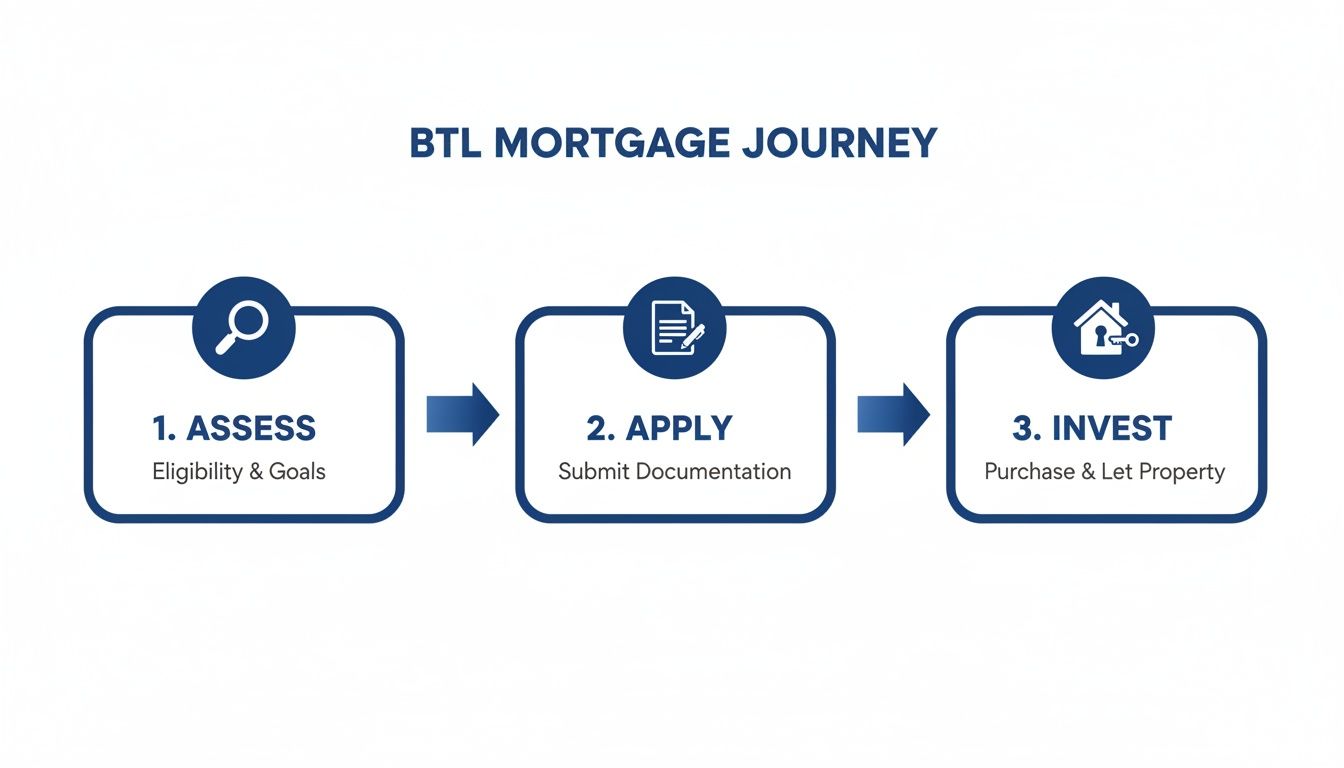
As you can see, a successful investment starts with a thorough assessment of your financial standing and the property’s viability, long before you get to the application stage.
Understanding the Eligibility Criteria
Your eligibility is the first gate you need to get through. It’s all about your personal and financial circumstances, giving the lender a snapshot of your reliability and experience. While specifics vary from lender to lender, they’ll almost always look at a few key areas.
Lenders use a checklist approach to assess your suitability. Below is a table outlining the typical criteria you can expect.
Typical Buy To Let Mortgage Eligibility Checklist
| Criteria | Typical Requirement | Why It Matters | EHF Mortgages Tip |
|---|---|---|---|
| Age | Minimum 21-25; maximum 70-85 at the end of the term. | Lenders need assurance that the loan will be repaid within the borrower’s expected lifetime. | Some specialist lenders have more flexible age caps. We can help you find them. |
| Homeowner Status | Most lenders prefer that you already own your home. | This demonstrates experience with mortgage repayments and property upkeep. | If you’re a first-time buyer landlord, options are limited but not impossible to find. |
| Credit History | A clean or near-clean credit file is usually essential. | Red flags like defaults or CCJs suggest higher risk and poor debt management. | Address any credit issues before applying. Even minor blips can cause delays. |
| Personal Income | A minimum of £25,000 per year is common. | This provides a safety net to cover mortgage payments during void periods. | Your income source matters. We can advise self-employed or contractor applicants. |
Meeting these initial checks is a great start, but it’s only half the story. The next step is proving the numbers add up.
The Importance of a Substantial Deposit
One of the biggest differences you’ll notice with BTL mortgages is the deposit requirement. Forget the 5% or 10% deposits common in the residential market. For a buy-to-let, you’ll almost certainly need a minimum of 25% of the property’s value.
Putting down a larger deposit – say, 30% or 40% –instantly makes you a more attractive prospect. It reduces the lender’s risk and often unlocks better products with more competitive interest rates. You can learn more in our dedicated guide on the deposit required for a buy-to-let property.
The Crucial Affordability Stress Test
Once you’ve passed the eligibility checks, the real number-crunching begins. This is where lenders use their primary tool: the Interest Cover Ratio (ICR). The ICR isn’t just about whether the rent covers the mortgage today; it’s a forward-looking stress test to see if your investment can handle future financial pressures.
Lenders will calculate your mortgage payments using a hypothetical ‘stressed’ interest rate, often around 5.5% or higher, regardless of the actual rate on your deal. They then require the expected rental income to cover this stressed payment by a healthy margin—typically 125% to 145%.
“Think of the ICR as a financial fire drill. The lender wants to see that your investment can withstand the heat if interest rates rise, ensuring it remains profitable and you can always meet your obligations.”
The size of this rental buffer is a key indicator of market health. For example, recent industry data showed that the average ICR across the market climbed to 215%, indicating a strong cushion between rental income and mortgage costs. With 59,467 new loans advanced in a single quarter, the market remains robust even with strict tests, indicating that well-prepared investors can still find opportunities.
Navigating Landlord Taxes and Regulations

Becoming a landlord is about more than just finding a tenant and collecting rent. To run a profitable and, just as importantly, legal rental business, you need to get your head around your tax and regulatory duties right from the start.
It might feel complex to step into, but understanding these key obligations is the only way to protect your investment and stay on the right side of the law. Your financial and legal responsibilities kick in the moment you decide to buy a property, covering everything from the initial purchase tax to ongoing income reporting and the eventual sale.
Understanding Key Property Taxes
In the UK, there are three main taxes every buy-to-let landlord needs to be aware of. Getting these wrong can seriously eat into your profits and land you with hefty penalties.
1. Stamp Duty Land Tax (SDLT)
This is the tax you pay when you buy a property. For landlords, it’s almost always higher than for someone buying their own home, thanks to the 5% surcharge on additional properties. The final bill is calculated in bands based on the property’s purchase price.
So, if you buy a rental property in Chelmsford for £300,000, you’ll pay the standard SDLT rates plus an extra 3% on the full price. It’s a high upfront cost you absolutely must factor into your budget.
2. Income Tax on Rental Profits
The rent you collect is considered income and is subject to Income Tax. To figure out your taxable profit, you take your total rental income and deduct your allowable expenses, like letting agent fees, insurance, and maintenance costs.
One of the biggest game-changers in recent years was the introduction of Section 24. This rule changed how you handle your mortgage interest. You can no longer deduct the full cost of your mortgage interest payments as a business expense. Instead, you get a tax credit equivalent to 20% of your annual interest. This has hit higher- and additional-rate taxpayers particularly hard, prompting many to explore alternative ownership structures. A popular alternative is to use a limited company, which you can read more about in our guide to limited company buy-to-let mortgages.
3. Capital Gains Tax (CGT)
When the time comes to sell your investment property, you might have to pay Capital Gains Tax. This is a tax on the profit you’ve made—the difference between what you bought it for and what you sold it for. The rate you pay depends on your income tax band, and everyone gets an annual tax-free allowance.
Essential Legal and Safety Compliance
Beyond your taxes, you have a legal duty to provide a safe and secure home for your tenants. This means staying up to date with several key regulations.
- Tenancy Deposit Protection (TDP) Scheme: You must protect your tenant’s deposit in one of the three government-approved schemes within 30 days of receiving it.
- Energy Performance Certificate (EPC): Your property needs an EPC rating of ‘E’ or above to be legally rented out. Be aware that there are plans to raise this minimum standard in the near future.
- Gas Safety Certificate: A Gas Safe registered engineer must carry out a gas safety check every year. You have to give your tenants a copy of the certificate.
- Electrical Safety Standards: All electrical installations must be inspected and tested by a qualified professional at least once every five years.
These aren’t just suggestions; they are legal requirements you can’t ignore. For example, it pays to fully understand the specifics of the Landlord Gas Safety Certificate Requirements to avoid falling foul of the rules.
“Compliance is the foundation of a sustainable property business. Staying on top of taxes and regulations not only protects you from fines but also builds trust with your tenants and safeguards your long-term investment.”
Getting to grips with this framework is a non-negotiable part of being a successful landlord. Seeking expert tax and mortgage advice from the outset will set you up correctly and let you focus on growing your portfolio with confidence.
Choosing the Right Type of BTL Mortgage
Not all buy-to-let (BTL) mortgages are cut from the same cloth. The right one for you hinges entirely on your investment strategy, your comfort with risk, and what you want to achieve in the long run. Get this wrong, and it can seriously dent your cash flow and profitability for years to come.
Think of it like choosing a vehicle for a job. A nippy sports car is great for a weekend drive, but completely impractical for a family of five. In the same way, the best BTL mortgage for a landlord in Braintree who needs maximum monthly profit will look very different from the one chosen by a long-term investor focused purely on capital growth.
Interest-Only vs Repayment Mortgages
The first big decision you’ll face is how you repay the loan. This choice is fundamental because it directly shapes your monthly outgoings and your overall investment approach.
Interest-Only Mortgages: For years, this has been the default choice for landlords, and for good reason. You only cover the interest each month, which keeps payments low and maximises your rental profit. Of course, the original loan amount doesn’t shrink. You’ll need a clear plan to repay it at the end of the term, usually by selling the property or remortgaging.
Repayment Mortgages: With this option, your monthly payment covers both interest and a small portion of the original loan balance. Your payments will be higher, eating into your monthly profit, but you’re steadily building equity. At the end of the term, the property is yours, free and clear.
For most investors, the lower monthly cost of an interest-only mortgage makes more sense. It frees up cash that can be put aside for maintenance, cover potential void periods, or be reinvested into another property.
Fixed, Variable, and Tracker Rates
Once you’ve settled on your repayment method, it’s time to pick your interest rate type. This is all about striking a balance between the certainty of fixed costs and the potential to save money if rates fall. You can see what’s currently on offer by checking out the latest buy-to-let mortgage rates.
The market has a clear favourite at the moment. Recent data from Q3 2025 shows that the number of outstanding fixed-rate mortgages hit 1.44 million, a 2.3% increase from 2024. Meanwhile, variable-rate products dropped by 9.7% to just 488,000. This trend, especially among landlords in Essex and Colchester with growing portfolios, reflects a clear move towards securing financial stability.
Comparing BTL Mortgage Rate Types
Choosing your rate type is a critical decision that balances predictability with potential savings. This table breaks down the main options to help you see which best fits your strategy.
| Rate Type | How It Works | Best For… | Key Risk |
|---|---|---|---|
| Fixed Rate | The interest rate is locked in for a set period, typically 2, 3, or 5 years. Your payments won’t change during this time. | Landlords who need predictable monthly payments for straightforward budgeting and financial planning. | If the Bank of England base rate drops significantly, you could be stuck paying a higher rate and miss out on savings. |
| Variable Rate | The lender sets the interest rate and can change it whenever they choose, usually in response to market conditions. | Seasoned landlords who are comfortable with fluctuating payments and have the cash reserves to absorb sudden rate hikes. | Your monthly payments could increase without warning, putting a tight squeeze on your profit margins. |
| Tracker Rate | Your interest rate is directly linked to the Bank of England base rate, and moves up or down in line with it. | Investors who believe interest rates are likely to fall and want their payments to decrease automatically when they do. | If the base rate rises, your mortgage payments will go up with it, guaranteed. |
Each has its place, but it’s vital to align your choice with your financial forecast and your willingness to take on risk.
Specialist BTL Products
Beyond the standard mortgage types, a whole-of-market broker can open the door to a range of specialist products. These are designed for more complex investment scenarios that most high-street lenders avoid.
- HMO Mortgages: Specifically for Houses in Multiple Occupation (HMOs), where you rent out individual rooms to separate tenants.
- Portfolio Mortgages: Built for landlords who own four or more mortgaged rental properties, where lenders assess the portfolio’s overall performance.
- Limited Company Mortgages: For purchasing property through a corporate structure, which can offer significant tax advantages.
Getting to grips with this full spectrum of financing is the key to structuring your property investments for the best possible returns.
Finding Solutions for Specialist and Complex Cases
The buy-to-let mortgage world is much bigger than what you’ll find on the high street. For every straightforward application, there’s an investor with a more complicated story to tell. This is where specialist lenders and expert buy-to-let mortgage advice really come into their own. These scenarios need a different playbook, one that goes beyond the standard tick-box exercise to find a genuinely suitable solution.
Whether you’re a seasoned portfolio landlord, a self-employed professional with fluctuating income, or an investor with a few bumps in your credit history, there are lenders and products out there designed for you. The real trick is knowing where to find them and how to package your application to show its best side.
Portfolio Landlords: A Holistic View
Once you have four or more mortgaged rental properties, you’re officially a portfolio landlord in the eyes of a lender. This completely changes the game. Lenders will no longer look at each property in isolation; instead, they take a holistic, bird’s-eye view of your entire portfolio’s health and profitability.
They’ll want to dig into the details. Expect to provide a comprehensive property schedule showing rental incomes, mortgage balances, and the overall cash flow. Lenders need to be confident that your portfolio is robust enough to handle bumps in the road, such as a vacant property or a sudden rise in interest rates.
The good news is that the lending market for portfolio landlords is very much alive and kicking. In fact, Bank of England data revealed that buy-to-let lending jumped by 26% year-on-year in Q3 2025, reaching £6.6 billion. This signals significant activity, especially from experienced investors in rental hotspots like Essex who are ready to expand.
Limited Company and SPV Mortgages
More and more landlords are buying property through a limited company, usually a Special Purpose Vehicle (SPV) set up solely to hold property. This route has surged in popularity because of the potential tax efficiencies it offers, particularly for higher-rate taxpayers affected by the Section 24 changes to mortgage interest relief.
But getting a mortgage for a company is a different beast than getting one for yourself.
- The Upside: You can generally offset 100% of your mortgage interest against rental income before paying corporation tax. This structure can also make long-term inheritance planning a bit simpler.
- The Downside: Mortgage rates for limited companies often come with a slightly higher price tag, and the application itself is more involved, demanding a lot more paperwork.
Choosing the SPV route is a big strategic move. It’s a decision that requires careful consideration of not just the mortgage options but your personal tax situation as a whole.
“Navigating specialist lending is about matching your unique story to the right lender. A broker who understands the nuances of self-employed income or adverse credit can turn a ‘no’ from a high-street bank into a ‘yes’ from a specialist.”
Navigating Adverse Credit and Self-Employed Status
Life happens, and past financial hiccups or an unconventional income shouldn’t slam the door on property investment.
For self-employed applicants, the main hurdle is proving your income in a way lenders understand. Specialist lenders are well-versed in assessing income for company directors, sole traders, and contractors, often happy to work with just one or two years of accounts or tax returns.
For investors with adverse credit –think missed payments or a past default -specialist lenders can offer a way forward. They’ll look at what happened and when, and putting down a larger deposit often goes a long way to calming any nerves about perceived risk. It shows you’re back on solid financial ground.
Of course, landlord challenges can sometimes extend beyond mortgages into difficult areas like ownership disputes, where understanding forensic accounting in property disputes can become surprisingly important. In all these complex situations, the value of a broker who knows the entire market is crystal clear. They have the relationships and the know-how to find lenders who look past the raw numbers to see the real potential.
Preparing Your Application and Finding the Right Broker
Getting your paperwork in order before you start hunting for deals will put you miles ahead. A smooth and successful mortgage process really boils down to two things: being thoroughly prepared and having the right expert on your side. Lenders need to see a clear, organised picture of your finances to feel confident, and a tidy application is the first step.

Your Essential Document Checklist
Having your documents ready to go shows lenders you’re a serious and organised applicant. It makes a huge difference, speeding up the whole process and cutting out that last-minute stress. While every lender has slightly different requirements, this checklist covers the core documents you’ll almost certainly need.
- Proof of Identity: A valid passport or driving licence is the standard go-to.
- Proof of Address: You’ll need recent utility bills or bank statements from the last three months.
- Proof of Income: If you’re employed, get your payslips for the last three months and your most recent P60 ready.
- Self-Employed Income: For the self-employed, lenders will want to see two to three years of accounts or your SA302 tax calculations.
- Bank Statements: Typically, the last three to six months of statements for your main current account show your income and outgoings.
- Proof of Deposit: You must be able to show exactly where your deposit funds have come from, usually with statements or a letter from a donor.
- Property Details: Have the info on the property you’re buying, including the address and a realistic estimated rental income.
Pulling these items together early means you can act fast when you find the right property and mortgage deal.
Why a Specialist Broker Is Your Greatest Asset
Once your documents are in order, your next big decision is how you’ll actually find the mortgage. You could walk into your own bank, but for buy-to-let investments, that can be a surprisingly limiting approach. The smartest move any landlord can make is to partner with a specialist, whole-of-market mortgage broker.
A broker’s value goes far beyond simply finding a low interest rate. In a competitive market like Essex, local knowledge is a massive advantage. An adviser who understands the rental demand in Braintree or the property values in Colchester can provide buy-to-let mortgage advice that is genuinely shaped around your specific goals.
“A great mortgage broker doesn’t just process your application; they champion it. They know which lenders are right for your circumstances and how to present your case to give you the highest chance of success.”
The table below really highlights the difference between going it alone and using a broker.
Broker vs Bank: A Direct Comparison
| Feature | Direct to a Bank | Whole-of-Market Broker |
|---|---|---|
| Product Access | Limited to that one bank’s products. | Access to thousands of deals from dozens of lenders. |
| Specialist Deals | Very little access to specialist or exclusive rates. | Often have access to broker-only deals that you cannot find online. |
| Expertise | General mortgage knowledge. | Specialist knowledge of BTL criteria across the market. |
| Application Success | You must meet their narrow criteria perfectly. | They match you to the lender most likely to approve you. |
Ultimately, a broker works for you, not for a lender. They save you time, reduce stress, and can often save you a significant amount of money over the life of your mortgage by securing a more competitive deal. Their job is to navigate the entire market to find the financing that fits your unique investment strategy.
Frequently Asked Questions About BTL Mortgages
Getting started or expanding a property portfolio always brings up plenty of questions. Here are some straightforward answers to the queries we hear most often from landlords, both new and experienced, right here in Essex.
How Much Deposit Do I Need for a Buy-to-Let Mortgage?
For most buy-to-let mortgages, you’ll need to find a deposit of at least 25% of the property’s value. It’s the standard benchmark.
While a few lenders might offer a 20% deposit, those deals are much harder to come by. They usually come with higher interest rates and much tougher lending criteria to compensate for the lender’s extra risk.
If you can stretch to a larger deposit – say, 40% – you’ll be in a much stronger position. Lenders see you as a lower-risk borrower, which opens the door to a wider selection of mortgages with more competitive rates, saving you a significant amount of money over the term of the loan.
Can I Get a BTL Mortgage as a First-Time Buyer?
It’s definitely tricky, but not impossible. The vast majority of lenders prefer BTL applicants to be homeowners already. From their perspective, it demonstrates that you have experience managing a property and handling mortgage repayments, which ticks a big box in their risk assessment.
However, a small pocket of specialist lenders will consider applications from ‘first-time buyers, first-time landlords’. If this is you, get ready for some extra scrutiny. They’ll want to see higher personal income and, almost certainly, a larger deposit to feel comfortable with the risk. This is one scenario where a good broker is worth their weight in gold.
What Are the Main Fees for a BTL Mortgage?
When you’re budgeting for a buy-to-let, the deposit is just the start. There are several other costs you need to factor in, and they can add up if you aren’t prepared.
You’ll typically face a lender’s arrangement fee (which can sometimes be added to the loan), a booking fee to lock in your rate, and a valuation fee. On top of that, you have legal fees for the conveyancing work. If you’re using a mortgage adviser, there may also be a broker fee. It’s vital to look at the total cost of any deal -fees and interest rate combined – to figure out which mortgage is truly the most cost-effective for your investment.
How Is My Rental Income Assessed?
This is the absolute cornerstone of any BTL application. Lenders use a strict calculation called an Interest Cover Ratio (ICR) stress test to decide if the property is a viable investment for them.
They don’t just check if the rent covers the mortgage payment at today’s rate. Instead, they “stress test” it against a much higher hypothetical interest rate. This is to ensure you can still afford the repayments if rates were to rise in the future.
Typically, lenders will require the projected monthly rent to cover between 125% and 145% of the mortgage payment at that higher, stressed rate. It’s their way of building a safety buffer into the loan.
Ready to take the next step in your property investment journey? The team at EHF Mortgages is here to provide the expert, whole-of-market advice you need to succeed.