Best Buy To Let Mortgage Rates UK Landlords Can Secure in 2026
💡 Top Tip: This may be a simple one, but trips over many Landlords – Don’t just look at the headline interest rate. The real value is found by looking at the total cost, including all the fees.
We’ll show you exactly how to work this out later in the guide.
Table of Contents
- Understanding The 2026 Buy-to-Let Mortgage Market
- What Key Factors Determine Your Mortgage Rate
- How To Secure The Best Buy To Let Mortgage Rates
- Frequently Asked BTL Mortgage Questions

Trying to make sense of the buy-to-let mortgage market can feel like navigating a maze, especially with rates and lender rules constantly changing. This guide is here to bring some clarity for property investors, whether you have one property in Chelmsford, or a growing portfolio across Essex.
Getting the right buy-to-let mortgage deal is fundamental to boosting your rental yield and hitting your investment targets. In this guide, we will walk you through the key factors that influence the rates you’re offered and explain how to compare deals to find the best fit.
We’ve designed this guide to cover everything you need to know.
What This Guide Covers
- Understanding the Market: We’ll start with an overview of the economic climate shaping buy-to-let rates in 2026.
- Key Rate Factors: Discover what lenders really look for, from your Loan-to-Value (LTV) to rental cover calculations.
- True Cost Analysis: Learn how to see past the headline rate and calculate the actual cheapest deal for your circumstances.
- Securing Your Mortgage: We’ll provide practical, actionable steps to get your application ready and connect with the right lender.
So, whether you’re buying a new rental in Colchester or remortgaging a property in Braintree, the insights that follow will give you the confidence to make a smart, informed decision.
Understanding The 2026 Buy-to-Let Mortgage Market
Economic Factors Influencing Rates
To get your hands on the best buy-to-let mortgage rates, you first need a solid grasp of the economic climate that shapes them. Lenders do not just pick their rates out of thin air; they’re constantly reacting to wider financial pressures and what they see coming down the track.
The biggest driver by far is the Bank of England’s base rate. When this goes up, it costs lenders more to borrow money, and you can be sure they’ll pass that expense on to borrowers in the form of higher mortgage rates. On the flip side, when the base rate drops, mortgage rates usually follow.
Inflation is another major player. High inflation erodes the value of money, often forcing the Bank of England to raise the base rate to bring it under control. For landlords, this is a clear signal: periods of high inflation almost always mean borrowing will become more expensive.
Why 2026 Is A Pivotal Year
The year 2026 is shaping up to be a defining moment for property investors, but not for the reasons you might think. We’re seeing a significant shift in the market, with many landlords shifting their focus from snapping up new properties to strategically refinancing their existing portfolios. This is largely driven by evolving tax rules and a collective desire to lock in good terms before any more rate volatility kicks in.
The market data fully supports this. A look at the total value of buy-to-let mortgages in the UK tells a clear story. Remortgaging is forecast to surge to a massive £28 billion by 2026. That figure absolutely dwarfs new purchase lending, which is expected to chug along at around £9-11 billion. It shows landlords are prioritising getting their existing finances in order over expansion, a trend that’s only been accelerated by regulatory tweaks and Stamp Duty changes.
For a deeper look into how these products work from the ground up, you might find our guide on how buy-to-let mortgages are explained useful.
Fixed vs Variable Rates: A Quick Comparison
Choosing between a fixed or variable rate is one of the most fundamental decisions any landlord will make. A fixed-rate mortgage does what it says on the tin: it locks in your interest rate for a set period, usually two, five, or sometimes even ten years. This gives you absolute certainty over your monthly payments, protecting you from any sudden rate hikes during that term.
On the other hand, a variable-rate mortgage, like a tracker, moves in line with the Bank of England’s base rate. This means your payments can go up or down. While they often start at a lower rate than fixed deals, they carry more risk. For a landlord in Braintree with tight margins, the stability of a fixed rate might be far more appealing.
Here’s a simple breakdown of the main points to consider.
| Feature | Fixed-Rate Mortgage | Variable-Rate Mortgage |
|---|---|---|
| Payment Stability | Payments are constant for the fixed term. | Payments can rise or fall with the base rate. |
| Risk Level | Low risk of payment increases. | Higher risk, but potential for lower payments. |
| Budgeting | Easy to budget for mortgage costs. | Monthly payments are unpredictable. |
| Typical User | Landlords who prioritise certainty and stability. | Landlords are comfortable with market fluctuations. |
| Flexibility | Less flexible, with Early Repayment Charges. | Often more flexible with lower or no ERCs. |
The Impact Of Regulation and Tax
Finally, you cannot ignore how the regulatory landscape directly affects profitability and, by extension, your mortgage decisions. Changes to tax relief on mortgage interest and tweaks to Capital Gains Tax mean landlords have to be more strategic than ever before.
These financial pressures make finding the best buy-to-let mortgage rates even more critical. A lower mortgage payment can go a long way to offsetting a higher tax bill and keeping your rental property in areas like Colchester and the rest of Essex in healthy profit.
Navigating this market takes careful planning and the right advice. Whether you’re looking to buy a new property or refinance an existing one, understanding these underlying forces is the first step toward securing the best possible deal.
What Key Factors Determine Your Mortgage Rate
While the Bank of England base rate sets the general tone for the market, the specific buy-to-let mortgage rate you’re offered comes down to a lender’s assessment of your individual circumstances. They are essentially weighing up the risk of lending to you, and several key factors influence their decision. Understanding these elements is the first step towards presenting the strongest possible application.
To truly get to grips with what influences your mortgage rate, it helps to understand the wider context of financing investment property. Lenders in areas like Chelmsford and across Essex will scrutinise every detail to calculate the rate that matches their perceived level of risk.
The Power of Loan-to-Value (LTV)
The Loan-to-Value (LTV) ratio is perhaps the most critical factor. It’s a simple calculation: your mortgage amount divided by the property’s value, expressed as a percentage. From a lender’s perspective, a lower LTV means you have more of your own money invested in the property, making you a much less risky borrower.
This is why a larger deposit directly translates to better rates. Most buy-to-let lenders require a minimum deposit of 25% (a 75% LTV), but if you can stretch to 30% or even 40%, you’ll gain access to a far wider pool of lenders and their most competitive products. Each percentage point can make a real difference to your monthly payments and overall profitability. To understand more, you can read our guide on the deposit required for a buy-to-let.
Passing the Affordability Test with ICR
Next up, lenders will look at the Interest Coverage Ratio (ICR). This is a crucial stress test they use to ensure the property’s rental income can comfortably cover the mortgage payments, even if interest rates were to rise in the future.
Lenders typically require the projected rental income to be between 125% and 145% of the monthly mortgage payment, which is calculated at a “stressed” interest rate (usually higher than the actual rate you’ll pay). For a higher-rate taxpayer, this requirement can be even steeper. A strong ICR demonstrates that your investment is financially sound and can withstand market fluctuations, making you a more attractive applicant.
Your Borrower Profile Matters
Your personal financial profile also plays a huge role in the rates available to you. Lenders will conduct a thorough review of your circumstances to build a complete picture of you as a borrower.
This assessment typically includes:
- Credit History: A clean and robust credit history is essential. Lenders see it as proof of your ability to manage debt.
- Personal Income: While rental income is key, many lenders have a minimum personal income requirement, often around £25,000 per year, to ensure you can cover void periods or unexpected costs.
- Landlord Experience: First-time landlords may face slightly higher rates or stricter criteria than experienced portfolio landlords who have a proven track record.
- Investment Structure: Whether you are buying as an individual or through a limited company (SPV) will also affect the products available to you. Limited company mortgages are a specialist area with different rates and criteria.
By optimising each of these factors, from saving for a larger deposit to maintaining a strong credit score, you can significantly improve your chances of securing the very best buy-to-let mortgage rates on the market.
Don’t get dazzled by a low headline interest rate. It’s often just clever marketing. To find the genuine best buy-to-let mortgage rates, you need to dig a little deeper and calculate the true cost by factoring in all the fees. It’s a simple yet crucial step that sets savvy investors apart from the rest.
A low interest rate is designed to catch your eye, but it often hides hefty upfront costs that can make it a far more expensive deal in the long run. A proper comparison means looking at the total amount you’ll actually pay over the initial fixed or discounted period.
This infographic breaks down the core elements lenders look at, which directly influence the rates and fees they’ll offer you.
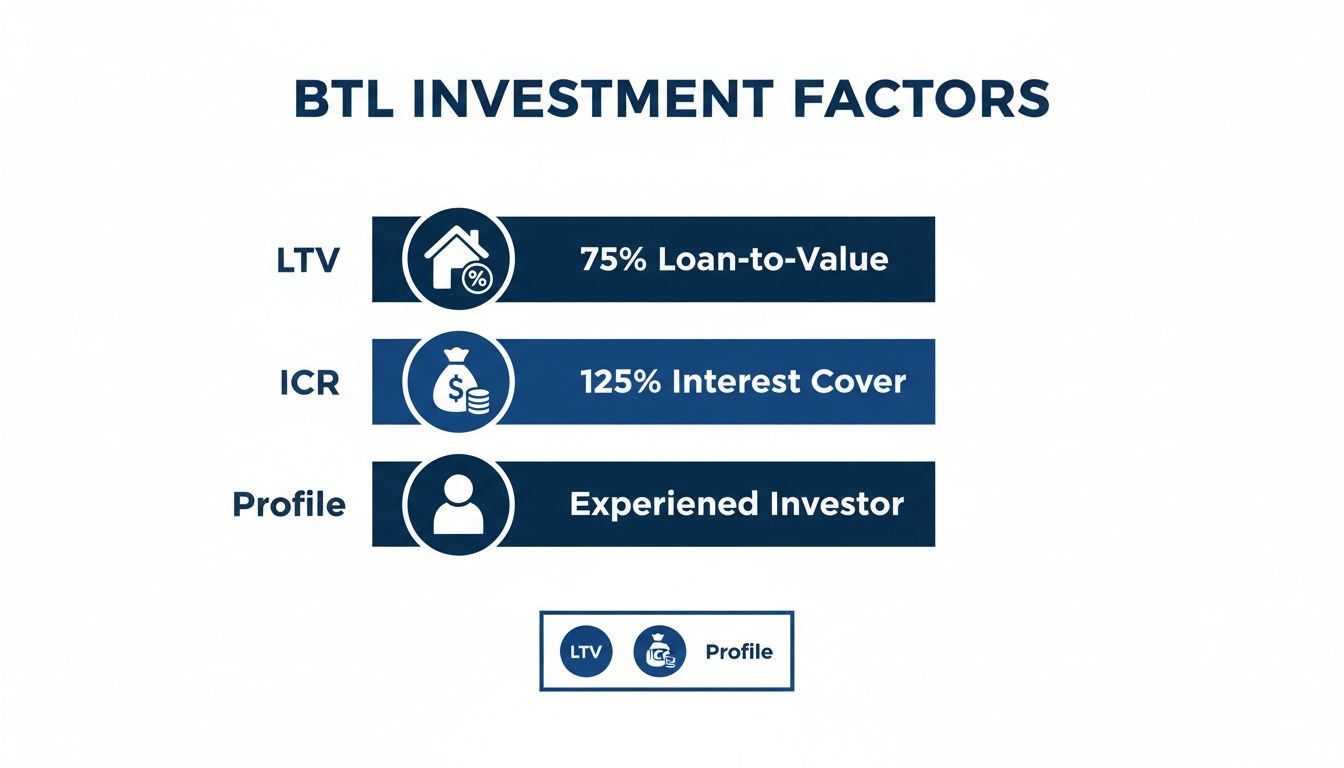
As you can see, things like your Loan-to-Value (LTV), the property’s rental cover, and your personal profile as an investor are the fundamental building blocks of any mortgage offer.
Looking Beyond The Interest Rate
The biggest culprit that turns a cheap-looking deal into an expensive one is the arrangement fee. This is what the lender charges to set up the mortgage, and it can range from a few hundred pounds to several thousand pounds. While some lenders offer deals with no arrangement fee, these almost always come with a higher interest rate to compensate.
Your job is to work out which combination offers the best value for your circumstances. A mortgage with a £1,999 fee might seem steep, but if its lower rate saves you £3,000 in interest payments over two years compared to a fee-free alternative, it’s the clear winner. This total cost calculation is the only real way to find the best deal.
Calculating The Effective Rate
A straightforward way to compare different mortgage deals is to work out the effective rate. This is not a figure lenders advertise, but it’s one you can calculate yourself. It represents the total cost of the mortgage: your monthly payments plus all fees, over the initial term, expressed as a percentage of the loan.
This approach cuts through the marketing noise of varying rates and fees, giving you a single, comparable number for each product. It ensures you’re comparing apples with apples, not being misled by a shiny headline figure.
To show this in action, here’s a simplified comparison for a £200,000 buy-to-let mortgage over a two-year fixed term.
True Cost Comparison: 2-Year Fixed BTL Mortgages
| Feature | Mortgage A (Low Rate, High Fee) | Mortgage B (Higher Rate, Low Fee) | Commentary |
|---|---|---|---|
| Interest Rate | 4.50% | 4.85% | On the surface, Mortgage A appears to be the cheaper option. |
| Arrangement Fee | £2,999 | £499 | A significant difference in upfront costs. |
| Total Payments (24 Months) | £18,000 | £19,400 | Mortgage B’s monthly costs are higher due to the rate. |
| Total Cost (Payments + Fee) | £20,999 | £19,899 | This is the key number. Mortgage B is the cheaper deal overall. |
As the table clearly shows, Mortgage B, despite its higher headline rate, is over £1,000 cheaper over the two-year term. This is the power of a true cost analysis.
Other Important Costs to Compare
While the arrangement fee is usually the largest, other costs can also add up and impact your bottom line. When you’re comparing offers, make sure you check for:
- Valuation Fees: The cost for the lender to value the property. This can sometimes be offered for free as an incentive, so it’s worth asking about.
- Legal Fees: You will need a solicitor for the conveyancing. Some remortgage deals include a “free legals” package that covers standard legal work.
- Booking Fees: A smaller upfront fee, often non-refundable, to secure the mortgage product while your application goes through.
Real-World Example in Chelmsford
Let’s put this into a local context. Imagine you’re buying a rental property in Chelmsford for £250,000 and need a £187,500 mortgage (that’s a 75% LTV). You’re offered two five-year fixed rates.
- Offer 1: 4.75% with a £3,499 arrangement fee.
- Offer 2: 4.99% with a £999 arrangement fee.
At first glance, Offer 1 seems better because of the lower rate. But let’s run the numbers. Over the five-year term, Offer 1 costs a total of £47,874 (£44,375 in interest + £3,499 fee). Offer 2, on the other hand, costs £47,764 (£46,765 in interest plus £999 fee).
Despite having the higher interest rate, Offer 2 actually saves you £110 over the fixed term. It might seem like a small difference, but these savings add up. This highlights precisely why a detailed comparison is essential for maximising your investment returns, especially in competitive markets like Chelmsford and across Essex.
How To Secure The Best Buy To Let Mortgage Rates
Finding the best buy-to-let mortgage rates is not about luck; it’s about smart preparation. When you present yourself as a low-risk, well-organised applicant, you open the door to the most competitive deals on the market. This section is a practical guide to getting your finances in order and explains why professional advice is often the key to unlocking true value.

Preparing Your Finances To Be Mortgage Ready
The groundwork you lay before even approaching a lender is crucial. Lenders are looking for a clear, stable financial picture that proves you’re a reliable borrower.
Start by getting all your documentation in order. This is not just a box-ticking exercise; it’s about building a compelling case that shows you’re a safe bet.
Your essential document checklist should include:
- Proof of Income: Your payslips for the last three months and your latest P60 are standard. If you’re self-employed, expect to provide two to three years of accounts or your SA302 tax calculations.
- Bank Statements: You’ll need at least three months of recent statements for all current accounts to demonstrate your income, outgoings, and responsible financial habits.
- Proof of Deposit: Lenders need a clear paper trail showing exactly where your deposit funds came from.
- Existing Property Details: For portfolio landlords, be ready with tenancy agreements and mortgage statements for every property you currently own.
Beyond the paperwork, actively working to improve your credit score can make a real difference. Make sure you’re registered on the electoral roll, check your credit files for any errors, and ensure every single payment is made on time. A strong credit history is non-negotiable for accessing the best rates. For more practical advice, check out these essential buy-to-let mortgage tips.
The Broker Advantage: Whole-Of-Market Access
Once your finances are in shape, the next question is where to find your mortgage. While it might seem convenient to walk into your own high street bank, doing so severely limits your options. A bank can only ever offer you its own products, which might not be the most competitive or suitable for your specific needs as a landlord.
This is where a whole-of-market mortgage broker becomes your most valuable asset. Unlike a bank, an independent broker has access to a wide range of lenders, from the big high-street names to specialist lenders that do not deal directly with the public.
This broad access is particularly vital for landlords with more complex circumstances, such as:
- Portfolio Landlords: Anyone with four or more mortgaged properties will find that specialist lenders often have more appropriate criteria.
- Limited Company Applicants: A broker can connect you with lenders who are experts in SPV (Special Purpose Vehicle) mortgages.
- Unusual Properties: Investing in a flat above a shop or a multi-unit freehold block almost always requires a niche lender.
Remember, lenders often want to see a comprehensive business strategy before finalising a mortgage. You can learn more about creating an effective vacation rental business plan to maximise profits.
A Case Study In Braintree Success
To see the power of a broker in action, consider this real-world scenario. An experienced Essex landlord with a six-property portfolio, including several in Braintree, was approaching the end of a fixed-rate deal. His high street lender’s renewal offer was significantly higher than he’d hoped, putting a real squeeze on his profit margins.
Frustrated, he contacted a whole-of-market broker. The broker did not just look for a new rate; they conducted a detailed review of his entire portfolio and personal finances. This deep dive allowed them to identify a specialist lender, inaccessible to the public, that offered exclusive rates for portfolio landlords and was actively lending in the Essex area.
The result? The broker secured him a five-year fixed-rate loan at 0.75% below his bank’s offer. Over the five-year term, this single move saved him thousands of pounds in interest and dramatically improved the profitability of his Braintree investments. It’s a perfect example of how professional advice opens doors that would otherwise remain firmly closed.
In 2026, the UK buy-to-let mortgage market is highly competitive, with experts predicting that average 5-year fixed rates could settle around 4.5% by the end of the year. With over 30% of landlords recently taking out rates above 5%, there’s huge potential for savings by remortgaging. For Essex landlords with properties in Chelmsford, Braintree, or Colchester, using a broker gives you access to the entire market, helping you optimise your returns.
Taking these proactive steps, preparing your finances meticulously and partnering with a specialist broker, is the most reliable path to securing the very best buy-to-let mortgage rates for your property investments.
Frequently Asked BTL Mortgage Questions
Should I Choose A 2-Year Or 5-Year Fixed Rate?
This is the classic landlord dilemma, a real balancing act between stability and flexibility. Opting for a 5-year fixed rate gives you fantastic long-term certainty over your monthly payments. It’s perfect for budgeting and gives you peace of mind, especially if you think interest rates might be on the up. The trade-off? You’re locked in longer with early-repayment charges, which can tie your hands if you decide to sell or refinance.
On the other hand, a 2-year fixed-rate often comes with a slightly lower initial interest rate and allows you to get out of the deal sooner. This is a great choice if you anticipate rates will fall in the near future or if you know your circumstances are likely to change. We can help you model the total costs of both options to see which one best aligns with your property’s financial goals in Colchester or elsewhere in Essex.
Is an A Limited Company BTL Mortgage Better For Me?
Buying a buy-to-let property through a limited company, specifically a Special Purpose Vehicle (SPV), has become a very popular strategy for landlords in recent years. The main reason for this shift is changes to how mortgage interest tax relief works for individual landlords. For anyone paying higher-rate tax, operating through a limited company can be significantly more tax-efficient.
Now, lenders do tend to have slightly different criteria and sometimes higher rates for limited companies, but the overall financial benefits can easily outweigh this. It’s a complex area, which is why we always recommend speaking to a qualified tax advisor alongside your mortgage broker. This dual approach ensures you choose the most effective and profitable structure for your personal situation.
What Is The Minimum Deposit For A BTL Mortgage?
You’ll definitely need a larger deposit for a buy-to-let mortgage than you would for your own home. The industry standard most lenders use is a minimum deposit of 25% of the property’s value. In mortgage terms, that’s a 75% Loan-to-Value (LTV).
Some specialist lenders might consider a 20% deposit (an 80% LTV), but these products almost always come with higher interest rates and much stricter lending criteria. The simple truth is that putting down a larger deposit, say 30% or even 40%, will open the door to a much wider range of lenders and give you access to the most competitive buy-to-let mortgage rates on the market.
Can I Remortgage My BTL To Release Equity?
Yes, absolutely. This is a very common and highly effective strategy for property investors looking to grow their portfolios. If your property’s value has increased since you first bought it, or if you’ve paid down a good chunk of the original loan, you can remortgage to release that built-up equity as a tax-free lump sum of cash.
Landlords often use this capital to fund the deposit for their next buy-to-let purchase, carry out renovations on existing properties to increase rental yields, or expand their portfolios. The amount you can release will depend on the new property valuation, the rental income it generates, and the lender’s maximum LTV criteria. We can help you find lenders who are particularly favourable to capital-raising remortgages.
At EHF Mortgages, we provide expert, whole-of-market advice to help you secure the best buy-to-let mortgage rates for your investment goals.